Department of Interventional Radiology, the First Affiliated Hospital, Zhengzhou University, Zhengzhou, China.
Cancer Biol Ther. 2023 Dec 31;24(1):2166335. doi: 10.1080/15384047.2023.2166335.
Limited studies have reported the impact of drug-eluting bead transarterial chemoembolization (DEB-TACE) on hepatic fibrosis in hepatocellular carcinoma (HCC). This study evaluated multiple hepatic fibrosis indicators, aiming to comprehensively compare the influence of DEB-TACE and conventional transarterial chemoembolization (cTACE) on hepatic fibrosis in treating HCC patients.
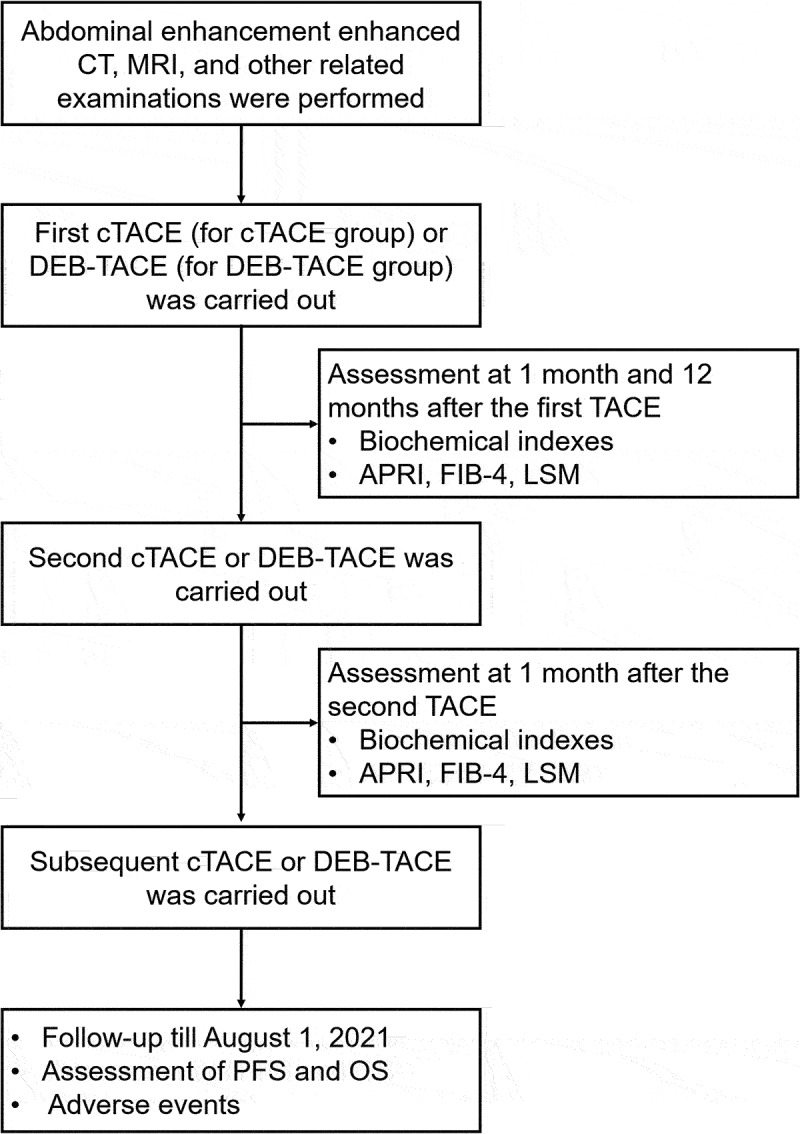
Intermediate/advanced HCC patients (N = 121) were divided into the DEB-TACE group (n = 62) and the cTACE group (n = 59) based on their chosen treatment. Serum hyaluronic acid (HA), pro-collagen type-III (PC-III), collagen type-IV (IV-C), and laminin (LN) were detected; aminotransferase to platelet ratio index (APRI) and fibrosis index based on the four factors (FIB-4) were calculated; liver stiffness measurement (LSM) was assessed by real-time shear wave elastography.
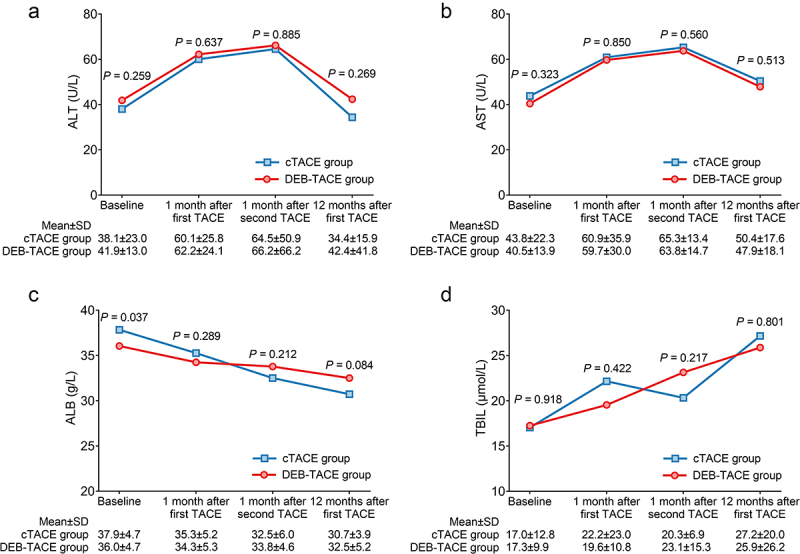
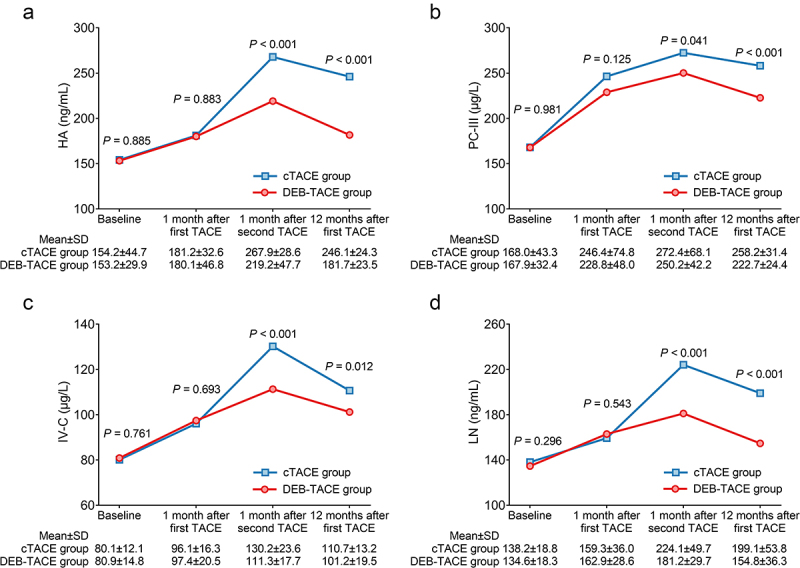
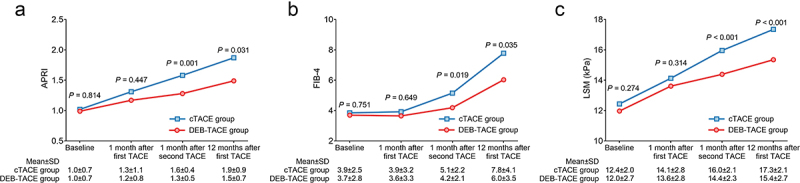
HA, PC-III, IV-C, and LN at 1 month after the second TACE and at 12 months after the first TACE were all decreased in DEB-TACE group compared with cTACE group (all < .050). Then, APRI, FIB-4, and LSM were further assessed, which also showed a decreasing trend at aforementioned timepoints in DEB-TACE group compared with cTACE group (all < .050). Additionally, the multivariate logistic regression analysis revealed that DEB-TACE (vs. cTACE) was independently associated with reduced occurrence of severe hepatic fibrosis at 12 months (OR = 0.215, 95%CI: 0.058-0.802, = .022). Concerning the liver function indexes, alanine aminotransferase, aspartate aminotransferase, and total bilirubin after treatment were not different between the two groups (all > .050).
DEB-TACE displays attenuated hepatic fibrosis progression and noninferior tolerance compared to cTACE in treating intermediate- or advanced-stage HCC patients.
已有研究报告显示,载药微球化疗栓塞术(DEB-TACE)对肝细胞癌(HCC)患者肝纤维化有一定影响。本研究旨在通过检测多项肝纤维化指标,全面比较 DEB-TACE 和常规 TACE 治疗 HCC 患者对肝纤维化的影响。
根据治疗方法的不同,将 121 例中晚期 HCC 患者分为 DEB-TACE 组(n=62)和 cTACE 组(n=59)。检测两组患者治疗后 1 个月及首次 TACE 后 12 个月血清透明质酸(HA)、III 型前胶原(PC-III)、IV 型胶原(IV-C)、层粘连蛋白(LN),计算天冬氨酸氨基转移酶/血小板计数比值指数(APRI)和基于 4 项指标的纤维化指数(FIB-4),采用实时剪切波弹性成像技术测量肝硬度值(LSM)。
DEB-TACE 组患者治疗后 1 个月及首次 TACE 后 12 个月的 HA、PC-III、IV-C、LN 水平均低于 cTACE 组(均 P<.050)。进一步评估 APRI、FIB-4 和 LSM,DEB-TACE 组患者在上述时间点的结果也均低于 cTACE 组(均 P<.050)。多因素 logistic 回归分析显示,与 cTACE 相比,DEB-TACE 可降低 HCC 患者在 12 个月时发生严重肝纤维化的风险(OR=0.215,95%CI:0.058-0.802,P=.022)。两组患者治疗后肝功能指标(丙氨酸氨基转移酶、天冬氨酸氨基转移酶、总胆红素)差异无统计学意义(均 P>.050)。
DEB-TACE 治疗中晚期 HCC 患者可减轻肝纤维化进展,且患者对治疗的耐受性与 cTACE 相当。