Department of Neurology, Amsterdam University Medical Centers, Universiteit Amsterdam, Amsterdam, The Netherlands/MS Center Amsterdam, Amsterdam, The Netherlands/Amsterdam Neuroscience, Amsterdam, The Netherlands.
Institute for Computing and Information Sciences, Radboud University, Nijmegen, The Netherlands.
Mult Scler. 2023 Apr;29(4-5):606-614. doi: 10.1177/13524585231152433. Epub 2023 Feb 8.
Remote smartphone-based 2-minute walking tests (s2MWTs) allow frequent and potentially sensitive measurements of ambulatory function.
To investigate the s2MWT on assessment of, and responsiveness to change in ambulatory function in MS.
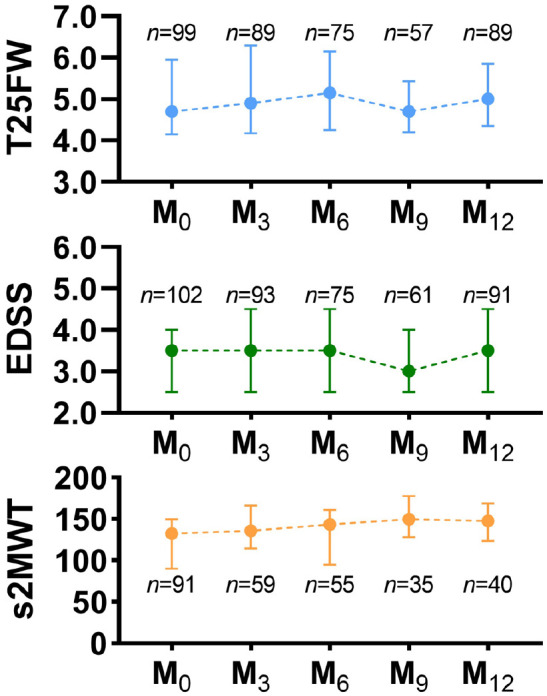
One hundred two multiple sclerosis (MS) patients and 24 healthy controls (HCs) performed weekly s2MWTs on self-owned smartphones for 12 and 3 months, respectively. The timed 25-foot walk test (T25FW) and Expanded Disability Status Scale (EDSS) were assessed at 3-month intervals. Anchor-based (using T25FW and EDSS) and distribution-based (curve fitting) methods were used to assess responsiveness of the s2MWT. A local linear trend model was used to fit weekly s2MWT scores of individual patients.
A total of 4811 and 355 s2MWT scores were obtained in patients ( = 94) and HC ( = 22), respectively. s2MWT demonstrated large variability (65.6 m) compared to the average score (129.5 m), and was inadequately responsive to anchor-based change in clinical outcomes. Curve fitting separated the trend from noise in high temporal resolution individual-level data, and statistically reliable changes were detected in 45% of patients.
In group-level analyses, clinically relevant change was insufficiently detected due to large variability with sporadic measurements. Individual-level curve fitting reduced the variability in s2MWT, enabling the detection of statistically reliable change in ambulatory function.
基于远程智能手机的 2 分钟步行测试(s2MWT)可频繁且潜在敏感地测量步行功能。
研究 s2MWT 在评估多发性硬化症(MS)患者的步行功能及其变化反应中的作用。
102 例多发性硬化症患者和 24 例健康对照者分别使用自备智能手机进行每周一次的 s2MWT,时间分别为 12 周和 3 个月。3 个月间隔评估定时 25 英尺步行测试(T25FW)和扩展残疾状态量表(EDSS)。采用锚定(使用 T25FW 和 EDSS)和分布(曲线拟合)方法评估 s2MWT 的反应性。采用局部线性趋势模型拟合每位患者的每周 s2MWT 评分。
共获得 94 例患者( = 4811 次)和 22 例健康对照者( = 355 次)的 s2MWT 评分。与平均得分(129.5m)相比,s2MWT 得分差异较大(65.6m),且对临床结局的锚定变化反应不足。曲线拟合将趋势与高时间分辨率个体水平数据中的噪声分离,45%的患者检测到了统计学上可靠的变化。
在组水平分析中,由于测量时间间隔较大且变异较大,未能充分检测到临床相关的变化。个体水平的曲线拟合降低了 s2MWT 的变异性,从而能够检测到步行功能的统计学上可靠变化。