Rivera Rivera Leonor, Séris Martínez Marina, Reynales Shigematsu Luz Myriam, Gómez García José Alberto, Austria Corrales Fernando, Toledano-Toledano Filiberto, Jiménez Tapia Alberto, Tejadilla Orozco Diana Iris, Astudillo García Claudia I
Centro de Investigación en Salud Poblacional, Instituto Nacional de Salud Pública (INSP), Cuernavaca 62100, Mexico.
Secretariado Técnico del Consejo Nacional de Salud Mental (STCONSAME), Secretaría de Salud, Mexico City 06900, Mexico.
Healthcare (Basel). 2023 Feb 1;11(3):419. doi: 10.3390/healthcare11030419.
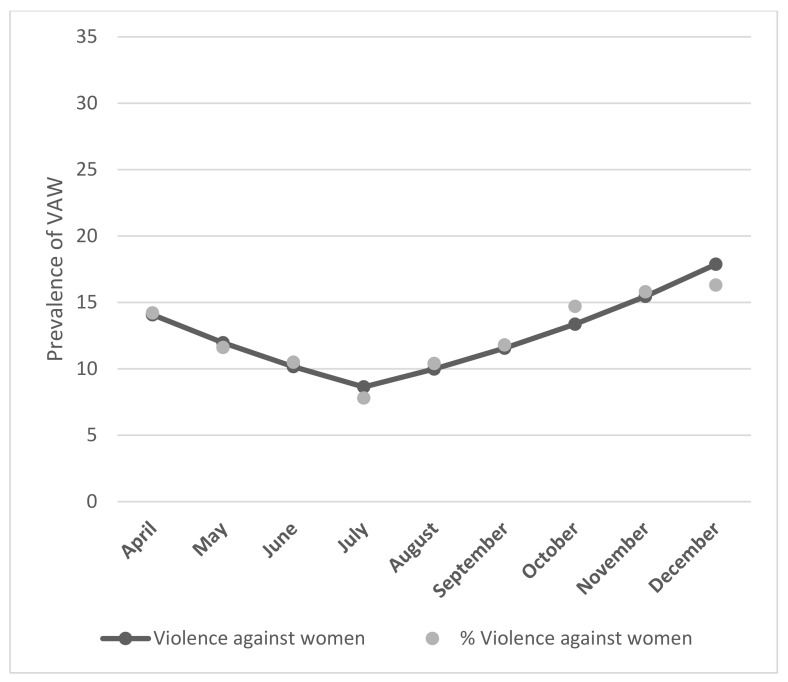
This study measured the prevalence of cases of domestic violence against women and some associated factors during the COVID-19 pandemic in Mexico. Data were collected through a remote survey during 2020. The sample included 47,819 women aged 15 years and older. Jointpoint regression and logistic regression models were used. The prevalence of violence was 11.5%, which decreased in July and subsequently increased. The associated factors were being unemployed (OR = 2.01; 95%CI 1.89-2.16); being partially and totally quarantined (OR = 1.58; 95%CI 1.43-1.75 and OR = 1.47; 95%CI 1.32-1.63); being a caregiver of children; being a caregiver of elderly and/or suffering from a chronic illness (OR = 1.27; 95%CI 1.19-1.36; OR = 1.42; 95%CI 1.33-1.53; OR = 1.59; 95%CI 1.47-1.73); losing a family member to COVID-19 (OR = 1.26; 95%CI 1.13-1.41); and binge drinking (OR = 1.94; 95%CI 1.78-2.12). The confinement measures increased gender inequalities, economic problems and workload which further evidenced violence against women.
本研究测量了墨西哥新冠疫情期间针对妇女的家庭暴力案件的发生率及一些相关因素。数据于2020年通过远程调查收集。样本包括47819名15岁及以上的女性。使用了Joinpoint回归模型和逻辑回归模型。暴力发生率为11.5%,在7月有所下降,随后又上升。相关因素包括失业(比值比=2.01;95%置信区间1.89 - 2.16);部分或完全被隔离(比值比=1.58;95%置信区间1.43 - 1.75和比值比=1.47;95%置信区间1.32 - 1.63);是儿童照顾者;是老年人照顾者和/或患有慢性病(比值比=1.27;95%置信区间1.19 - 1.36;比值比=1.42;95%置信区间1.33 - 1.53;比值比=1.59;95%置信区间1.47 - 1.73);因新冠疫情失去家庭成员(比值比=1.26;95%置信区间1.13 - 1.41);以及酗酒(比值比=1.94;95%置信区间1.78 - 2.12)。隔离措施加剧了性别不平等、经济问题和工作量,这进一步证明了针对妇女的暴力行为。