Department of Geosciences, College of Petroleum Engineering & Geosciences, King Fahd University of Petroleum & Minerals, Dhahran 31261, Saudi Arabia.
Department of Environmental Sciences, Faculty of Meteorology, Environment and Arid Land Agriculture, King Abdulaziz University, P.O. Box 80208, Jeddah 21589, Saudi Arabia.
Int J Environ Res Public Health. 2023 Feb 2;20(3):2687. doi: 10.3390/ijerph20032687.
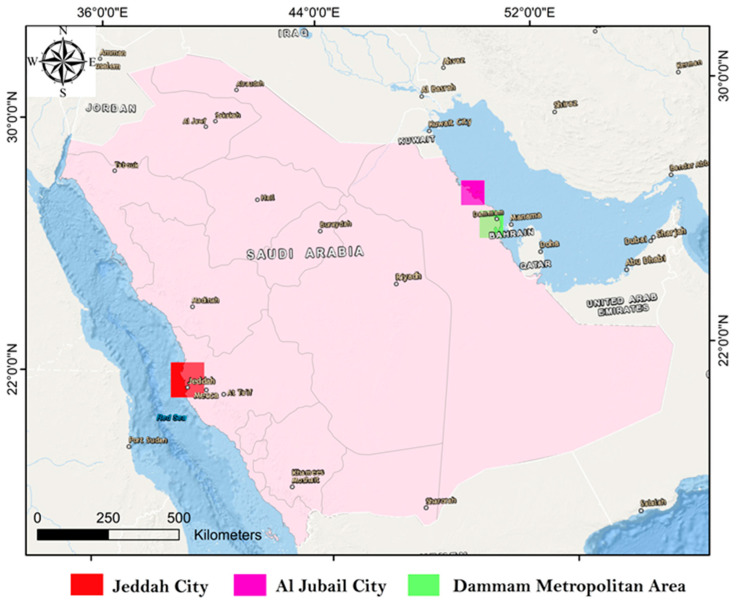
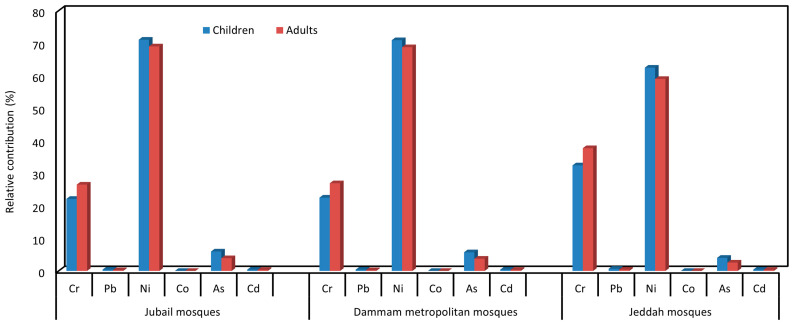
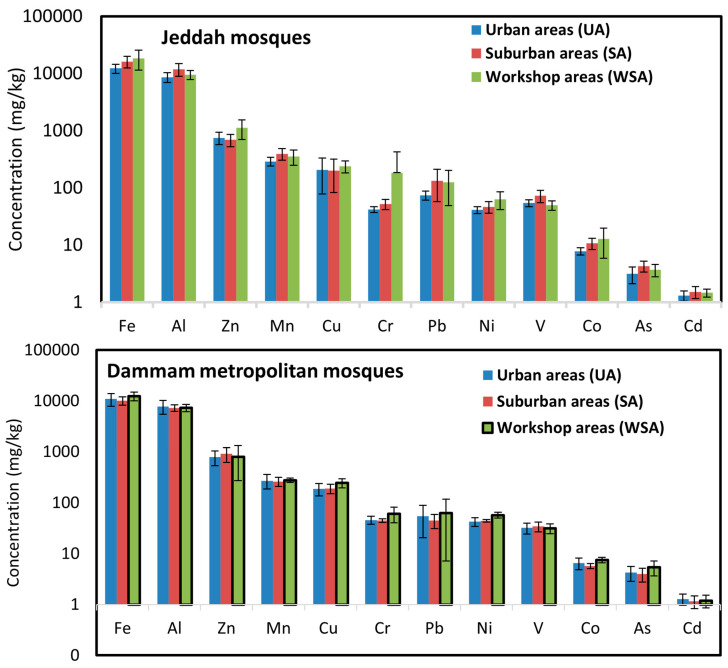
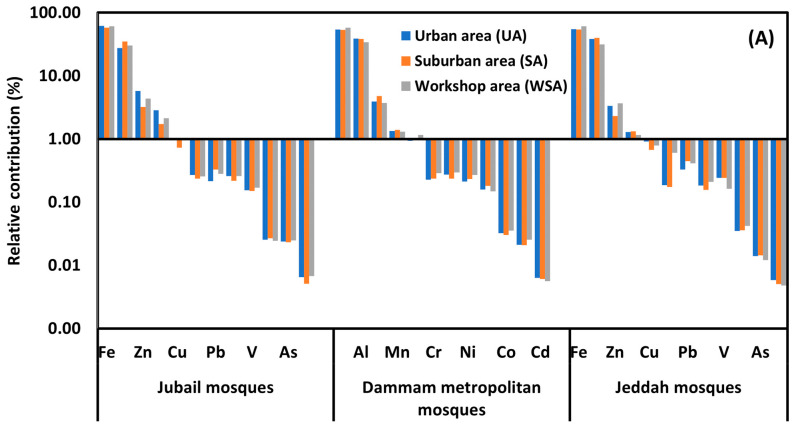
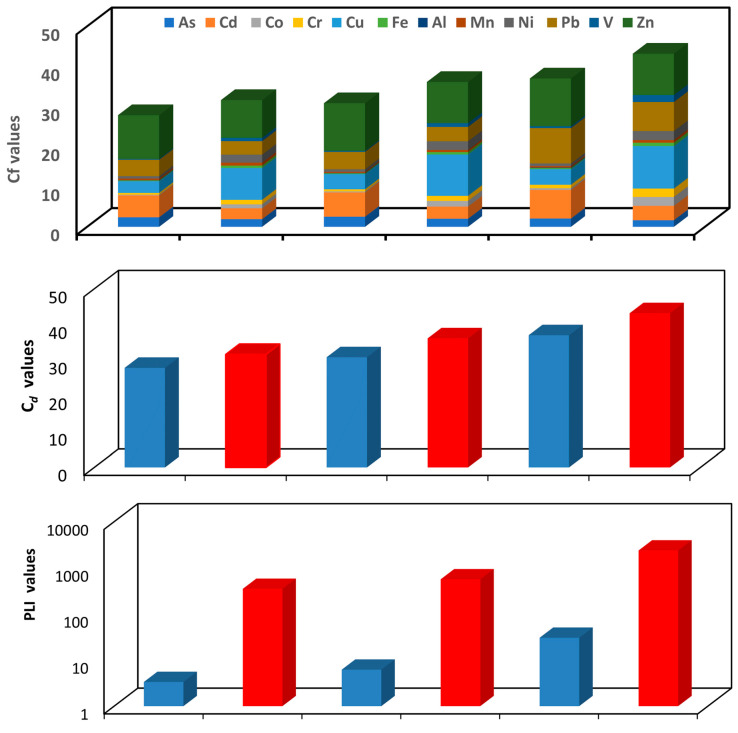
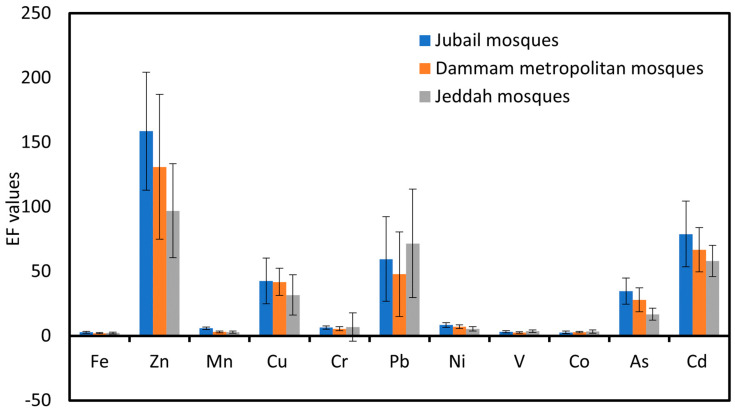
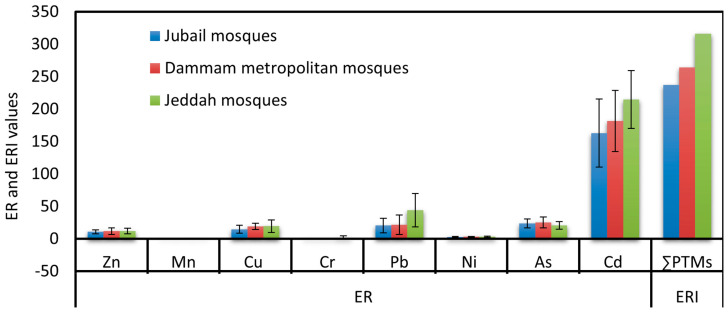
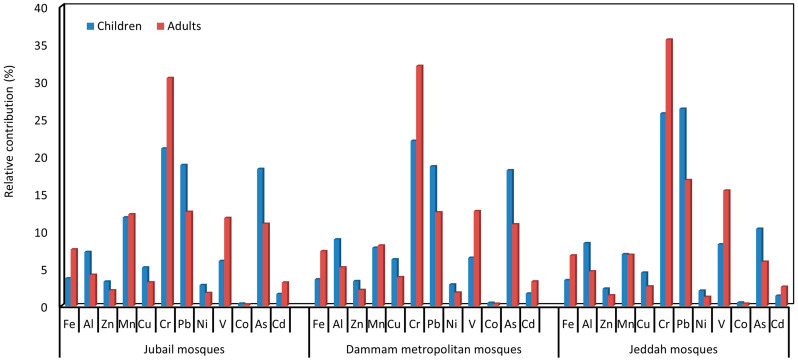
Potentially harmful elements (PHEs) associated with dust generated from anthropogenic sources can be transported into mosques and deposited on the filters of the air-conditioners (AC); thereby, children and adults are exposed to such PHEs while visiting mosques. Data dealing with the assessment of PHEs pollution and its human health risk in mosques dust in Saudi Arabia are scarce. Therefore, this work aims to examine the levels and pollution status of PHEs in AC filter dust (ACFD) of mosques and their associated human health risk in three Saudi cities: Jubail, Jeddah, and Dammam metropolitan. A similar concentration pattern of PHEs is observed in three cities' mosques with noticeably higher concentrations than both global crustal and local background values for Zn, Cu, Pb, As, and Cd only. Except for Fe, Al, and Mn, the highest PHEs concentrations were found in Jeddah (1407 mg/kg), followed by Dammam (1239 mg/kg) and Jubail (1103 mg/kg). High PHEs' concentrations were also recorded in mosques located near workshops and suburban areas compared to urban areas. Based on the spatial pattern, enrichment factor, geo-accumulation index, pollution load index, and ecological risk values, Jubail, Jeddah, and Dammam have shown moderate pollution levels of Cd, As, Pb, and Zn. On the other hand, Cu. Zn, Cu, Cr, Pb, Ni, As, and Cd had degrees of enrichment levels that varied from significantly enriched to extremely highly enriched in the ACFD of the three cities. Heavy pollution is found in Jubail, which posed a higher potential ecological risk than in Jeddah and Dammam. Cd presents the highest ecological risk factors (ER) in the three cities. Carcinogenic and non-carcinogenic risks for children and adults follow the order: Jeddah > Dammam > Jubail, and the ingestion pathway was the main route for exposure. Carcinogenic and con-carcinogenic risks in the mosques of the various studied cities were generally within the acceptable range.
与人为源相关的粉尘中可能存在有害元素(PHEs),这些元素可能会被带入清真寺,并沉积在空调(AC)的过滤器上;因此,儿童和成人在访问清真寺时会接触到这些 PHEs。关于沙特阿拉伯清真寺灰尘中 PHEs 污染及其对人类健康风险的评估数据非常有限。因此,本研究旨在检测沙特三个城市(朱拜勒、吉达和达曼)的清真寺空调过滤器灰尘(ACFD)中 PHEs 的水平和污染状况及其对人类健康的潜在风险。在这三个城市的清真寺中观察到 PHEs 的浓度模式相似,Zn、Cu、Pb、As 和 Cd 的浓度明显高于全球地壳和本地背景值。除 Fe、Al 和 Mn 外,吉达(1407mg/kg)的 PHEs 浓度最高,其次是达曼(1239mg/kg)和朱拜勒(1103mg/kg)。位于车间和郊区附近的清真寺的 PHEs 浓度也高于城市地区。基于空间模式、富集因子、地积累指数、污染负荷指数和生态风险值,朱拜勒、吉达和达曼的 Cd、As、Pb 和 Zn 显示出中度污染水平。另一方面,Cu、Zn、Cu、Cr、Pb、Ni、As 和 Cd 的富集水平从明显富集到极度富集,在三个城市的 ACFD 中都有不同程度的富集。朱拜勒污染严重,其潜在生态风险高于吉达和达曼。Cd 在这三个城市中表现出最高的生态风险因素(ER)。儿童和成人的致癌和非致癌风险大小顺序为:吉达>达曼>朱拜勒,摄入途径是暴露的主要途径。在所研究的各个城市的清真寺中,致癌和共致癌风险通常在可接受范围内。