UCL Genetics Institute, Department of Genetics, Evolution and Environment, University College London, London, WC1E 6BT, UK.
Nat Commun. 2023 Feb 11;14(1):789. doi: 10.1038/s41467-023-36439-7.
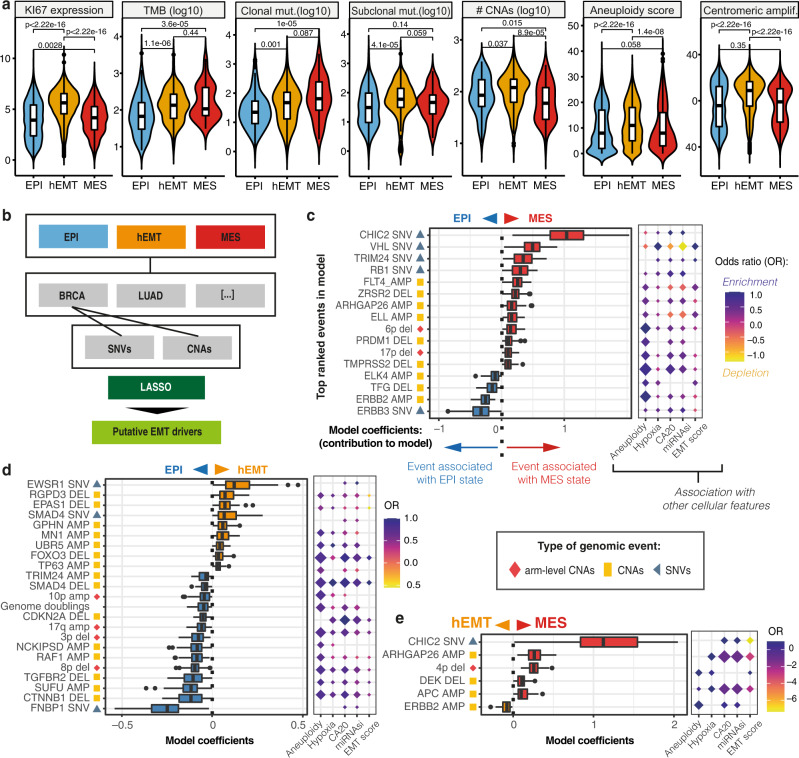
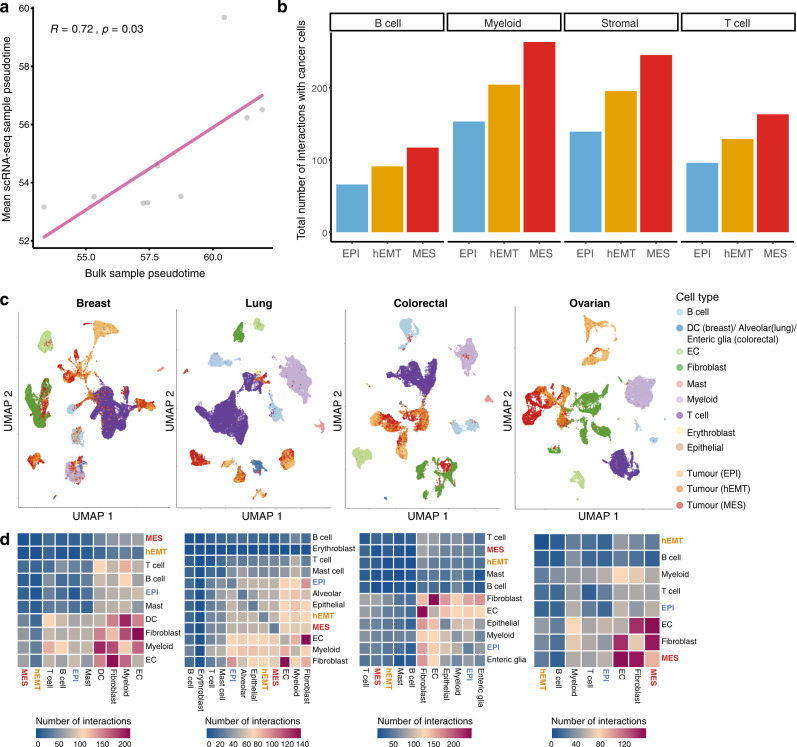
The epithelial to mesenchymal transition (EMT) is a key cellular process underlying cancer progression, with multiple intermediate states whose molecular hallmarks remain poorly characterised. To fill this gap, we present a method to robustly evaluate EMT transformation in individual tumours based on transcriptomic signals. We apply this approach to explore EMT trajectories in 7180 tumours of epithelial origin and identify three macro-states with prognostic and therapeutic value, attributable to epithelial, hybrid E/M and mesenchymal phenotypes. We show that the hybrid state is relatively stable and linked with increased aneuploidy. We further employ spatial transcriptomics and single cell datasets to explore the spatial heterogeneity of EMT transformation and distinct interaction patterns with cytotoxic, NK cells and fibroblasts in the tumour microenvironment. Additionally, we provide a catalogue of genomic events underlying distinct evolutionary constraints on EMT transformation. This study sheds light on the aetiology of distinct stages along the EMT trajectory, and highlights broader genomic and environmental hallmarks shaping the mesenchymal transformation of primary tumours.
上皮间质转化(EMT)是癌症进展的关键细胞过程,具有多种中间状态,其分子特征仍未得到很好的描述。为了填补这一空白,我们提出了一种基于转录组信号在个体肿瘤中稳健评估 EMT 转化的方法。我们应用这种方法来探索 7180 个上皮源性肿瘤中的 EMT 轨迹,并确定了具有预后和治疗价值的三种宏观状态,归因于上皮、混合 E/M 和间充质表型。我们表明,混合状态相对稳定,与非整倍体增加有关。我们进一步利用空间转录组学和单细胞数据集来探索 EMT 转化的空间异质性以及与肿瘤微环境中的细胞毒性、NK 细胞和成纤维细胞的不同相互作用模式。此外,我们提供了一个基因组事件目录,这些事件对 EMT 转化的不同进化限制具有基础作用。这项研究揭示了 EMT 轨迹不同阶段的病因,并强调了更广泛的基因组和环境特征,这些特征塑造了原发性肿瘤的间质转化。