Epidemic Intelligence Service, Center for Surveillance, Epidemiology and Laboratory Services, Centers for Disease Control and Prevention, Atlanta, Georgia; Oregon Health Authority Public Health Division, Oregon Health Authority, Portland, Oregon; COVID-19 Response Team, Centers for Disease Control and Prevention, Atlanta, Georgia.
COVID-19 Response Team, Centers for Disease Control and Prevention, Atlanta, Georgia; Oak Ridge Institute for Science and Education, Oak Ridge, Tennesse; Immunization Services Division, National Center for Immunization and Respiratory Diseases (NCIRD), Centers for Disease Control and Prevention, Atlanta, Georgia.
Am J Prev Med. 2023 Jun;64(6):865-876. doi: 10.1016/j.amepre.2023.01.014. Epub 2023 Jan 25.
COVID-19 vaccines are safe, effective, and widely available, but many adults in the U.S. have not been vaccinated for COVID-19. This study examined the associations between behavioral and social drivers of vaccination with COVID-19 vaccine uptake in the U.S. adults and their prevalence by region.
A nationally representative sample of U.S. adults participated in a cross-sectional telephone survey in August-November 2021; the analysis was conducted in January 2022. Survey questions assessed self-reported COVID-19 vaccine initiation, demographics, and behavioral and social drivers of vaccination.
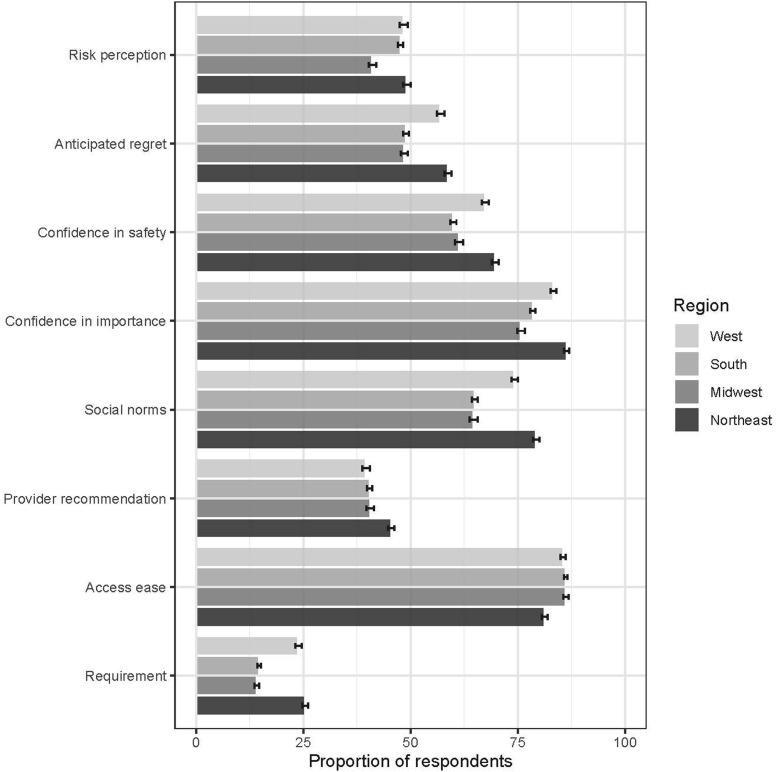
Among the 255,763 respondents, 76% received their first dose of COVID-19 vaccine. Vaccine uptake was higher among respondents aged ≥75 years (94%), females (78%), and Asian non-Hispanic people (94%). The drivers of vaccination most strongly associated with uptake included higher anticipated regret from nonvaccination, risk perception, and confidence in vaccine safety and importance, followed by work- or school-related vaccination requirements, social norms, and provider recommendation (all p<0.05). The direction of association with uptake varied by reported level of difficulty in accessing vaccines. The prevalence of all of these behavioral and social drivers of vaccination was highest in the Northeast region and lowest in the Midwest and South.
This nationally representative survey found that COVID-19 vaccine uptake was most strongly associated with greater anticipated regret, risk perception, and confidence in vaccine safety and importance, followed by vaccination requirements and social norms. Interventions that leverage these social and behavioral drivers of vaccination have the potential to increase COVID-19 vaccine uptake and could be considered for other vaccine introductions.
COVID-19 疫苗安全、有效且广泛可用,但美国仍有许多成年人未接种 COVID-19 疫苗。本研究旨在探讨与疫苗接种相关的行为和社会驱动因素与美国成年人 COVID-19 疫苗接种率的关联,以及这些因素在不同地区的流行情况。
本研究采用横断面电话调查的方法,于 2021 年 8 月至 11 月期间在美国招募了代表性样本,于 2022 年 1 月进行分析。调查问题评估了自我报告的 COVID-19 疫苗接种启动情况、人口统计学特征以及与疫苗接种相关的行为和社会驱动因素。
在 255763 名受访者中,76%的人接种了第一剂 COVID-19 疫苗。75 岁及以上(94%)、女性(78%)和亚裔非西班牙裔人群(94%)的疫苗接种率较高。与接种率相关性最强的疫苗接种驱动因素包括对未接种疫苗的更高预期后悔感、风险感知以及对疫苗安全性和重要性的信心,其次是与工作或学校相关的疫苗接种要求、社会规范和提供者推荐(均 p<0.05)。与接种率的关联方向因疫苗接种的可得性难度而有所不同。这些行为和社会疫苗接种驱动因素在东北地区的流行率最高,在中西部和南部地区的流行率最低。
本研究采用全国代表性调查发现,COVID-19 疫苗接种率与更高的预期后悔感、风险感知以及对疫苗安全性和重要性的信心密切相关,其次是疫苗接种要求和社会规范。利用这些疫苗接种的社会和行为驱动因素的干预措施有可能提高 COVID-19 疫苗接种率,可考虑将其应用于其他疫苗的推广。