Borin Joshua M, Liu Roland, Wang Yanhan, Wu Tsung-Chin, Chopyk Jessica, Huang Lina, Kuo Peiting, Ghose Chandrabali, Meyer Justin R, Tu Xin M, Schnabl Bernd, Pride David T
Division of Biological Sciences, University of California San Diego, La Jolla, CA, USA.
Department of Pathology, University of California San Diego, La Jolla, CA, USA.
bioRxiv. 2023 Feb 4:2023.02.03.527064. doi: 10.1101/2023.02.03.527064.
The gastrointestinal microbiome plays a significant role in numerous host processes and has an especially large impact on modulating the host metabolism. Prior studies have shown that when mice receive fecal transplants from obese donors that were fed high-fat diets (HFD) (even when recipient mice are fed normal diets after transplantation), they develop obese phenotypes. These studies demonstrate the prominent role that the gut microbiota play in determining lean and obese phenotypes. While much of the credit has been given to gut bacteria, studies have not measured the impact of gut viruses on these phenotypes. To address this shortcoming, we gavaged mice with viromes isolated from donors fed HFD or normal chow. By characterizing the mice’s gut bacterial biota and weight-gain phenotypes over time, we demonstrate that viruses can shape the gut bacterial community and affect weight gain or loss.
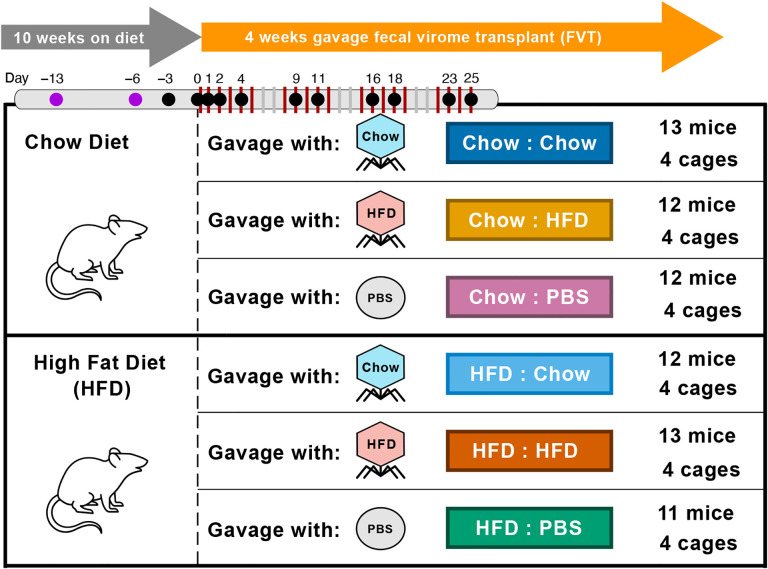
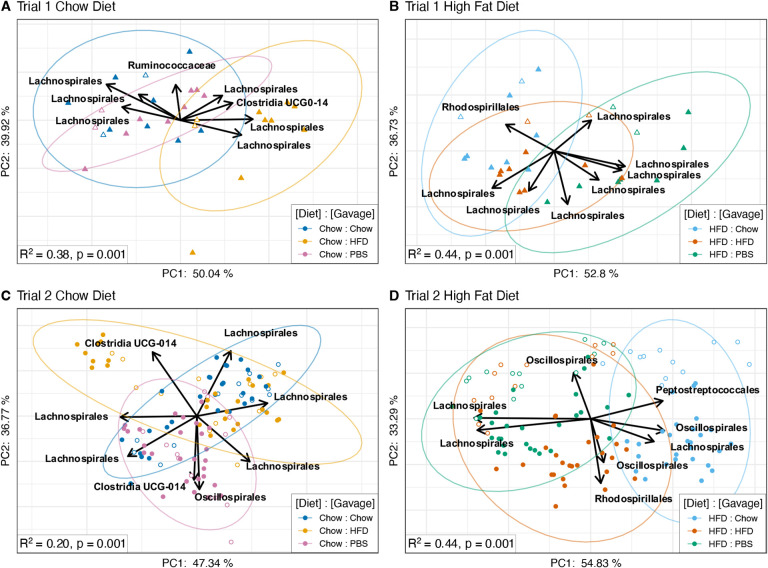
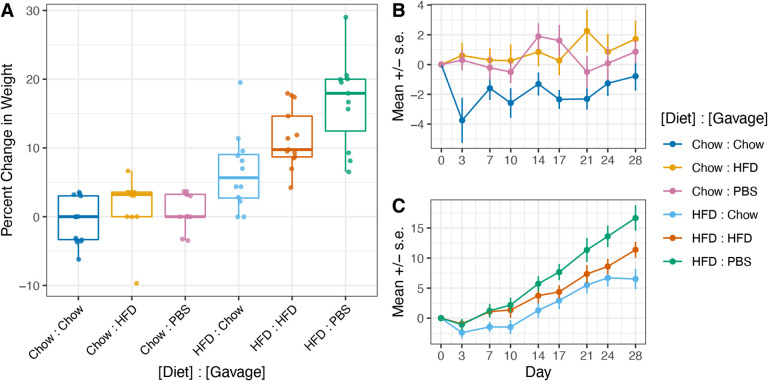
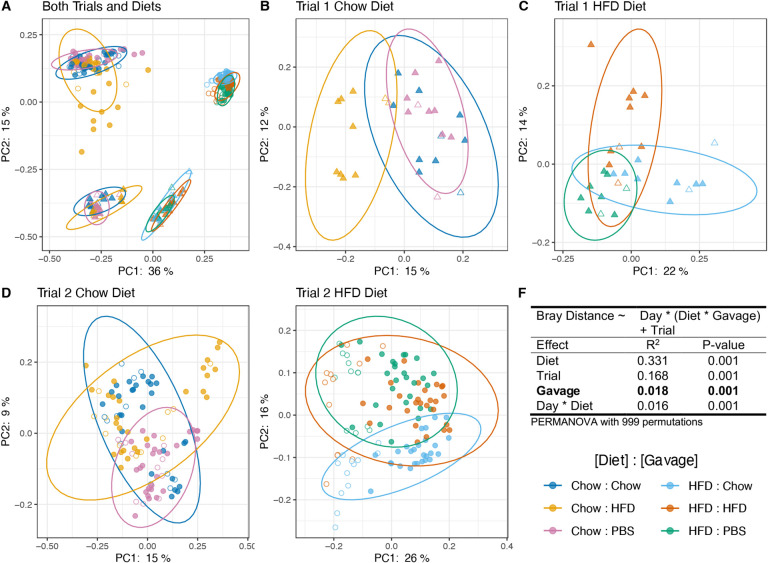
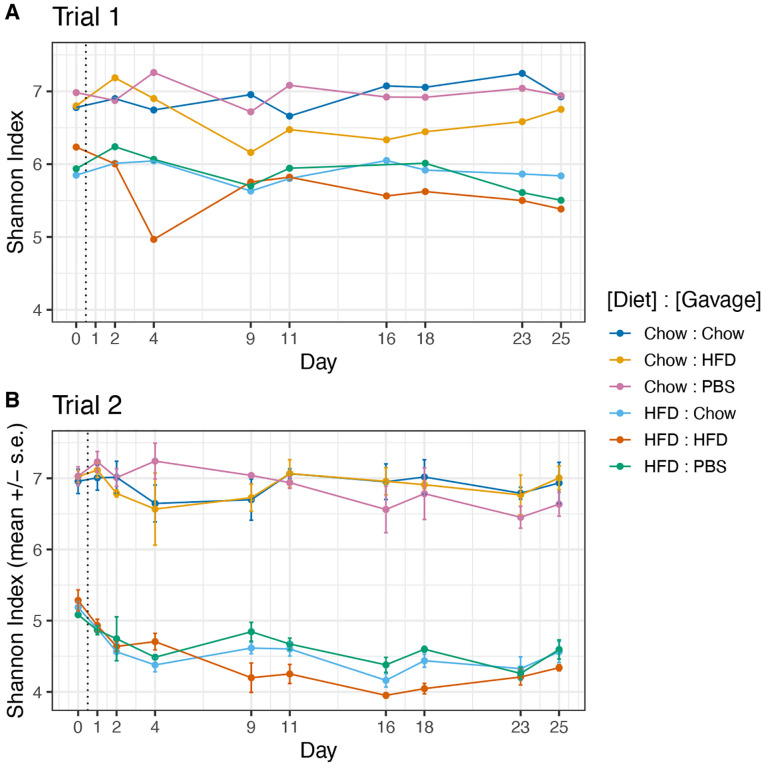
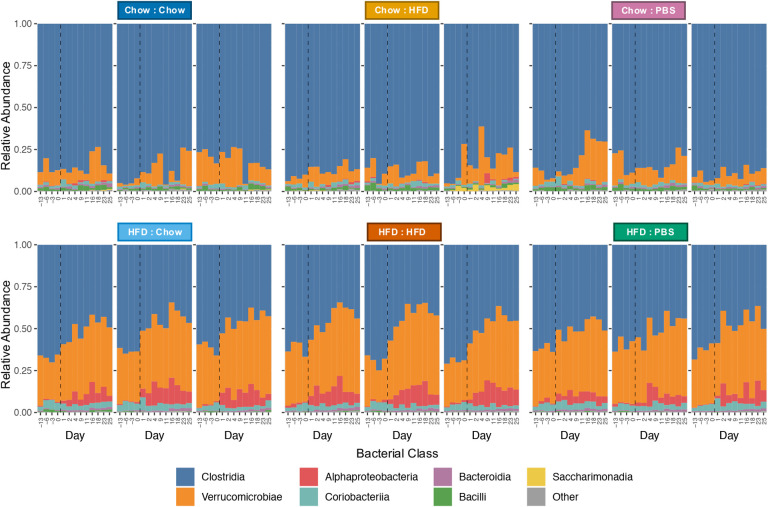
We gavaged mice longitudinally over 4 weeks while measuring their body weights and collecting fecal samples for 16S rRNA amplicon sequencing. We evaluated mice that were fed normal chow or high-fat diets, and gavaged each group with either chow-derived fecal viromes, HFD-derived fecal viromes, or phosphate buffered saline controls. We found a significant effect of gavage type, where mice fed chow but gavaged with HFD-derived viromes gained significantly more weight than their counterparts receiving chow-derived viromes. The converse was also true: mice fed HFD but gavaged with chow-derived viromes gained significantly less weight than their counterparts receiving HFD-derived viromes. These results were replicated in two separate experiments and the phenotypic changes were accompanied by significant and identifiable differences in the fecal bacterial biota. Notably, there were differences in Lachnospirales and Clostridia in mice fed chow but gavaged with HFD-derived fecal viromes, and in Peptostreptococcales, Oscillospirales, and Lachnospirales in mice fed HFD but gavaged with chow-derived fecal viromes. Due to methodological limitations, we were unable to identify specific bacterial species or strains that were responsible for respective phenotypic changes.
This study confirms that virome-mediated perturbations can alter the fecal microbiome in an model and indicates that such perturbations are sufficient to drive lean and obese phenotypes in mice.
胃肠道微生物群在众多宿主生理过程中发挥着重要作用,对调节宿主新陈代谢尤其具有重大影响。先前的研究表明,当小鼠接受来自喂食高脂饮食(HFD)的肥胖供体的粪便移植时(即使受体小鼠在移植后喂食正常饮食),它们会出现肥胖表型。这些研究证明了肠道微生物群在决定瘦和胖表型方面所起的重要作用。虽然大部分功劳都归于肠道细菌,但研究尚未衡量肠道病毒对这些表型的影响。为了弥补这一不足,我们用从喂食HFD或正常食物的供体中分离出的病毒组对小鼠进行灌胃。通过随时间表征小鼠的肠道细菌群落和体重增加表型,我们证明病毒可以塑造肠道细菌群落并影响体重增加或减轻。
我们在4周内对小鼠进行纵向灌胃,同时测量它们的体重并收集粪便样本用于16S rRNA扩增子测序。我们评估了喂食正常食物或高脂饮食的小鼠,并给每组小鼠灌胃食物来源的粪便病毒组、HFD来源的粪便病毒组或磷酸盐缓冲盐水对照。我们发现灌胃类型有显著影响,喂食正常食物但用HFD来源的病毒组灌胃的小鼠比接受食物来源病毒组灌胃的小鼠体重增加明显更多。反之亦然:喂食HFD但用食物来源的病毒组灌胃的小鼠比接受HFD来源病毒组灌胃的小鼠体重增加明显更少。这些结果在两个独立实验中得到重复,并且表型变化伴随着粪便细菌群落中显著且可识别的差异。值得注意的是,喂食正常食物但用HFD来源的粪便病毒组灌胃的小鼠中,毛螺菌科和梭菌纲存在差异,而喂食HFD但用食物来源的粪便病毒组灌胃的小鼠中,消化链球菌目、颤螺菌目和毛螺菌科存在差异。由于方法学上的限制,我们无法确定导致各自表型变化的具体细菌种类或菌株。
本研究证实病毒组介导的扰动可以在模型中改变粪便微生物群,并表明这种扰动足以在小鼠中驱动瘦和胖表型。