Department of Computer Science, COMSATS University Islamabad, Attock Campus, Attock, Pakistan.
Department of Computer Engineering, UET Taxila, Taxila, Pakistan.
J Healthc Eng. 2023 Feb 6;2023:1847115. doi: 10.1155/2023/1847115. eCollection 2023.
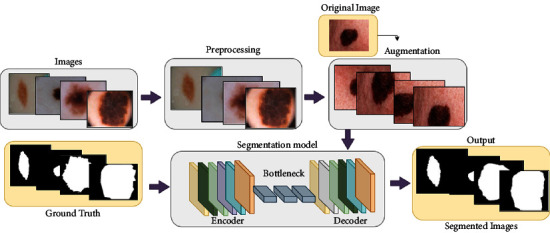
Skin cancer remains one of the deadliest kinds of cancer, with a survival rate of about 18-20%. Early diagnosis and segmentation of the most lethal kind of cancer, melanoma, is a challenging and critical task. To diagnose medicinal conditions of melanoma lesions, different researchers proposed automatic and traditional approaches to accurately segment the lesions. However, visual similarity among lesions and intraclass differences are very high, which leads to low-performance accuracy. Furthermore, traditional segmentation algorithms often require human inputs and cannot be utilized in automated systems. To address all of these issues, we provide an improved segmentation model based on depthwise separable convolutions that act on each spatial dimension of the image to segment the lesions. The fundamental idea behind these convolutions is to divide the feature learning steps into two simpler parts that are spatial learning of features and a step for channel combination. Besides this, we employ parallel multidilated filters to encode multiple parallel features and broaden the view of filters with dilations. Moreover, for performance evaluation, the proposed approach is evaluated on three different datasets including DermIS, DermQuest, and ISIC2016. The finding indicates that the suggested segmentation model has achieved the Dice score of 97% for DermIS and DermQuest and 94.7% for the ISBI2016 dataset, respectively.
皮肤癌仍然是最致命的癌症之一,存活率约为 18-20%。早期诊断和分割最致命的癌症——黑色素瘤,是一项具有挑战性和关键性的任务。为了诊断黑色素瘤病变的医学状况,不同的研究人员提出了自动和传统的方法来准确地分割病变。然而,病变之间的视觉相似性和类内差异非常高,导致性能精度低。此外,传统的分割算法通常需要人工输入,并且不能用于自动化系统。为了解决所有这些问题,我们提供了一种基于深度可分离卷积的改进分割模型,该模型作用于图像的每个空间维度,以分割病变。这些卷积背后的基本思想是将特征学习步骤分为两个更简单的部分,即特征的空间学习和通道组合的步骤。除此之外,我们还采用并行多扩张滤波器来编码多个并行特征,并通过扩张拓宽滤波器的视角。此外,为了进行性能评估,该方法在包括 DermIS、DermQuest 和 ISIC2016 在内的三个不同数据集上进行了评估。结果表明,所提出的分割模型在 DermIS 和 DermQuest 数据集上的 Dice 得分分别达到了 97%,在 ISBI2016 数据集上的 Dice 得分达到了 94.7%。