Division of Interdisciplinary Research and Practice, School of Health and Social Care, University of Essex, Essex, Colchester CO4 3SQ, UK.
Department of Gerontology and Geriatrics, Africa Centre for Epidemiology, Accra, Ghana.
Health Promot Int. 2023 Feb 1;38(1). doi: 10.1093/heapro/daac191.
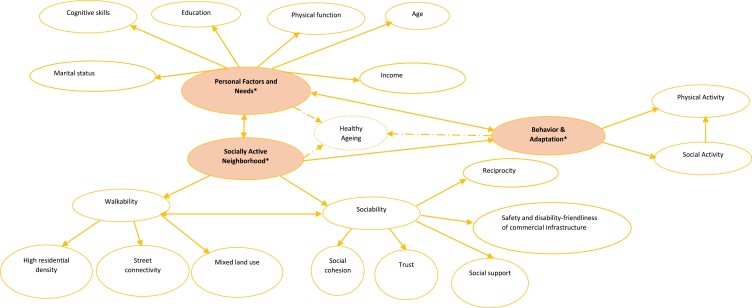
From the year 2003 when the first walkability scale was published to date, person-environment fit models and empirical research, some of which was published in Health Promotion International, have encapsulated healthy communities in 'neighborhood walkability'. While there is no doubt that neighborhood walkability positively influences health-seeking behaviors and health, recent models suggest that their measurement and conceptualization have not emphasized the role played by psychosocial and personal factors in aging in place. Thus, the development of scales measuring human ecosystem factors has not recognized all critical factors suited for older adults. In this paper, we aim to draw on relevant literature to frame a more holistic construct, hereby referred to as Socially Active Neighborhoods (SAN), that would better support aging in place in older populations. Through a narrative review based on a systematic search of the literature, we define the scope of SAN and delineate some contextual implications for gerontology, health promotion and psychometric testing. SAN, unlike neighborhood walkability in its current measurement and conceptualization, incorporates critical theory-informed psychosocial factors (i.e. safety and disability friendliness of neighborhood infrastructure) that can encourage older adults with physiological and cognitive limitations to maintain physical and social activities as well as health in later life. The SAN is the result of our adaptation of key person-environment models, including the Context Dynamics in Aging (CODA) framework, that recognizes the role of context in healthy aging.
从 2003 年首次发布步行能力量表到今天,人与环境适配模型和实证研究,其中一些发表在《国际健康促进》杂志上,将健康社区概括为“邻里步行能力”。虽然毫无疑问,邻里步行能力对健康行为和健康有积极影响,但最近的模型表明,它们的测量和概念化并没有强调心理社会和个人因素在就地老龄化中的作用。因此,衡量人类生态系统因素的量表的发展并没有认识到所有适合老年人的关键因素。在本文中,我们旨在借鉴相关文献,构建一个更全面的概念框架,即“社会活跃社区”(SAN),以更好地支持老年人就地老龄化。通过对文献进行系统搜索的叙述性综述,我们定义了 SAN 的范围,并为老年学、健康促进和心理计量测试划定了一些背景意义。SAN 与当前邻里步行能力的测量和概念化不同,它纳入了基于关键理论的心理社会因素(即邻里基础设施的安全性和无障碍性),这些因素可以鼓励有生理和认知限制的老年人在晚年保持身体和社会活动以及健康。SAN 是我们对关键人-环境模型(包括认知动态老龄化框架(CODA))的改编的结果,该模型认识到环境在健康老龄化中的作用。