Labouesse Marie A, Torres-Herraez Arturo, Chohan Muhammad O, Villarin Joseph, Greenwald Julia, Sun Xiaoxiao, Zahran Mysarah, Tang Alice, Lam Sherry, Veenstra-VanderWeele Jeremy, Lacefield Clay, Bonaventura Jordi, Michaelides Michael, Chan C Savio, Yizhar Ofer, Kellendonk Christoph
Department of Psychiatry, College of Physicians and Surgeons, Columbia University, New York, NY 10032, USA.
Division of Molecular Therapeutics, New York State Psychiatric Institute, New York, NY 10032, USA.
Res Sq. 2023 Feb 11:rs.3.rs-2524816. doi: 10.21203/rs.3.rs-2524816/v1.
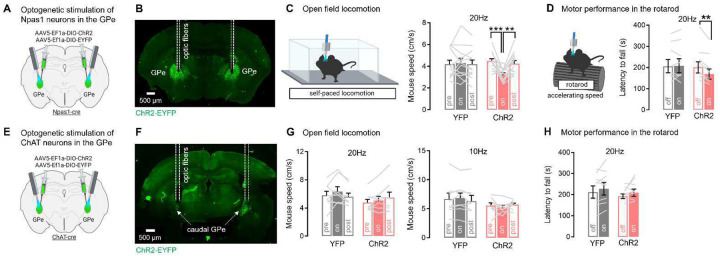
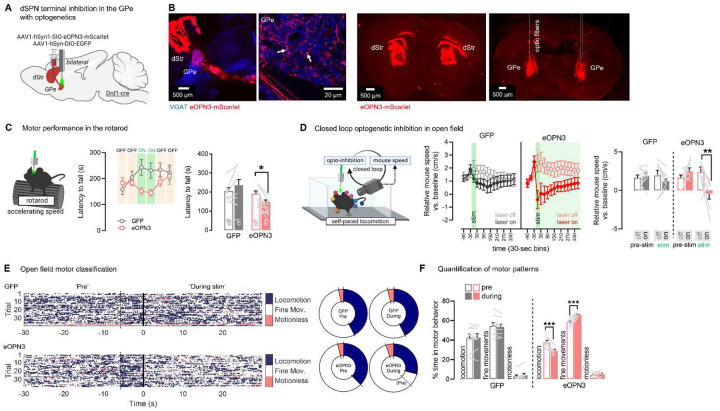
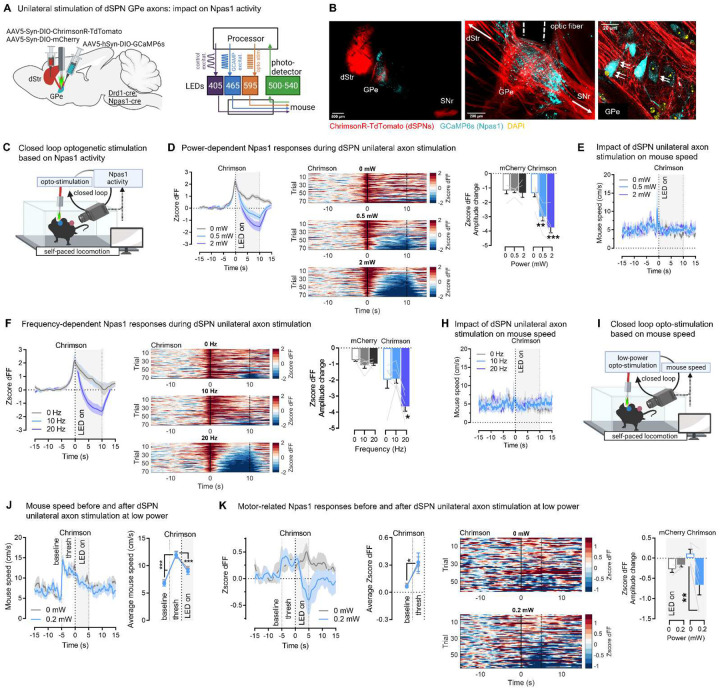
In the classical model of the basal ganglia, direct pathway striatal projection neurons (dSPNs) send projections to the substantia nigra (SNr) and entopeduncular nucleus to regulate motor function. Recent studies have re-established that dSPNs also possess "bridging" collaterals within the globus pallidus (GPe), yet the significance of these collaterals for behavior is unknown. Here we use in vivo optical and chemogenetic tools combined with deep learning approaches to dissect the roles of bridging collaterals in motor function. We find that dSPNs projecting to the SNr send synchronous motor-related information to the GPe via axon collaterals. Inhibition of native activity in dSPN GPe terminals impairs motor activity and function via regulation of pallidostriatal Npas1 neurons. We propose a model by which dSPN GPe collaterals ("striatopallidal Go pathway") act in concert with the canonical terminals in the SNr to support motor control by inhibiting Npas1 signals going back to the striatum.
在基底神经节的经典模型中,直接通路纹状体投射神经元(dSPN)向黑质(SNr)和内苍白球核发送投射,以调节运动功能。最近的研究重新证实,dSPN在苍白球(GPe)内也具有“桥接”侧支,然而这些侧支对行为的意义尚不清楚。在这里,我们使用体内光学和化学遗传学工具结合深度学习方法来剖析桥接侧支在运动功能中的作用。我们发现,投射到SNr的dSPN通过轴突侧支将同步的运动相关信息发送到GPe。抑制dSPN GPe终末的固有活动会通过调节苍白球 - 纹状体Npas1神经元来损害运动活动和功能。我们提出了一个模型,通过该模型dSPN GPe侧支(“纹状体 - 苍白球直接通路”)与SNr中的经典终末协同作用,通过抑制返回纹状体的Npas1信号来支持运动控制。