Centre for Regenerative Medicine & Devices, School of Applied Sciences, University of Brighton, Huxley Building Lewes Road, Brighton, BN2 4GJ, UK.
AECC University College, Parkwood Campus, Parkwood Road, Bournemouth, Dorset, BH5 2DF, UK.
J Foot Ankle Res. 2023 Feb 20;16(1):7. doi: 10.1186/s13047-023-00607-1.
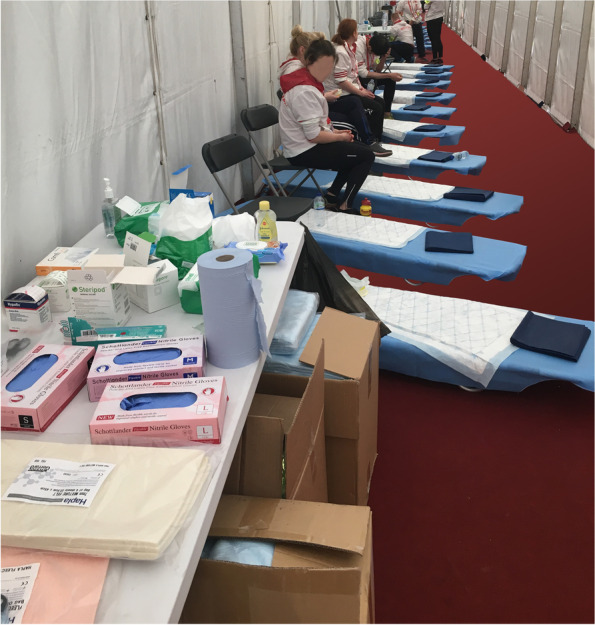
Final year podiatry students volunteer annually as part of the wider interprofessional medical team at both the Brighton and London Marathon race events, supervised by qualified podiatrists, allied health professionals and physicians. Volunteering has been reported to be a positive experience for all participants and a way of developing a range of professional, transferable, and where appropriate, clinical skills. We sought to explore the lived experience of 25 students who volunteered at one of these events and aimed to: i) examine the experiential learning reported by students while volunteering in a dynamic and demanding clinical field environment; ii) determine whether there were elements of learning that could be translated to the traditional teaching environment in a pre-registration podiatry course.
A qualitative design framework informed by the principles of interpretative phenomenological analysis, was adopted to explore this topic. We used IPA principles to enable analysis of four focus groups over a two-year period to generate findings. Focus group conversations were led by an external researcher, recorded, independently transcribed verbatim and anonymised prior to analysis by two different researchers. To enhance credibility, data analysis was followed by independent verification of themes, in addition to respondent validation.
In total, five themes were identified: i) a new inter-professional working environment, ii) identification of unexpected psychosocial challenges, iii) the rigors of a non-clinical environment, iv) clinical skill development, and v) learning in an interprofessional team. Throughout the focus group conversations, a range of positive and negative experiences were reported by the students. This volunteering opportunity fills a gap in learning as perceived by students, particularly around developing clinical skills and interprofessional working. However, the sometimes-frantic nature of a Marathon race event can both facilitate and impede learning. To maximize learning opportunities, particularly in the interprofessional environment, preparing students for new or different clinical settings remains a considerable challenge.
在布莱顿和伦敦马拉松比赛中,作为更广泛的跨专业医疗团队的一部分,足病学专业的应届毕业生每年都会自愿参加,由合格的足病医生、联合健康专业人员和医生监督。志愿服务被报道对所有参与者都是一次积极的体验,也是培养一系列专业、可转移的、在适当情况下的临床技能的一种方式。我们试图探索 25 名在其中一项赛事中自愿参加的学生的生活体验,并旨在:i)检查学生在动态和高要求的临床领域环境中志愿服务时报告的体验式学习;ii)确定是否有学习元素可以转化为传统的注册前足病学课程的教学环境。
采用解释现象学分析原则指导的定性设计框架,探索这一主题。我们使用 IPA 原则,在两年内进行了四次焦点小组讨论,以生成研究结果。焦点小组讨论由一名外部研究人员主持,记录下来,在分析之前由两名不同的研究人员独立进行逐字转录和匿名处理。为了提高可信度,在对主题进行独立验证的同时,还对参与者进行了验证,对数据分析进行了补充。
共确定了五个主题:i)新的跨专业工作环境,ii)识别意想不到的社会心理挑战,iii)非临床环境的严格性,iv)临床技能发展,和 v)跨专业团队中的学习。在整个焦点小组讨论中,学生们报告了一系列积极和消极的体验。这种志愿服务机会填补了学生们学习的空白,特别是在发展临床技能和跨专业工作方面。然而,马拉松比赛的有时紧张的性质既可以促进学习,也可以阻碍学习。为了最大限度地利用学习机会,特别是在跨专业环境中,为学生做好新的或不同的临床环境的准备仍然是一个相当大的挑战。