Ethiopian Biodiversity Institute, P.O.Box. 30726, Addis Ababa, Ethiopia.
BMC Plant Biol. 2023 Feb 20;23(1):102. doi: 10.1186/s12870-023-04117-x.
Evaluation of the extent of genetic variation within and between the populations of crop genetic resources are of paramount importance in any breeding program. An experiment aimed at assessing the extent of variation among barley lines and the degree of association between hordein polypeptide and agronomic traits was hence executed.
Field experiment was conducted in six environments between 2017-2019 involving 19 barley lines. Hordein bands were separated using vertical Sodium Dodecyl Sulphate Poly- acrylamide Gel Electrophoresis (SDS-PAGE).
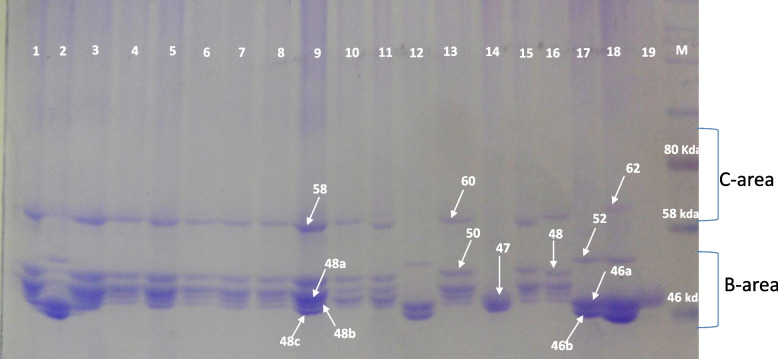
The analysis of variance revealed significant variation among lines and wider range units were observed for the agronomic traits. The line (Acc# 16,811-6) was superior, producing the highest grain yield (2.97 ton ha) across environments, 3.6 ton ha at Holleta, and 1.93 ton ha at Chefedonsa. At Arsi Negelle a different line Acc# 17146-9 was the highest yielding (3.15ton ha). SDS-PAGE-based analysis of barley lines separated 12 hordein bands between C (four bands) and B (eight bands) subunits. Interestingly bands 52, 46a, and 46b were uniquely conserved in the four naked barley lines (Acc#16809-14,16956-11, 17240-3, 17244-19). A considerably high proportion of genetic diversity within the populations than among the populations could be a repercussion of high gene flow which substantiates the longstanding and dominant informal seed exchange system among the farmers. The significant positive association between grain yield and band 50 evocates the expression of this allele may code for higher grain yield. The negative association between days to maturity and band 52 perhaps stipulates earliness in barely lines upon the manifestation of the band. Band 52 and 60 appeared to be associated with more than one agronomic trait (days to maturity and thousand kernel weight; grain filling period and grain yield respectively) and could be the result of pleiotropic characteristics of the genes residing in these banding regions.
The barley lines exhibited substantial variation for hordein protein and agronomic traits. However, imparted the need for the implementation of decentralized breeding as a consequence of genotype-by-environment interaction. Significant hordein polypeptide and agronomic traits association advocated the utilization of hordein as a protein marker and perhaps consider them in the parental line selection.
评估作物遗传资源群体内和群体间遗传变异的程度在任何育种计划中都至关重要。因此,进行了一项旨在评估大麦品系间变异程度以及醇溶蛋白多肽与农艺性状之间关联程度的实验。
2017-2019 年在六个环境中进行了田间试验,涉及 19 个大麦品系。使用垂直十二烷基硫酸钠聚丙烯酰胺凝胶电泳(SDS-PAGE)分离醇溶蛋白带。
方差分析表明,品系间存在显著差异,且农艺性状的变化范围较大。在所有环境中,品系(Acc# 16,811-6)表现最优,产量最高(2.97 吨/公顷),在 Holleta 产量为 3.6 吨/公顷,在 Chefedonsa 产量为 1.93 吨/公顷。在 Arsi Negelle,另一个不同的品系 Acc# 17146-9 的产量最高(3.15 吨/公顷)。基于 SDS-PAGE 的大麦品系分析将 C(四个带)和 B(八个带)亚基之间的 12 个醇溶蛋白带分开。有趣的是,4 个裸大麦品系(Acc#16809-14、16956-11、17240-3 和 17244-19)中独特地保守了带 52、46a 和 46b。群体内的遗传多样性比例显著高于群体间,这可能是由于基因流较高所致,这证实了农民之间长期存在的、占主导地位的非正式种子交换系统。带 50 与粒重之间存在显著的正关联,这表明该等位基因的表达可能编码更高的粒重。带 52 与成熟期之间的负关联可能表明在带出现时大麦品系的早熟。带 52 和 60 似乎与一个以上的农艺性状(成熟期和千粒重;灌浆期和粒重)有关,这可能是由于这些带区基因的多效性特征所致。
大麦品系在醇溶蛋白和农艺性状方面表现出显著的变异。然而,由于基因型-环境互作的影响,需要实施分散的育种。醇溶蛋白多肽和农艺性状之间存在显著关联,这表明可以利用醇溶蛋白作为蛋白质标记,并在亲本系选择中考虑这些标记。