Douglas Mental Health University Institute, 6875 Boulevard LaSalle, Montreal, QC, H4H 1R3, Canada.
Department of Psychiatry, McGill University, Montreal, QC, Canada.
Subst Abuse Treat Prev Policy. 2023 Feb 17;18(1):13. doi: 10.1186/s13011-023-00518-1.
Young people are disproportionately more likely than other age groups to use substances. The rise in substance use and related harms, including overdose, during the Covid-19 pandemic has created a critical need for more innovative and accessible substance use interventions. Digital interventions have shown effectiveness and can provide more engaging, less stigmatizing, and accessible interventions that meet the needs of young people. This review provides an overview of recent literature on the nature of recently published digital interventions for young people in terms of technologies used, substances targeted, intended outcomes and theoretical or therapeutic models employed.
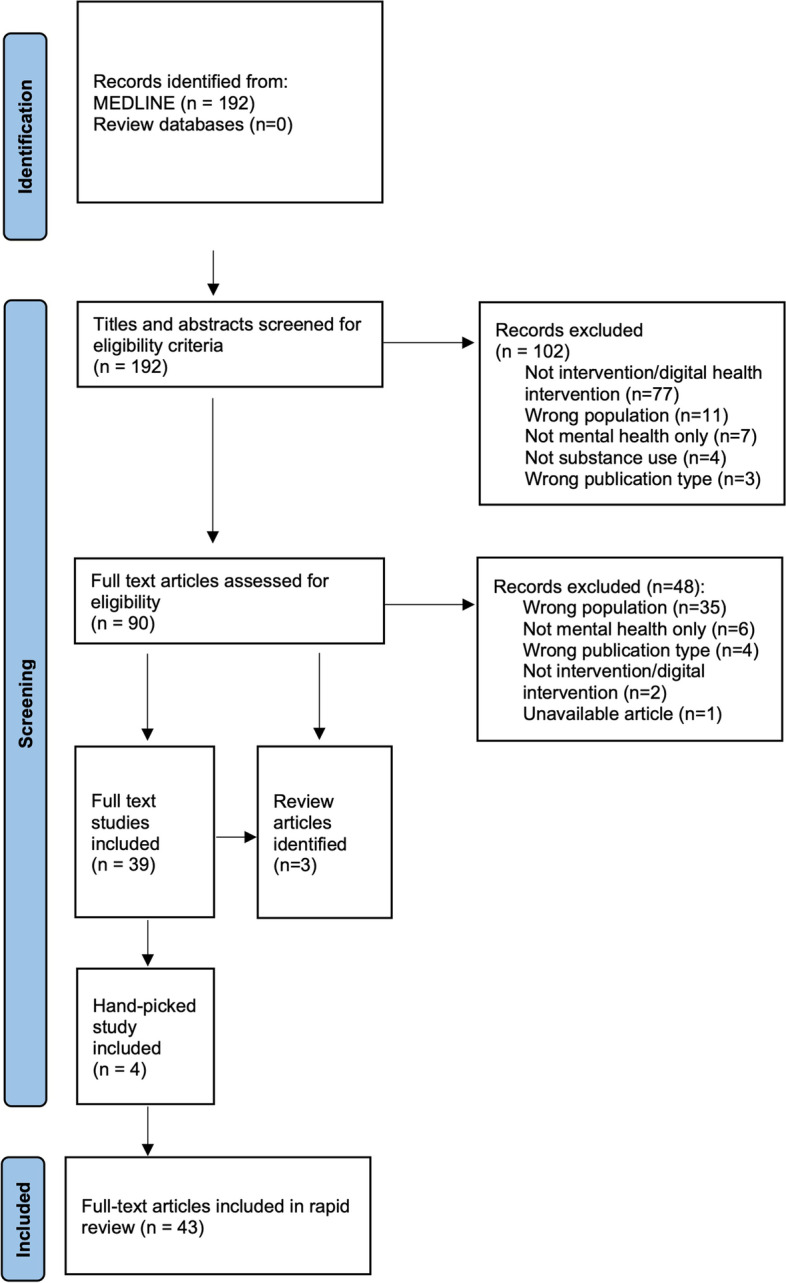
Rapid review methodology was used to identify and assess the literature on digital interventions for young people. An initial keyword search was conducted using MEDLINE the Cochrane Database of Systematic Reviews, Database of Abstracts of Reviews of Effects (DARE), Health Technology Assessment Database (HTA) and PROSPERO for the years 2015-2020, and later updated to December 2021. Following a title/abstract and full-text screening of articles, and consensus decision on study inclusion, the data extraction process proceeded using an extraction grid developed for the study. Data synthesis relied on an adapted conceptual framework by Stockings, et al. that involved a three-level treatment spectrum for youth substance use (prevention, early intervention, and treatment) for any type of substance.
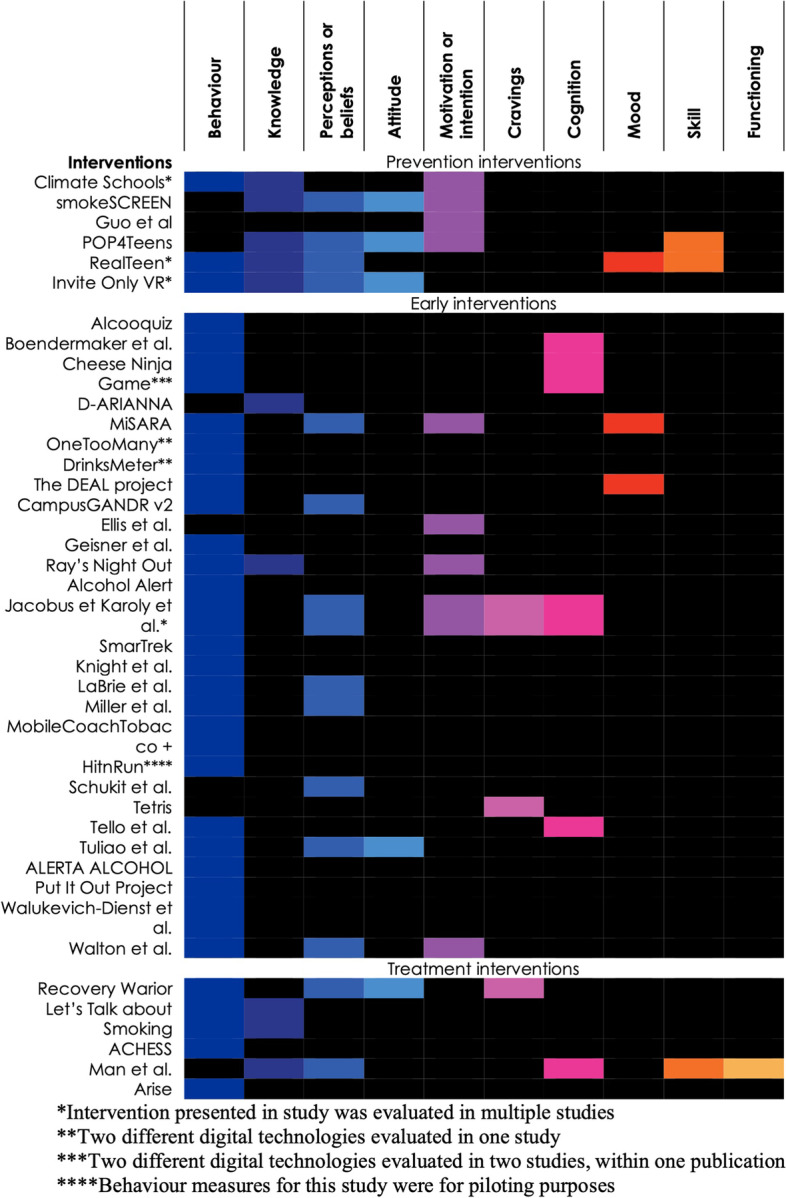
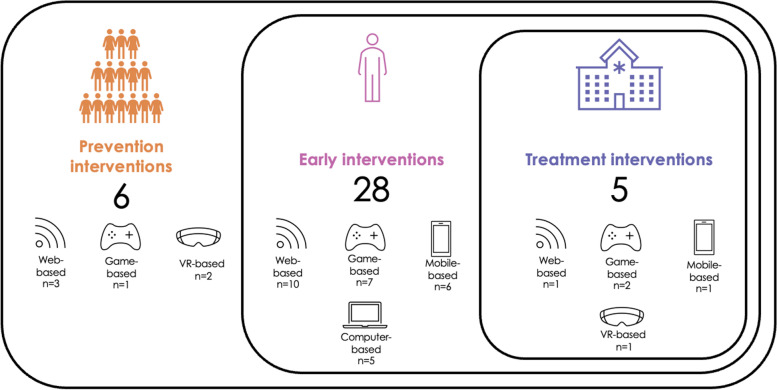
In total, the review identified 43 articles describing 39 different digital interventions. Most were early interventions (n = 28), followed by prevention interventions (n = 6) and treatment interventions (n = 5). The identified digital technologies included web-based (n = 14), game-based (n = 10), mobile-based (n = 7), and computer-based (n = 5) technologies, and virtual reality (n = 3). Most interventions targeted alcohol use (n = 20) followed by tobacco/nicotine (n = 5), cannabis (n = 2), opioids (n = 2), ketamine (1) and multiple, or any substances (n = 9). Most interventions used a personalized or normative feedback approach and aimed to effect behaviour change as the intended outcome. Interestingly, a harm reduction approach guided only one of the 39 interventions.
While web-based interventions represented the most common type of technology, more recently developed immersive and interactive technologies such as virtual reality and game-based interventions call for further exploration. Digital interventions focused mainly on alcohol use, reflecting less concern for tobacco, cannabis, co-occurring substance use, and illicit drug use. Specifically, the recent exacerbation in the opioid crisis throughout North American underlines the urgent need for more prevention-oriented digital interventions for opioid use. The uptake of digital interventions among youth also depends on the incorporation of harm reduction approaches.
与其他年龄段相比,年轻人更有可能使用物质。在新冠疫情期间,物质使用和相关危害(包括过量使用)的增加,使得人们迫切需要更多创新和易于获得的物质使用干预措施。数字干预措施已被证明有效,并且可以提供更具吸引力、污名化程度更低且更易于获得的干预措施,以满足年轻人的需求。本综述概述了最近关于针对年轻人的数字干预措施的文献,涉及使用的技术、针对的物质、预期结果以及采用的理论或治疗模型。
使用快速审查方法来确定和评估 2015 年至 2020 年期间发表的关于年轻人数字干预措施的文献,并在后来更新至 2021 年 12 月,使用 MEDLINE、Cochrane 系统评价数据库、效应摘要数据库 (DARE)、卫生技术评估数据库 (HTA) 和 PROSPERO 进行了初步的关键词搜索。在对文章进行标题/摘要和全文筛选,并就研究纳入达成共识后,使用为该研究制定的提取网格进行数据提取过程。数据综合依赖于 Stockings 等人的改编概念框架,该框架涉及针对任何类型物质的青年物质使用的三级治疗范围(预防、早期干预和治疗)。
该综述共确定了 43 篇描述 39 种不同数字干预措施的文章。大多数是早期干预措施(n=28),其次是预防干预措施(n=6)和治疗干预措施(n=5)。所确定的数字技术包括基于网络的(n=14)、基于游戏的(n=10)、基于移动的(n=7)和基于计算机的(n=5)技术以及虚拟现实(n=3)。大多数干预措施针对饮酒(n=20),其次是吸烟/尼古丁(n=5)、大麻(n=2)、阿片类药物(n=2)、氯胺酮(n=1)和多种或任何物质(n=9)。大多数干预措施使用个性化或规范反馈方法,旨在实现行为改变作为预期结果。有趣的是,只有 39 种干预措施中的一种采用了减少伤害的方法。
虽然基于网络的干预措施是最常见的技术类型,但最近开发的沉浸式和互动技术,如虚拟现实和基于游戏的干预措施,需要进一步探索。数字干预措施主要集中在饮酒上,对吸烟、大麻、共病物质使用和非法药物使用的关注较少。具体来说,北美阿片类药物危机的最近加剧突显了针对阿片类药物使用的更具预防导向的数字干预措施的迫切需要。青年对数字干预措施的接受程度还取决于减少伤害方法的纳入。