Department Artificial Intelligence in Biomedical EngineeringFriedrich-Alexander-University Erlangen-Nürnberg (FAU) 91052 Erlangen Germany.
Division of Phoniatrics and Pediatric AudiologyDepartment of Otorhinolaryngology, Head and Neck SurgeryUniversity Hospital Erlangen, Friedrich-Alexander-University Erlangen-Nürnberg (FAU) 91054 Erlangen Germany.
IEEE J Transl Eng Health Med. 2023 Jan 19;11:137-144. doi: 10.1109/JTEHM.2023.3237859. eCollection 2023.
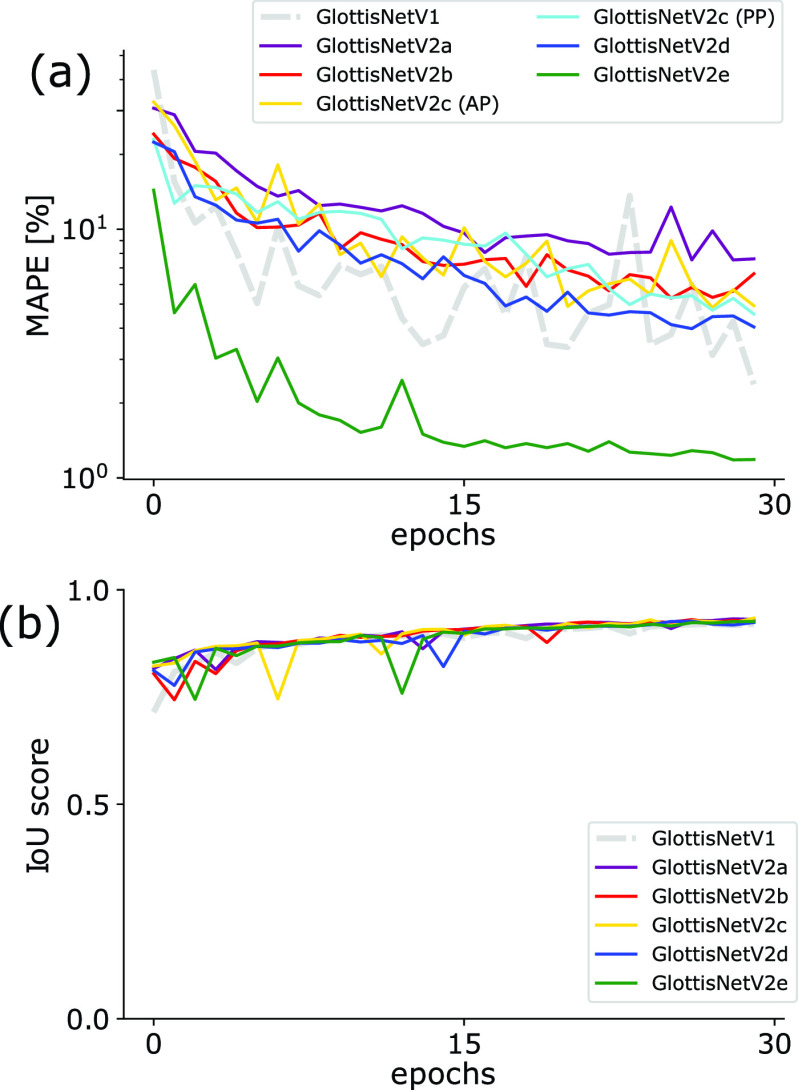
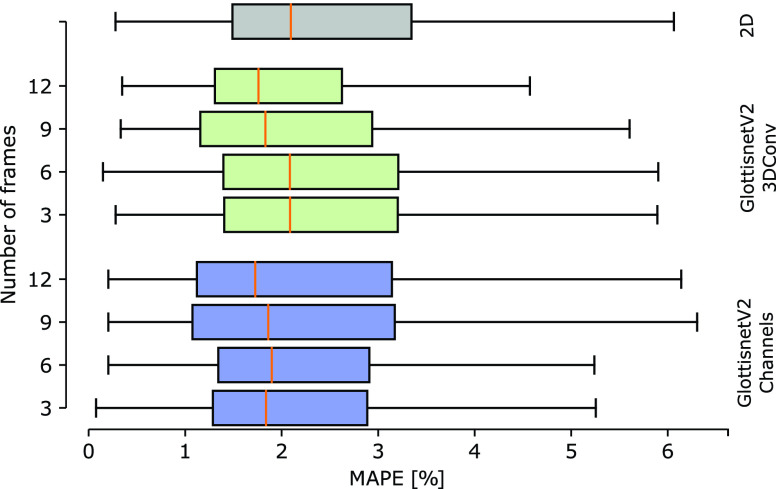
High-speed videoendoscopy is a major tool for quantitative laryngology. Glottis segmentation and glottal midline detection are crucial for computing vocal fold-specific, quantitative parameters. However, fully automated solutions show limited clinical applicability. Especially unbiased glottal midline detection remains a challenging problem. We developed a multitask deep neural network for glottis segmentation and glottal midline detection. We used techniques from pose estimation to estimate the anterior and posterior points in endoscopy images. Neural networks were set up in TensorFlow/Keras and trained and evaluated with the BAGLS dataset. We found that a dual decoder deep neural network termed GlottisNetV2 outperforms the previously proposed GlottisNet in terms of MAPE on the test dataset (1.85% to 6.3%) while converging faster. Using various hyperparameter tunings, we allow fast and directed training. Using temporal variant data on an additional data set designed for this task, we can improve the median prediction accuracy from 2.1% to 1.76% when using 12 consecutive frames and additional temporal filtering. We found that temporal glottal midline detection using a dual decoder architecture together with keypoint estimation allows accurate midline prediction. We show that our proposed architecture allows stable and reliable glottal midline predictions ready for clinical use and analysis of symmetry measures.
高速频闪喉镜是定量喉科学的主要工具。声门分割和声带中线检测对于计算声带特定的定量参数至关重要。然而,完全自动化的解决方案显示出有限的临床适用性。特别是无偏的声带中线检测仍然是一个具有挑战性的问题。我们开发了一种用于声门分割和声带中线检测的多任务深度神经网络。我们使用来自姿态估计的技术来估计内窥镜图像中的前点和后点。神经网络在 TensorFlow/Keras 中建立,并使用 BAGLS 数据集进行训练和评估。我们发现,一种称为 GlottisNetV2 的双解码器深度神经网络在测试数据集上的 MAPE 方面优于先前提出的 GlottisNet(从 1.85%提高到 6.3%),同时收敛速度更快。通过使用各种超参数调整,我们可以实现快速和有针对性的训练。在为该任务设计的附加数据集上使用时变数据,并使用 12 个连续帧和附加的时间滤波,可以将中位数预测精度从 2.1%提高到 1.76%。我们发现,使用双解码器架构和关键点估计进行时变声带中线检测可以实现准确的中线预测。我们表明,我们提出的架构允许稳定可靠的声带中线预测,可用于临床使用和分析对称度措施。