Fooladfar Zahra, Moradi Farhad
Department of Bacteriology & Virology, School of Medicine, Shiraz University of Medical Sciences, Shiraz, Iran.
Student Research Committee, Shiraz University of Medical Sciences, Shiraz, IR, Iran.
New Microbes New Infect. 2023 Jan 28;52:101092. doi: 10.1016/j.nmni.2023.101092. eCollection 2023 Mar.
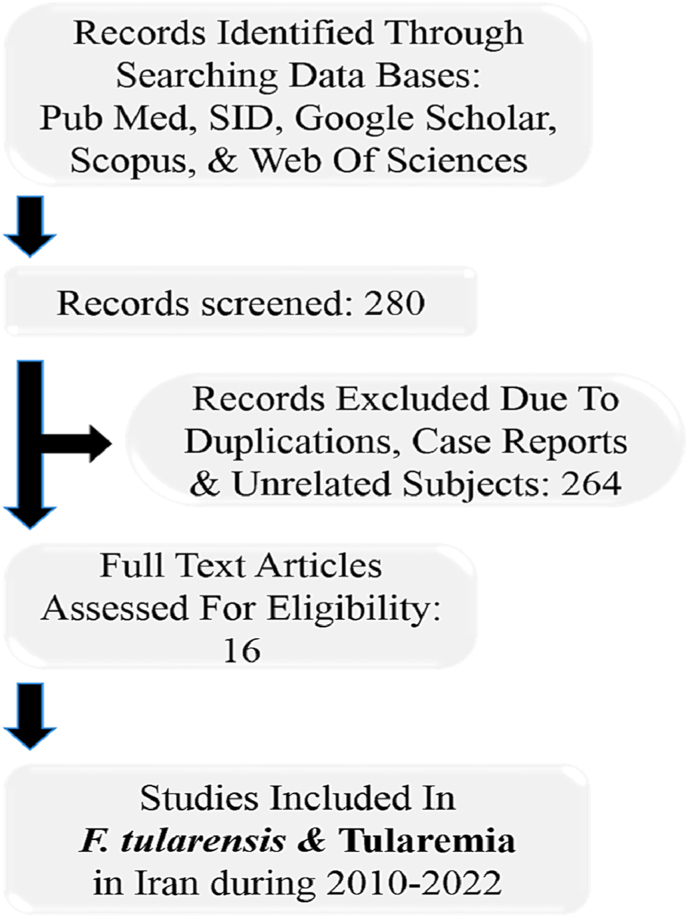
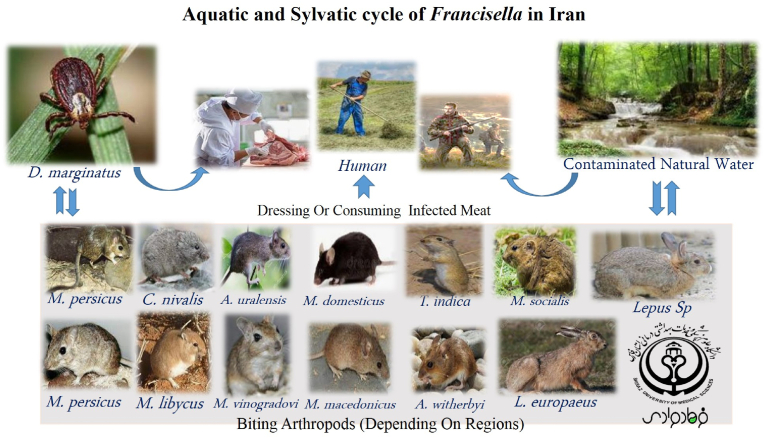
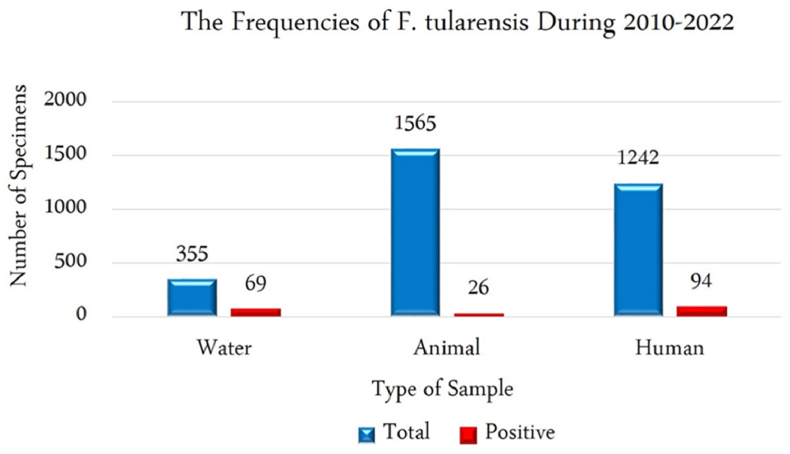
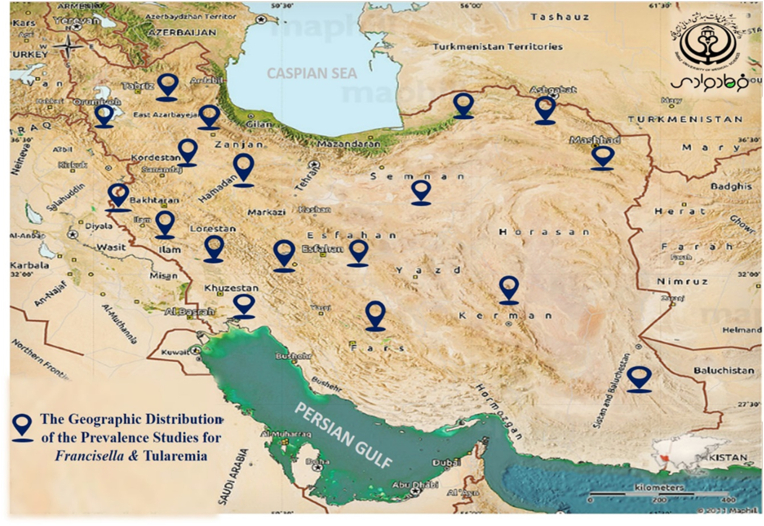
Tularemia or rabbit fever is a transmissible disease from animals, rodents, and insects to human populations that is caused by . Epidemiological studies showed that tularemia is endemic throughout most different regions of the world. Recent evidence documented the transmission of the in a different part of Asia. Because there is no updated review information for tularemia in Iran, we performed this systematic review. In this study, we systematically explored biomedical databases (Google Scholar, Scopus, PubMed, and Web of sciences) to identify epidemiology, reservoirs, and carriers of Francisella in animal and human clinical specimens from 2010 to 2020, either in English or in Persian. Different studies have shown the different frequencies of F. tularensis among human and animal resources in eighteen provinces of Iran. In total, 1242 human clinical specimens, 1565 animal samples, and 355 environmental water samples were investigated to find F. tularensis in different provinces of Iran. According to the collected documents, 94 human clinical samples, 69 water samples, and 26 animal specimens were introduced as positive samples for the F. tularensis. According to studies, thirteen species of rodent and hare presented as an inter-epizootic reservoir. Only one species of tick (D. marginatus) was introduced as a vector for Francisella in Iran. According to these results, it is essential for exclusive attention to the prevalence of F. tularensis in different provinces of Iran. Furthermore, special planning should be done for prevention, control of the outbreak, and proper treatment of the tularemia.
兔热病或土拉菌病是一种由动物、啮齿动物和昆虫传播给人类的疾病。流行病学研究表明,兔热病在世界上大多数不同地区呈地方性流行。最近有证据记录了该病在亚洲不同地区的传播情况。由于伊朗没有关于兔热病的最新综述信息,我们进行了这项系统综述。在本研究中,我们系统地检索了生物医学数据库(谷歌学术、Scopus、PubMed和科学网),以识别2010年至2020年期间来自动物和人类临床标本中的土拉弗朗西斯菌的流行病学、储存宿主和传播媒介,文献语言为英语或波斯语。不同研究显示了伊朗18个省份人类和动物资源中土拉弗朗西斯菌的不同感染频率。总共对1242份人类临床标本、1565份动物样本和355份环境水样进行了调查,以在伊朗不同省份寻找土拉弗朗西斯菌。根据收集到的文献,94份人类临床样本、69份水样和26份动物标本被确定为土拉弗朗西斯菌阳性样本。根据研究,13种啮齿动物和野兔被认定为动物间流行的储存宿主。在伊朗,仅有一种蜱(边缘革蜱)被确定为土拉弗朗西斯菌的传播媒介。根据这些结果,必须特别关注伊朗不同省份土拉弗朗西斯菌的流行情况。此外,应制定专门计划以预防、控制疫情爆发并对兔热病进行适当治疗。