Arnesen Erik Kristoffer, Thorisdottir Birna, Bärebring Linnea, Söderlund Fredrik, Nwaru Bright I, Spielau Ulrike, Dierkes Jutta, Ramel Alfons, Lamberg-Allardt Christel, Åkesson Agneta
Department of Nutrition, Institute of Basic Medical Sciences, University of Oslo, Oslo, Norway.
Health Science Institute, University of Iceland, Reykjavik, Iceland.
Food Nutr Res. 2023 Feb 14;67. doi: 10.29219/fnr.v67.8961. eCollection 2023.
We aimed to systematically review studies and evaluate the strength of the evidence on nuts/seeds consumption and cardiometabolic diseases and their risk factors among adults.
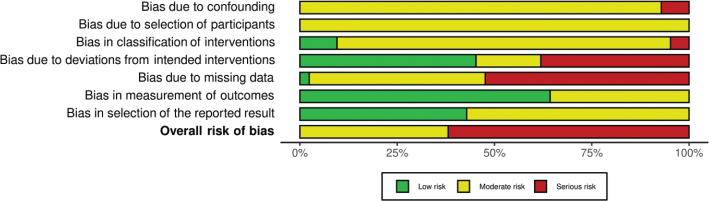
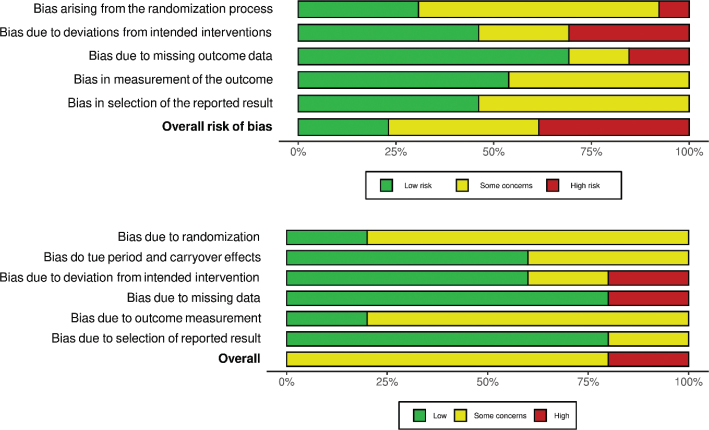
A protocol was pre-registered in PROSPERO (CRD42021270554). We searched MEDLINE, Embase, Cochrane Central Register of Controlled Trials and Scopus up to September 20, 2021 for prospective cohort studies and ≥12-week randomized controlled trials (RCTs). Main outcomes were cardiovascular disease (CVD), coronary heart disease (CHD), stroke and type 2 diabetes (T2D), secondary total-/low density lipoprotein (LDL)-cholesterol, blood pressure and glycaemic markers. Data extraction and risk of bias (RoB) assessments (using RoB 2.0 and RoB-NObS) were performed in duplicate. Effect sizes were pooled using random-effects meta-analyses and expressed as relative risk (RR) or weighted mean differences with 95% confidence intervals (CI); heterogeneity quantified as . One-stage dose-response analyses assessed the linear and non-linear associations with CVD, CHD, stroke and T2D. The strength of evidence was classified per the World Cancer Research Fund criteria.
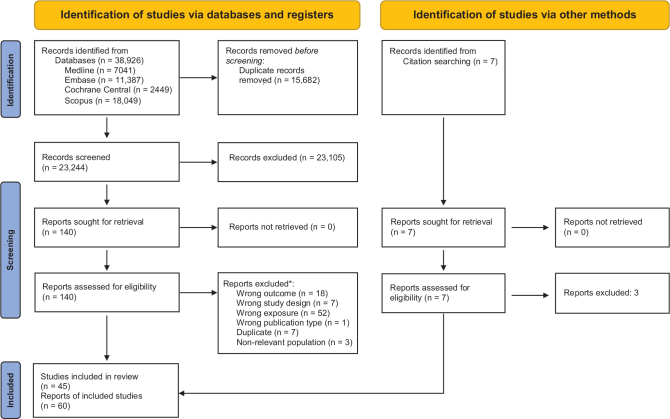
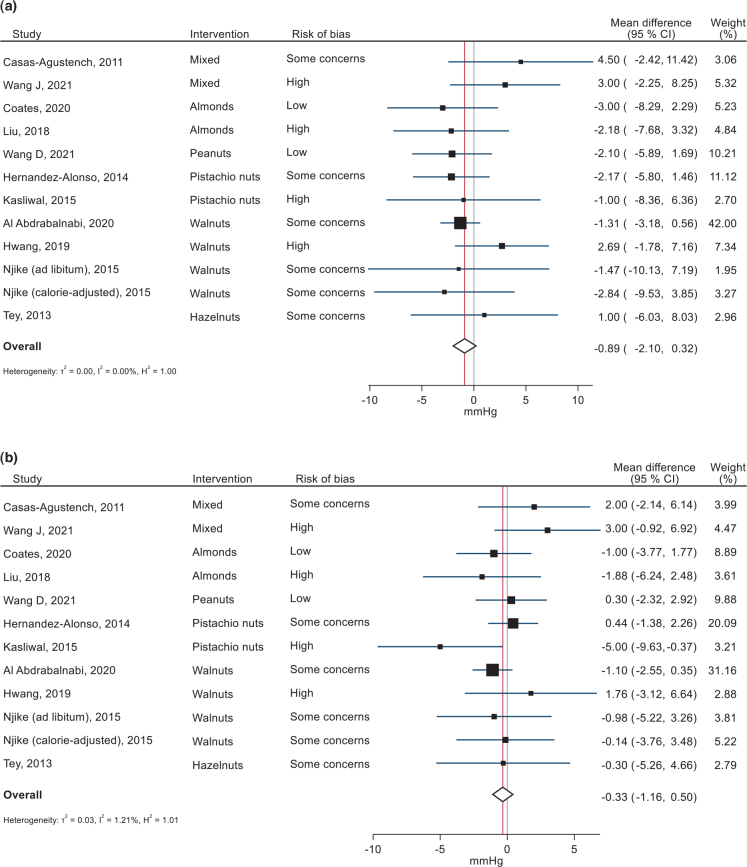
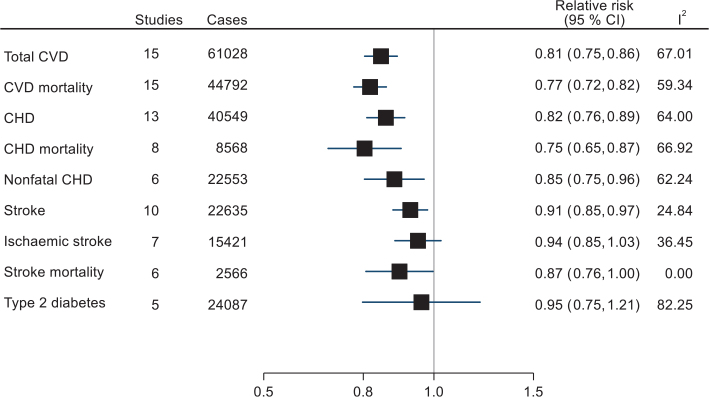
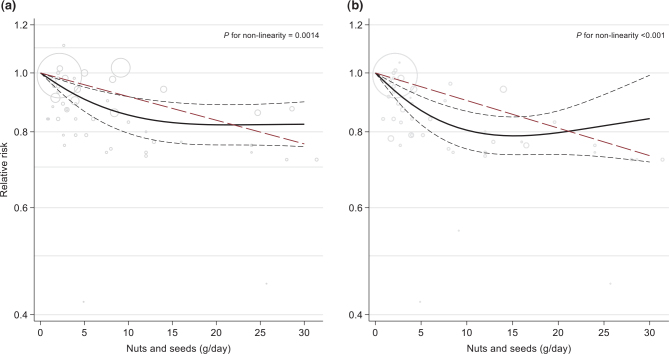
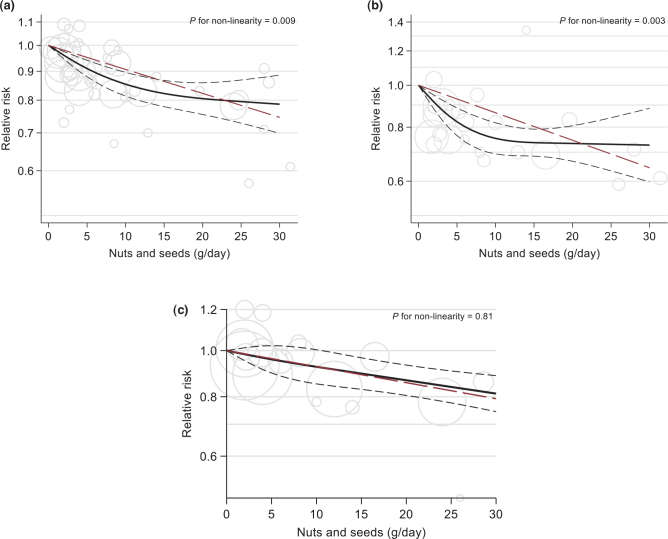
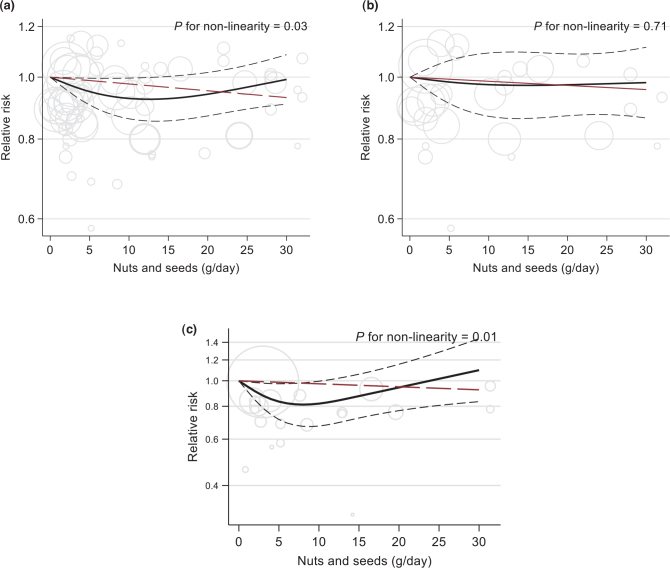
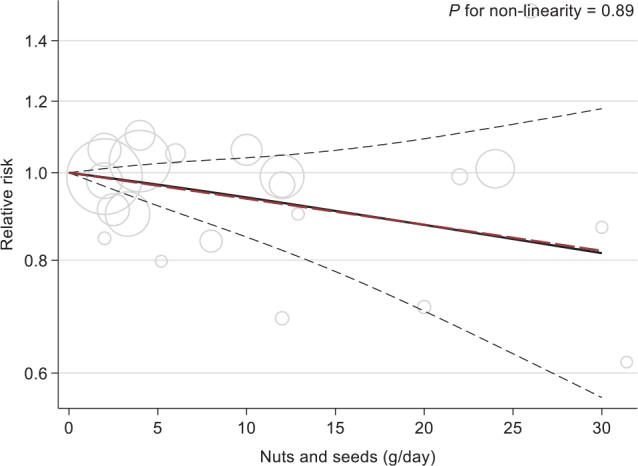
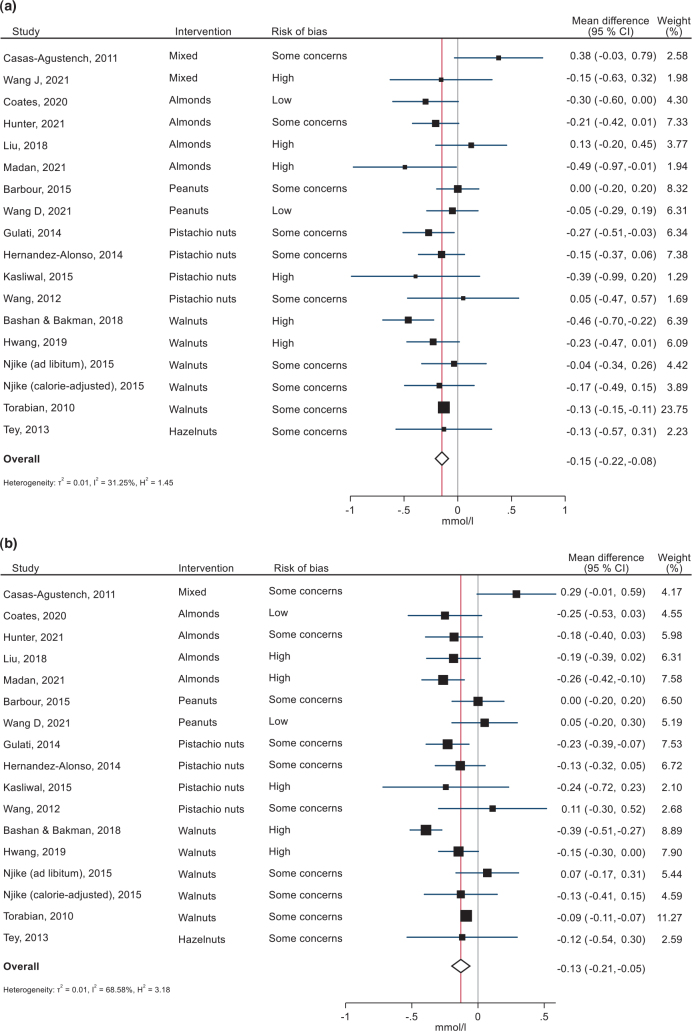
After screening 23,244 references, we included 42 papers from cohort studies (28 unique cohorts, 1,890,573 participants) and 18 RCTs (2,266 participants). In the cohorts, mainly populations with low consumption, high versus low total nuts/seeds consumption was inversely associated with total CVD (RR 0.81; 95% CI 0.75, 0.86; = 67%), CVD mortality (0.77; 0.72, 0.82; = 59.3%), CHD (0.82; 0.76, 0.89; = 64%), CHD mortality (0.75; 0.65, 0.87; = 66.9%) and non-fatal CHD (0.85; 0.75, 0.96; = 62.2%). According to the non-linear dose-response analyses, consumption of 30 g/day of total nuts/seeds was associated with RRs of similar magnitude. For stroke and T2D the summary RR for high versus low intake was 0.91 (95% CI 0.85, 0.97; = 24.8%) and 0.95 (0.75, 1.21; = 82.2%). Intake of nuts (median ~50 g/day) lowered total (-0.15 mmol/L; -0.22, -0.08; = 31.2%) and LDL-cholesterol (-0.13 mmol/L; -0.21, -0.05; = 68.6%), but not blood pressure. Findings on fasting glucose, HbA1c and insulin resistance were conflicting. The results were robust to sensitivity and subgroup analyses. We rated the associations between nuts/seeds and both CVD and CHD as . There was limited but evidence for no association with stroke. No conclusion could be made for T2D.
There is a probable relationship between consumption of nuts/seeds and lower risk of CVD, mostly driven by CHD, possibly in part through effects on blood lipids. More research on stroke and T2D may affect the conclusions. The evidence of specific nuts should be further investigated.
我们旨在系统回顾相关研究,并评估成人食用坚果/种子与心血管代谢疾病及其风险因素之间证据的强度。
一项方案已在国际前瞻性系统评价注册库(PROSPERO,注册号:CRD42021270554)中预先注册。我们检索了截至2021年9月20日的MEDLINE、Embase、Cochrane对照试验中央注册库和Scopus,以查找前瞻性队列研究和≥12周的随机对照试验(RCT)。主要结局包括心血管疾病(CVD)、冠心病(CHD)、中风和2型糖尿病(T2D),次要结局包括总胆固醇/低密度脂蛋白(LDL)胆固醇、血压和血糖指标。数据提取和偏倚风险(RoB)评估(使用RoB 2.0和RoB-NObS)进行了两次。效应量采用随机效应荟萃分析进行合并,并表示为相对风险(RR)或加权平均差及95%置信区间(CI);异质性用 量化。单阶段剂量反应分析评估了与CVD、CHD、中风和T2D的线性和非线性关联。证据强度根据世界癌症研究基金会标准进行分类。
在筛选了23244篇参考文献后,我们纳入了42篇队列研究论文(28个独立队列,1890573名参与者)和18项RCT(2266名参与者)。在队列研究中,主要是低摄入量人群,坚果/种子总摄入量高与低相比,与总心血管疾病(RR 0.81;95%CI 0.75,0.86; = 67%)、心血管疾病死亡率(0.77;0.72,0.82; = 59.3%)、冠心病(0.82;0.76,0.89; = 64%)、冠心病死亡率(0.75;0.65,0.87; = 66.9%)和非致命性冠心病(0.85;0.75,0.96; = 62.2%)呈负相关。根据非线性剂量反应分析,每天食用30克坚果/种子总摄入量与类似幅度的RR相关。对于中风和T2D,高摄入量与低摄入量的汇总RR分别为0.91(95%CI 0.85,0.97; = 24.8%)和0.95(0.75,1.21; = 82.2%)。食用坚果(中位数约为50克/天)可降低总胆固醇(-0.15 mmol/L;-0.22,-0.08; = 31.2%)和LDL胆固醇(-0.13 mmol/L;-0.21,-0.05; = 68.6%),但对血压无影响。关于空腹血糖、糖化血红蛋白和胰岛素抵抗的研究结果相互矛盾。结果在敏感性和亚组分析中具有稳健性。我们将坚果/种子与CVD和CHD之间的关联评为 。与中风无关联的证据有限但 。对于T2D无法得出结论。
食用坚果/种子与较低的心血管疾病风险之间可能存在关联,主要由冠心病驱动,可能部分是通过对血脂的影响。对中风和T2D的更多研究可能会影响结论。特定坚果的证据应进一步研究。