Department of Food and Nutrition, College of Life Science and Nano-technology, Hannam University, Daejeon, 34054, Korea.
Department of Genetics and Biotechnology, College of Life Sciences, Kyung Hee University, Yongin, 17104, Korea.
Nutr J. 2024 Sep 28;23(1):113. doi: 10.1186/s12937-024-01019-y.
Although nuts are a well-known healthy food group, the relationship between nut consumption and mortality remains unclear, particularly among Asians. This prospective cohort study examined the association between nut consumption and the risk of all-cause, cardiovascular disease (CVD), and cancer mortality in Korean adults.
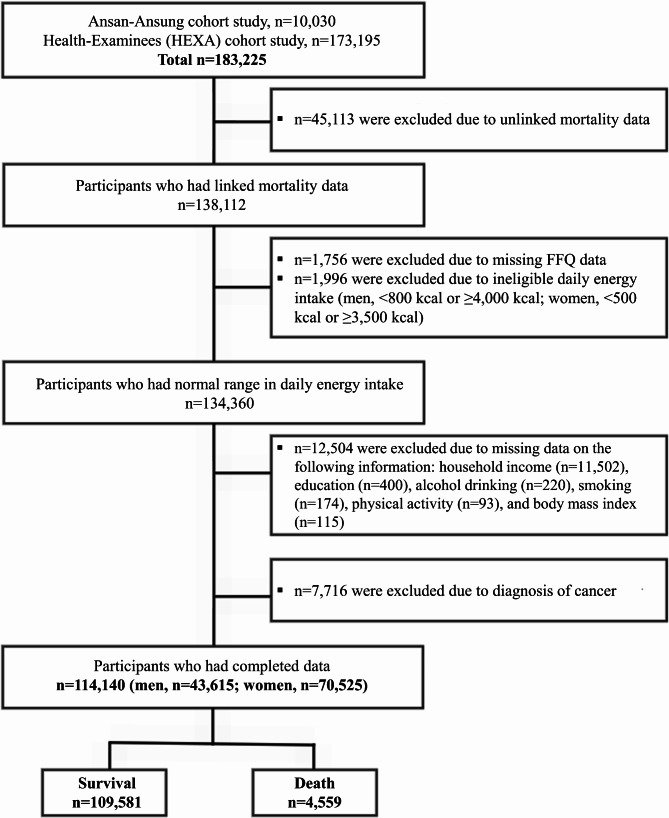
Data from two cohorts (the Ansan-Ansung and Health-Examinees) from the Korean Genome and Epidemiology Study were used. A total of 114,140 individuals aged 40-79 years were included in the data analyses. Nut consumption was assessed using a validated semi-quantitative food frequency questionnaire and categorized into four groups: non-consumers, less than 1 serving/week, 1-2 servings/week, and 2 or more servings/week (one serving was 15 g of nuts). Mortality outcomes were determined based on the 2001-2021 death records from Statistics Korea. Cox proportional hazard regression analysis was used to calculate hazard ratios (HRs) and 95% confidence intervals (CIs) for mortality across nut consumption categories. A stratified subgroup analysis by health-related variables was also performed.
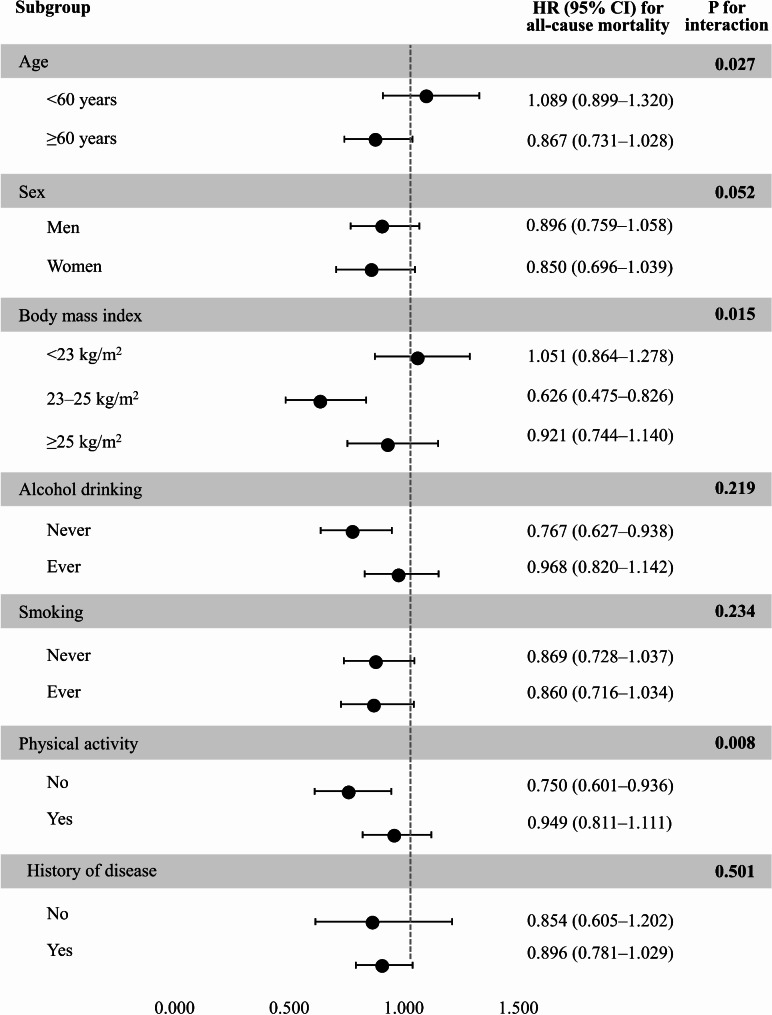
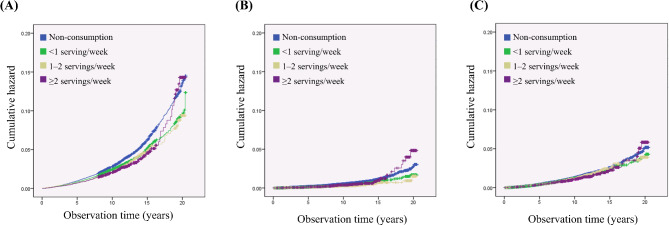
During a mean follow-up of 12.3 years, 4,559 deaths were recorded. After adjusting for covariates, the HR for all-cause mortality was 0.877 (95% CI = 0.772-0.996, p for trend = 0.006) in individuals with a nut consumption of 2 or more servings/week compared with that in non-consumers. Multivariable HRs for CVD mortality were 0.800 (95% CI = 0.681-0.939) in individuals consuming less than 1 serving/week, 0.656 (95% CI = 0.469-0.918) in those consuming 1-2 servings/week, and 1.009 (95% CI = 0.756-1.347) in those consuming 2 or more servings/week compared with that in non-consumers (p for trend = 0.080). No association was observed between nut consumption and cancer mortality. Stratified analysis identified significant interactions in the association between nut consumption and all-cause mortality by age, body mass index, and physical activity.
Nut consumption was linearly associated with the reduced risk of all-cause mortality and showed a non-linear dose-response relationship with CVD mortality in Koreans, but had no association with cancer mortality. The effects of nut consumption, which have been inadequately investigated in this population, varied across different subgroups. These findings suggest that incorporating nuts into the diet should be encouraged for long-term health of Korean adults.
尽管坚果是众所周知的健康食品,但坚果的消费与死亡率之间的关系仍不清楚,尤其是在亚洲人群中。本前瞻性队列研究旨在探讨韩国成年人中坚果摄入与全因、心血管疾病(CVD)和癌症死亡率风险之间的关系。
本研究使用了来自韩国基因组和流行病学研究的两个队列(安山-安城和健康检查队列)的数据。共纳入了 114140 名年龄在 40-79 岁的成年人进行数据分析。坚果摄入量通过经过验证的半定量食物频率问卷进行评估,并分为四组:非食用者、每周食用少于 1 份、每周食用 1-2 份和每周食用 2 份或更多份(1 份为 15 克坚果)。死亡率结果根据韩国统计局 2001-2021 年的死亡记录确定。使用 Cox 比例风险回归分析计算不同坚果摄入量组的死亡率风险比(HR)和 95%置信区间(CI)。还对健康相关变量进行了分层亚组分析。
在平均 12.3 年的随访期间,记录了 4559 例死亡。在调整了混杂因素后,与非食用者相比,每周食用 2 份或更多份坚果的个体全因死亡率的 HR 为 0.877(95%CI=0.772-0.996,p 趋势=0.006)。每周食用少于 1 份坚果的个体 CVD 死亡率的多变量 HR 为 0.800(95%CI=0.681-0.939),每周食用 1-2 份坚果的个体为 0.656(95%CI=0.469-0.918),每周食用 2 份或更多份坚果的个体为 1.009(95%CI=0.756-1.347)(p 趋势=0.080)。坚果摄入与癌症死亡率之间无关联。分层分析发现,坚果摄入与全因死亡率之间的关联存在显著的年龄、体重指数和体力活动交互作用。
在韩国人群中,坚果摄入与全因死亡率呈线性相关,与 CVD 死亡率呈非线性剂量反应关系,但与癌症死亡率无关。在该人群中,坚果摄入的影响尚未得到充分研究,在不同亚组中存在差异。这些发现表明,鼓励韩国成年人长期食用坚果有益于健康。