Liu Jinli, Liu Min, Chai Zhonglin, Li Chao, Wang Yanan, Shen Mingwang, Zhuang Guihua, Zhang Lei
China-Australia Joint Research Center for Infectious Diseases, School of Public Health, Xi'an Jiaotong University Health Science Center, Xi'an, Shaanxi, China.
National Center for Chronic and Noncommunicable Disease Control and Prevention, Chinese Center for Disease Control and Prevention, Beijing, China.
Lancet Reg Health West Pac. 2023 Feb 3;33:100700. doi: 10.1016/j.lanwpc.2023.100700. eCollection 2023 Apr.
This study projects the trend of disease burden and economic burden of diabetes in 33 Chinese provinces and nationally during 2020-2030 and investigates its spatial disparities.
Time series prediction on the prevalence and disability-adjusted life-year (DALY) rates of diabetes was conducted using a Bayesian modelling approach in 2020-2030. The top-down method and the human capital method were used to predict the direct and indirect costs of diabetes for each Chinese province. Global and local spatial autocorrelation analyses were used to identify geographic clusters of low-or high-burden areas.
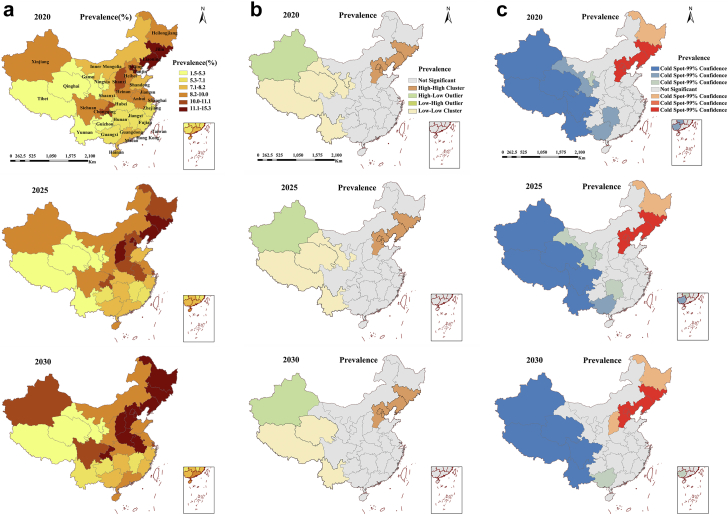
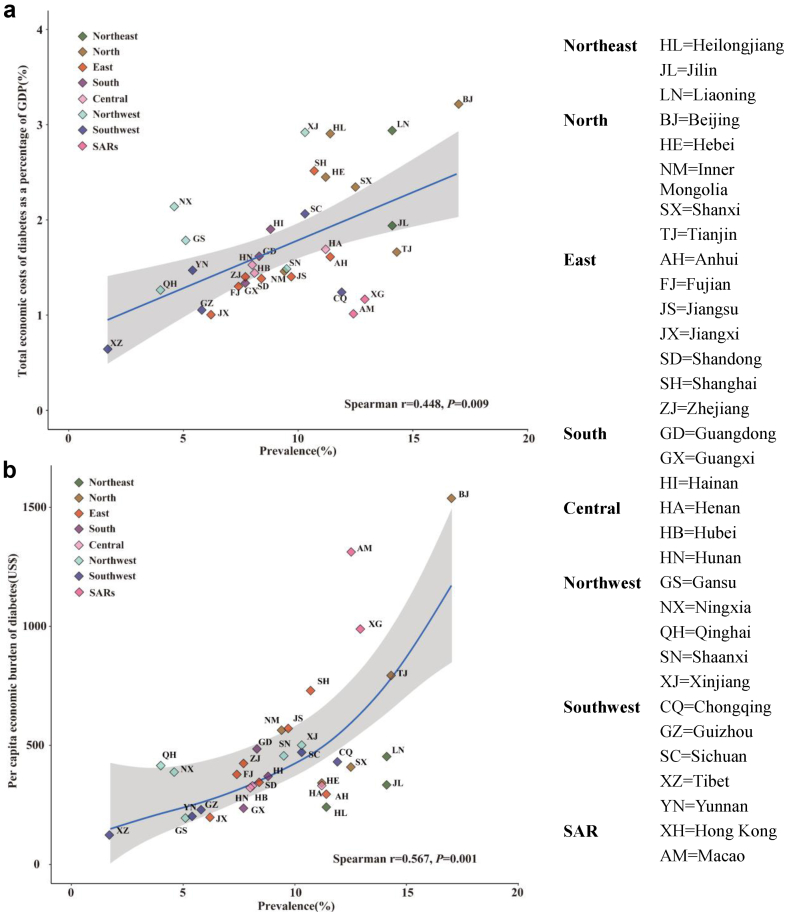
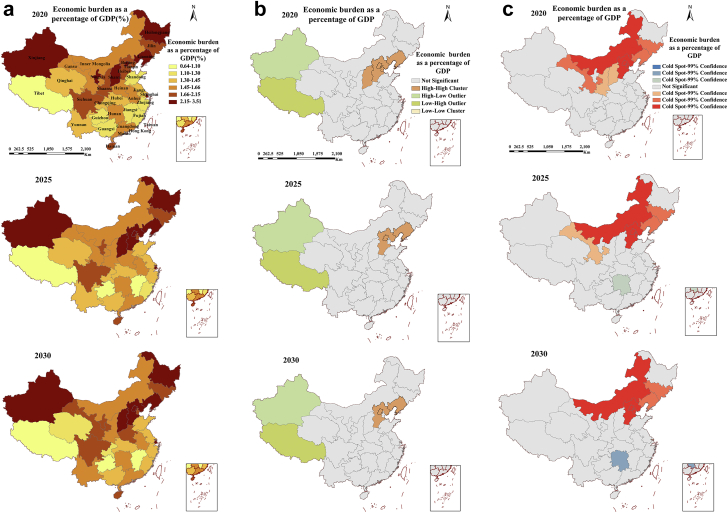
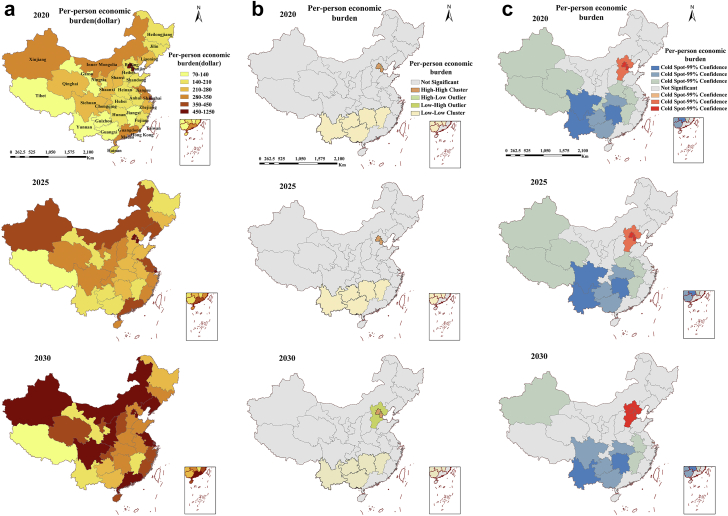
Diabetes prevalence in Chinese adults aged 20-79 years was projected to increase from 8.2% to 9.7% during 2020-2030. During the same period, the total costs of diabetes would increase from $250.2 billion to $460.4 billion, corresponding to an annual growth rate of 6.32%. The total costs of diabetes as a percentage of GDP would increase from 1.58% to 1.69% in China during 2020-2030, suggesting a faster growth in the economic burden of diabetes than China's economic growth. Consistently, the per-capita economic burden of diabetes would increase from $231 to $414 in China during 2020-2030, with an annual growth rate of 6.02%. High disease and economic burden areas were aggregated in Northeast and/or North China.
Our study projects a significant growth of disease and economic burden of diabetes in China during 2020-2030, with strong spatial aggregation in northern Chinese regions. The increase in the economic burden of diabetes will exceed that of GDP.
National Natural Science Foundation of China, Outstanding Young Scholars Funding.
本研究预测了2020 - 2030年中国33个省份及全国范围内糖尿病的疾病负担和经济负担趋势,并调查其空间差异。
采用贝叶斯建模方法对2020 - 2030年糖尿病的患病率和伤残调整生命年(DALY)率进行时间序列预测。运用自上而下法和人力资本法预测中国各省份糖尿病的直接和间接成本。采用全局和局部空间自相关分析来确定低负担或高负担地区的地理聚集情况。
预计2020 - 2030年中国20 - 79岁成年人糖尿病患病率将从8.2%升至9.7%。同期,糖尿病总成本将从2502亿美元增至4604亿美元,年增长率为6.32%。2020 - 2030年,中国糖尿病总成本占GDP的比例将从1.58%升至1.69%,这表明糖尿病经济负担的增长速度快于中国经济增长速度。同样,2020 - 2030年中国糖尿病的人均经济负担将从231美元增至414美元,年增长率为6.02%。高疾病负担和高经济负担地区集中在东北和/或华北地区。
我们的研究预测,2020 - 2030年中国糖尿病的疾病负担和经济负担将显著增长,在中国北方地区有强烈的空间聚集现象。糖尿病经济负担的增长将超过GDP的增长。
国家自然科学基金杰出青年科学基金项目。