Dehghani Mostafa, Namdari Mehrdad, Rafieian-Kopaei Mahmoud, Baharvand-Ahmadi Babak, Mokhayeri Yaser, Namdari Parsa, Dehghani Morteza, Cheragi Mostafa
Cardiovascular Research Center, Shahid Rahimi Hospital, Lorestan University of Medical Sciences, Khorramabad, Iran.
Department of Cardiology, School of Medicine AND Cardiovascular Research Center, Shahid Rahimi Hospital, Lorestan University of Medical Sciences, Khorramabad, Iran.
ARYA Atheroscler. 2022 Jan;18(1):1-9. doi: 10.48305/arya.v18i0.2167.
It seems that the time of performing cardiac rehabilitation is important in determining the risk of cardiac complications in patients with myocardial infarction (MI). The present study aimed to investigate the effects of a home-based cardiac rehabilitation program (HCRP) conducted in either the morning or evening on cardiometabolic risk factors in phase IV (maintenance) MI patients.
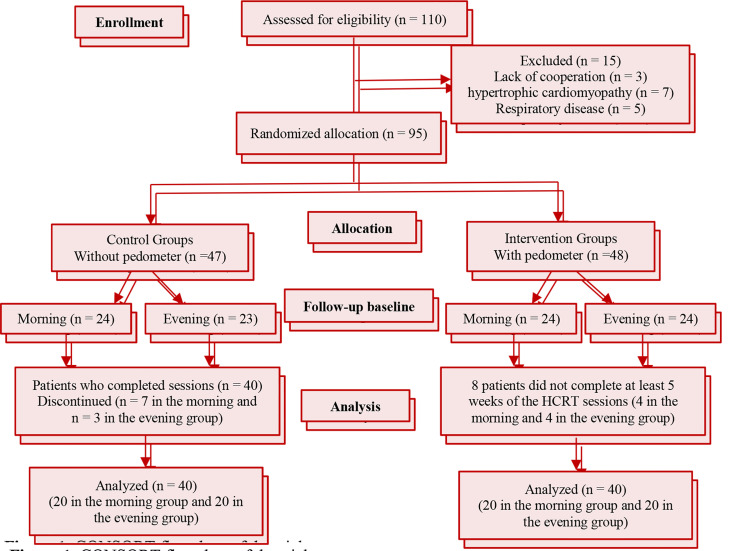
In this randomized controlled clinical trial, 80 patients with MI were divided into 2 groups of intervention and control (40 individuals per group). Patients in each group were categorized into morning and evening subgroups (20 individuals per subgroup). The therapeutic regimen in the intervention group included HCRP, routine medications, and exercise and walking programs for 8 weeks. Patients in the control group received routine treatments for 8 weeks. Cardiovascular risk factors comprising of cardiac troponin I (cTnI), mean platelet volume (MPV), C-reactive protein (CRP), and cardiometabolic indicators including cholesterol (Cho), high-density lipoprotein (HDL), low-density lipoprotein (LDL), triglyceride (TG), and the maximum rate of oxygen consumption (VO2 max) were measured for all patients before and after the intervention.
Our results showed significant reductions in Cho, TG, HDL, LDL, VO2 max, CRP, and MPV (P < 0.05) in the group performing HCRP in the evening compared with the morning group.
Performing HCRP in the evening, compared with morning, can be significantly more effective in improving the levels of cardiometabolic risk factors in patients with MI. Therefore, it is recommended that rehabilitation programs be implemented in these patients in evening shifts.
心肌梗死(MI)患者心脏康复的实施时间似乎对确定心脏并发症风险很重要。本研究旨在调查在上午或晚上进行的家庭心脏康复计划(HCRP)对IV期(维持期)MI患者心血管代谢危险因素的影响。
在这项随机对照临床试验中,80例MI患者被分为干预组和对照组(每组40人)。每组患者又分为上午和晚上亚组(每个亚组20人)。干预组的治疗方案包括HCRP、常规药物治疗以及为期8周的运动和步行计划。对照组患者接受为期8周的常规治疗。在干预前后对所有患者测量心血管危险因素,包括心肌肌钙蛋白I(cTnI)、平均血小板体积(MPV)、C反应蛋白(CRP),以及心血管代谢指标,包括胆固醇(Cho)、高密度脂蛋白(HDL)、低密度脂蛋白(LDL)、甘油三酯(TG)和最大耗氧率(VO2 max)。
我们的结果显示,与上午组相比,晚上进行HCRP的组中Cho、TG、HDL、LDL、VO2 max、CRP和MPV显著降低(P < 0.05)。
与上午相比,晚上进行HCRP对改善MI患者心血管代谢危险因素水平的效果可能显著更好。因此,建议对这些患者在晚班时段实施康复计划。