Rana Eaftekhar Ahmed, Nizami Tanvir Ahmad, Islam Md Sayedul, Barua Himel, Islam Md Zohorul
Chattogram Veterinary and Animal Sciences University, Khulshi, Chattogram-4225, Bangladesh.
Bangabandhu Sheikh Mujibur Rahman Agricultural University, Gazipur-1706, Bangladesh.
Vet Med Int. 2023 Feb 8;2023:2584171. doi: 10.1155/2023/2584171. eCollection 2023.
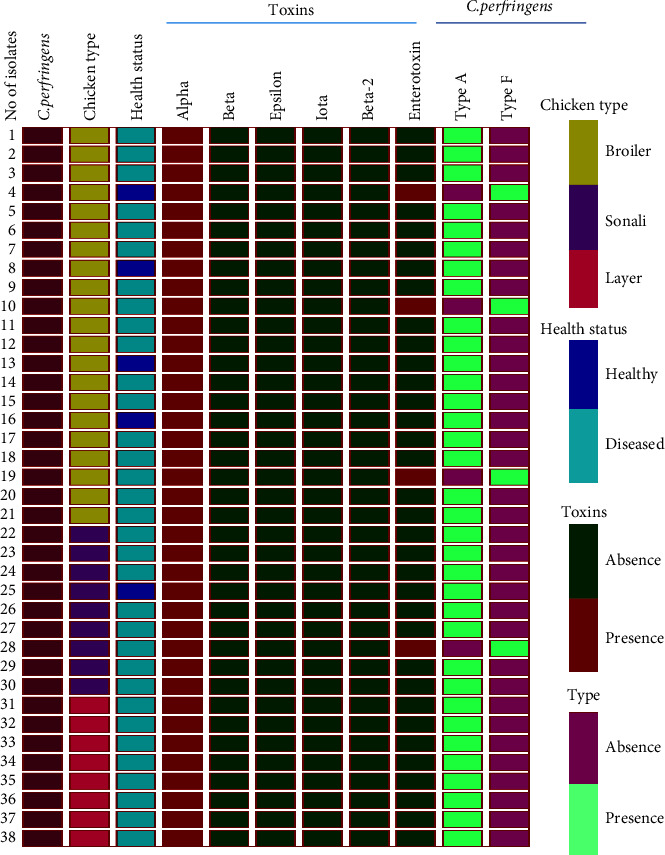
is a ubiquitous spore-forming anaerobic pathogen that is frequently associated with enteric disease in chickens. Moreover, enterotoxin-producing has high zoonotic potential as well as serious public health concerns due to the emanation of food-borne intoxication. The present study was designed to isolate, identify, and toxinotype from both healthy and cases of necrotic or ulcerative enteritis chickens. A total of 110 samples were collected from July 2019 to February 2021. Among the samples, 38 (34.5%, 95% CI: 26.39-43.83) were positive for and were obtained from broiler 21 (33.3%, 95% CI: 22.91-45.67), Sonali 9 (34.6%, 95% CI: 19.31-53.88), and layer 8 (38%, 95% CI: 20.68-59.20). was highly prevalent (35.7%, 95% CI: 25.48-47.44) in enteritis chickens compared with healthy ones. In multiplex PCR toxinotyping, 34 (89.4%) isolates were identified as type A by the presence of the alpha toxin gene (). Moreover, in addition to the cpa gene, 3 (14.3%, 95% CI: 4.14-35.48) broiler and 1 (11.1%, 95% CI: 0.01-45.67) Sonali isolates harbored the enterotoxin gene () and were classified as type F. However, none of the isolates carried genes encoding beta (), epsilon (), iota (), or beta-2 () toxins. Multivariable logistic regression analysis identified the following variables such as; "previously used litter materials" (OR 21.77, 95% CI 2.22-212.66, ≤ 0.008); intestinal lesions, "presence of ulceration" (OR 30.01, 95% CI 3.02-297.91, ≤ 0.004); "ballooned with gas" (OR 24.74, 95% CI 4.34-140.86, ≤ 0.001) and "use of probiotics" (OR 5.24, 95% CI 0.74-36.75, ≤ 0.095) act as risk factors for colonization in chicken gut. This is the first study of molecular toxinotyping of from healthy and enteric-diseased chickens in Bangladesh, which might have a potential food-borne zoonotic impact on human health.
是一种无处不在的形成孢子的厌氧病原体,常与鸡的肠道疾病有关。此外,由于食源性中毒的发生,产肠毒素的具有很高的人畜共患病潜力以及严重的公共卫生问题。本研究旨在从健康鸡以及坏死性或溃疡性肠炎鸡病例中分离、鉴定并进行毒素分型。2019年7月至2021年2月共收集了110份样本。在这些样本中,38份(34.5%,95%置信区间:26.39 - 43.83)检测为阳性,分别来自肉鸡21份(33.3%,95%置信区间:22.91 - 45.67)、索纳利鸡9份(34.6%,95%置信区间:19.31 - 53.88)和蛋鸡8份(38%,95%置信区间:20.68 - 59.20)。与健康鸡相比,在肠炎鸡中高度流行(35.7%,95%置信区间:25.48 - 47.44)。在多重PCR毒素分型中,34份(89.4%)分离株通过α毒素基因()的存在被鉴定为A型。此外,除cpa基因外,3份(14.3%,95%置信区间:4.14 - 35.48)肉鸡和1份(11.1%,95%置信区间:0.01 - 45.67)索纳利鸡分离株携带肠毒素基因(),并被分类为F型。然而,没有分离株携带编码β()、ε()、ι()或β - 2()毒素的基因。多变量逻辑回归分析确定了以下变量,如“先前使用的垫料材料”(比值比21.77,95%置信区间2.22 - 212.66,P≤0.008);肠道病变,“存在溃疡”(比值比30.01,95%置信区间3.02 - 297.91,P≤0.004);“气体膨胀”(比值比24.74,95%置信区间4.34 - 140.86,P≤0.001)以及“使用益生菌”(比值比5.24,95%置信区间0.74 - 36.75,P≤0.095)是鸡肠道中定植的危险因素。这是孟加拉国首次对健康鸡和患肠道疾病鸡进行分子毒素分型的研究,可能对人类健康产生潜在的食源性人畜共患病影响。