Fu Cuicui, Qin Xiaoyun, Zhang Jin, Zhang Ting, Song Yeqing, Yang Jiaqi, Wu Gang, Luo Dan, Jiang Nan, Bikker Floris J
Department of Oral Biochemistry, Academic Centre for Dentistry Amsterdam (ACTA), University of Amsterdam (UvA) and Vrije Universiteit Amsterdam (VU), Amsterdam 1081LA, the Netherlands.
School of Material and Chemical Engineering, Zhengzhou University of Light Industry, Zhengzhou 450002, China.
Heliyon. 2023 Feb 2;9(2):e13422. doi: 10.1016/j.heliyon.2023.e13422. eCollection 2023 Feb.
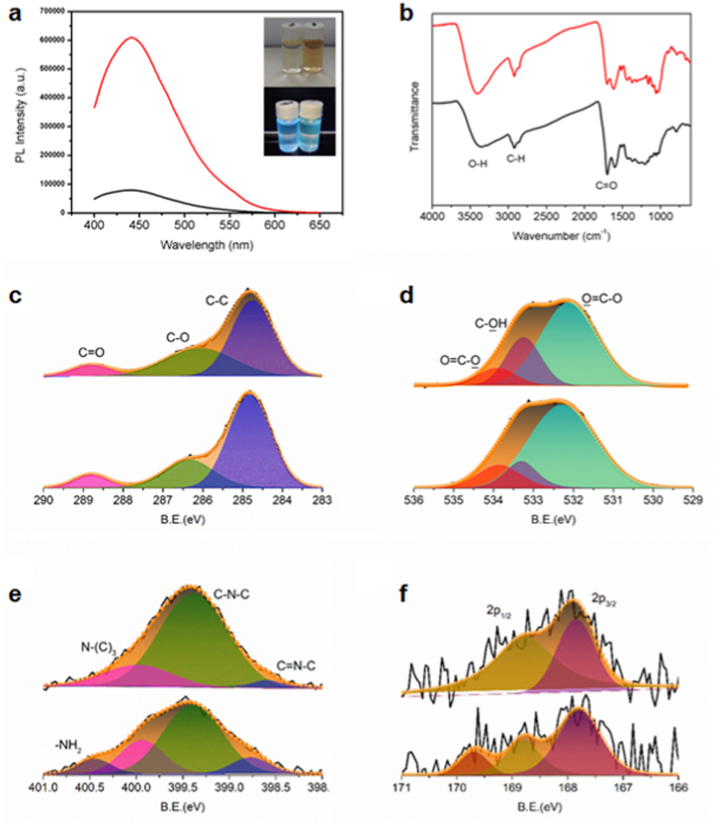
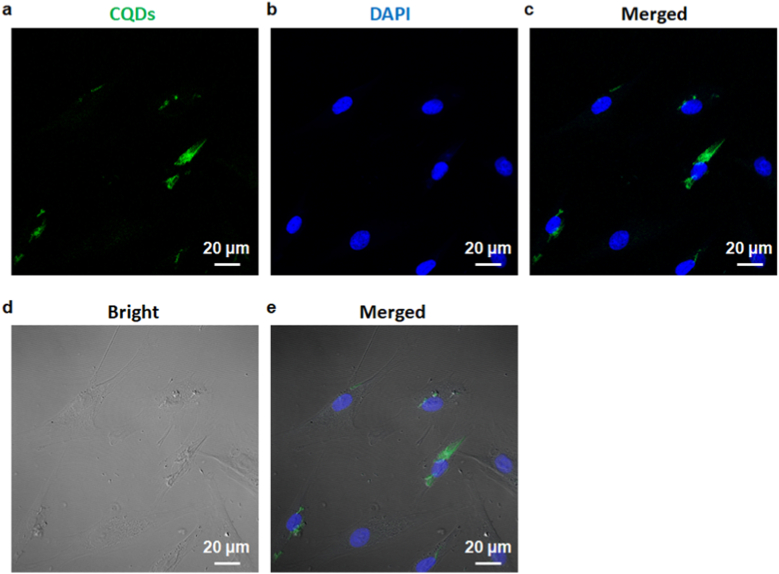
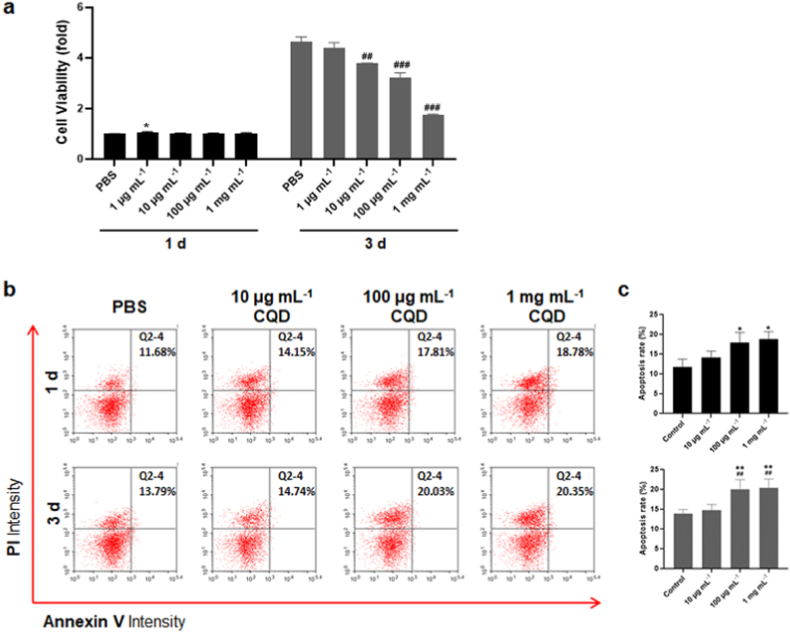
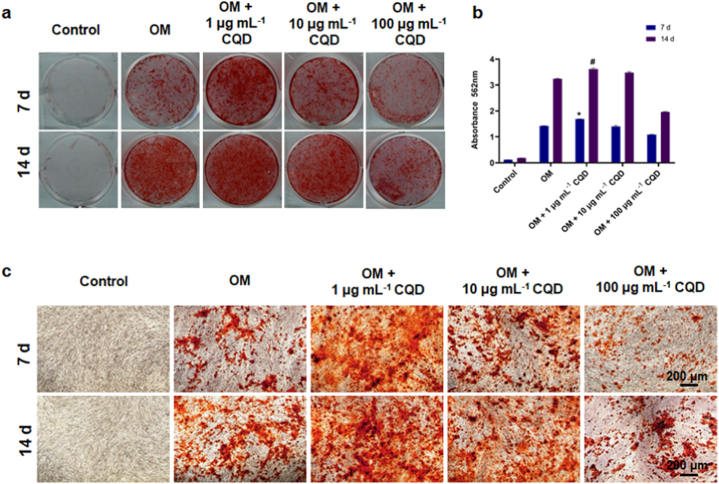
Food-derived carbon quantum dots (CQDs) can relatively easily be synthesized and chemically manipulated for a broad spectrum of biomedical applications. However, their toxicity may hinder their actual use. Here, -derived CQDs ., CQD-1 and CQD-2, were synthesized by means of different shredding methods and followed by a microwave-assisted hydrothermal approach. Subsequently, these CQDs were analyzed and in an mice model to test their biocompatibility and potential use as bioimaging agents and for activation of osteogenic differentiation. When comparing CQD-1 and CQD-2, it was found that CQD-1 exhibited 7.6 times higher photoluminescent (PL) emission intensity around 411 nm compared to CQD-2. Besides, it was found that the size distribution of CQD-1 was 2.05 ± 0.08 nm, compared with 2.14 ± 0.04 nm for CQD-2. Upon exposure to human bone marrow-derived mesenchymal stem cells (hBMSCs) , CQD-1 was endocytosed into the cytoplasm and significantly increased the differentiation of hBMSCs up to 10 μg mL after 7 and 14 days. Apparently, the presence of relatively low doses of CQD-1 showed virtually no toxic or histological effects in the major organs . In contrast, high doses of CQD-1 (1 mg mL) caused cell death ranging from 35% on day 1 to 80% on day 3 post-exposure, and activated the apoptotic machinery and increased lymphocyte aggregates in the liver tissue. In conclusion, -derived CQDs have the potential for biomedical applications in bioimaging and activation of stem cells osteogenic differentiation. Therefore, it is postulated that CQD-1 from remains potential prospective material at appropriate doses and specifications.
食物源碳量子点(CQDs)相对容易合成且可进行化学操控,以用于广泛的生物医学应用。然而,它们的毒性可能会阻碍其实际应用。在此,通过不同的粉碎方法合成了源自 - 的CQDs,即CQD - 1和CQD - 2,随后采用微波辅助水热法。随后,对这些CQDs进行了分析,并在小鼠模型中测试它们的生物相容性以及作为生物成像剂和激活成骨分化的潜在用途。比较CQD - 1和CQD - 2时发现,与CQD - 2相比,CQD - 1在411nm左右的光致发光(PL)发射强度高7.6倍。此外,发现CQD - 1的尺寸分布为2.05±0.08nm,而CQD - 2为2.14±0.04nm。将其暴露于人类骨髓间充质干细胞(hBMSCs)后,CQD - 1被内吞进入细胞质,并在7天和14天后显著提高了hBMSCs的分化,浓度高达10μg/mL。显然,相对低剂量的CQD - 1在主要器官中几乎没有毒性或组织学影响。相比之下,高剂量的CQD - 1(1mg/mL)在暴露后第1天导致35%的细胞死亡,第3天导致80%的细胞死亡,并激活了凋亡机制,增加了肝脏组织中的淋巴细胞聚集。总之,源自 - 的CQDs在生物成像和干细胞成骨分化激活方面具有生物医学应用潜力。因此,推测来自 的CQD - 1在适当的剂量和规格下仍是潜在的前瞻性材料。