Sotio Biotech, Prague, Czech Republic.
Gynecologic Oncology Center, Department of Obstetrics and Gynecology, First Faculty of Medicine, Charles University and General University Hospital, Prague, Czech Republic.
J Immunother Cancer. 2023 Feb;11(2). doi: 10.1136/jitc-2022-005968.
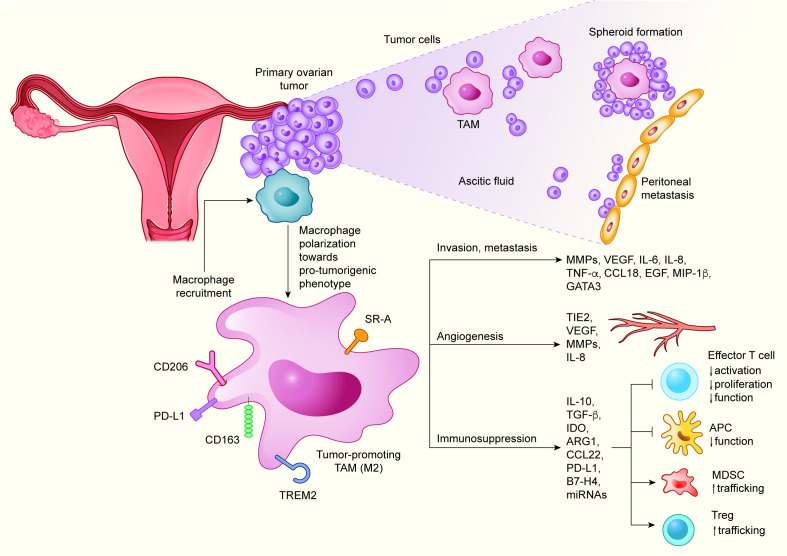
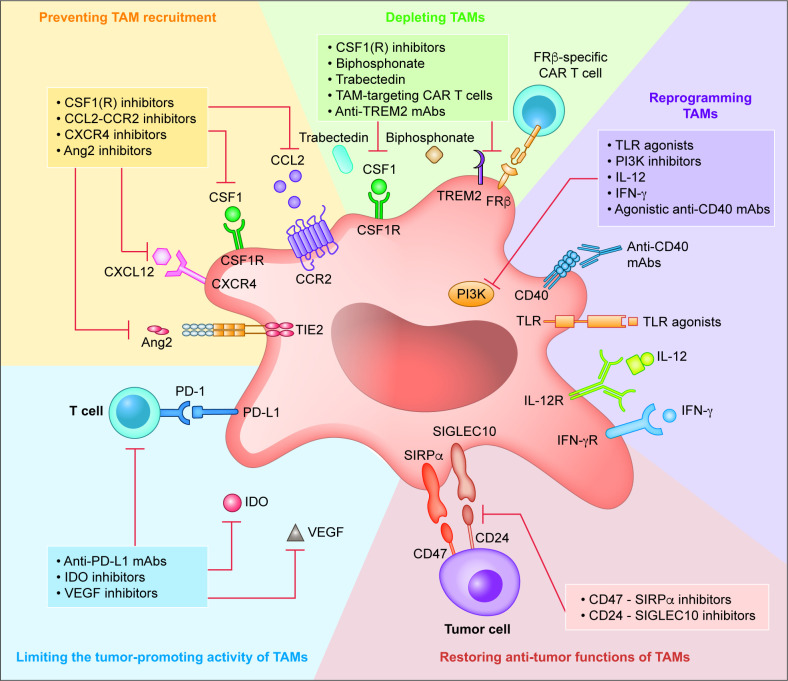
Epithelial ovarian cancer (EOC) is among the top five causes of cancer-related death in women, largely reflecting early, prediagnosis dissemination of malignant cells to the peritoneum. Despite improvements in medical therapies, particularly with the implementation of novel drugs targeting homologous recombination deficiency, the survival rates of patients with EOC remain low. Unlike other neoplasms, EOC remains relatively insensitive to immune checkpoint inhibitors, which is correlated with a tumor microenvironment (TME) characterized by poor infiltration by immune cells and active immunosuppression dominated by immune components with tumor-promoting properties, especially tumor-associated macrophages (TAMs). In recent years, TAMs have attracted interest as potential therapeutic targets by seeking to reverse the immunosuppression in the TME and enhance the clinical efficacy of immunotherapy. Here, we review the key biological features of TAMs that affect tumor progression and their relevance as potential targets for treating EOC. We especially focus on the therapies that might modulate the recruitment, polarization, survival, and functional properties of TAMs in the TME of EOC that can be harnessed to develop superior combinatorial regimens with immunotherapy for the clinical care of patients with EOC.
上皮性卵巢癌 (EOC) 是女性癌症相关死亡的前五大原因之一,主要反映了恶性细胞在诊断前向腹膜的早期扩散。尽管医学治疗方法有所改进,特别是新型药物靶向同源重组缺陷的应用,但 EOC 患者的生存率仍然很低。与其他肿瘤不同,EOC 对免疫检查点抑制剂相对不敏感,这与肿瘤微环境 (TME) 的特点有关,其特点是免疫细胞浸润不良,以具有肿瘤促进特性的免疫成分为主导的主动免疫抑制。近年来,TAMs 作为潜在的治疗靶点引起了人们的兴趣,因为它们试图逆转 TME 中的免疫抑制,增强免疫疗法的临床疗效。在这里,我们回顾了影响肿瘤进展的 TAMs 的关键生物学特征及其作为治疗 EOC 的潜在靶点的相关性。我们特别关注可能调节 EOC 的 TME 中 TAMs 的募集、极化、存活和功能特性的治疗方法,这些方法可以被利用来为 EOC 患者的临床护理制定与免疫疗法相结合的卓越联合方案。