Physics Department, Faculty of Science, Cairo University, Giza, Egypt.
Sci Rep. 2023 Feb 23;13(1):3141. doi: 10.1038/s41598-023-30255-1.
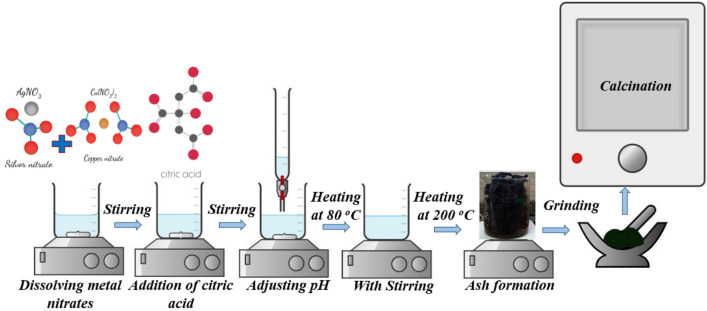
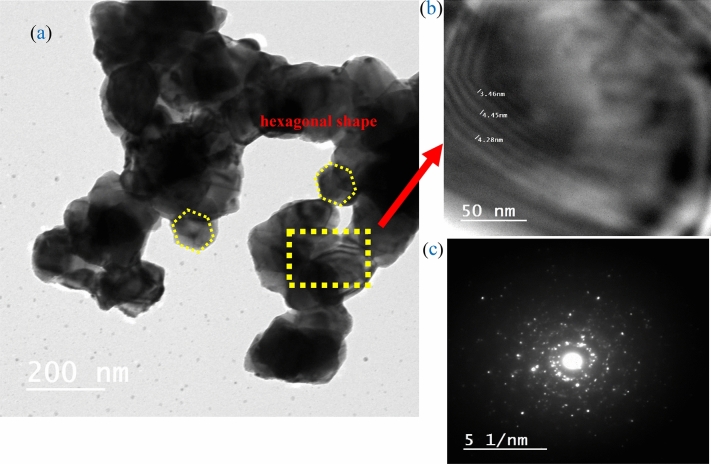
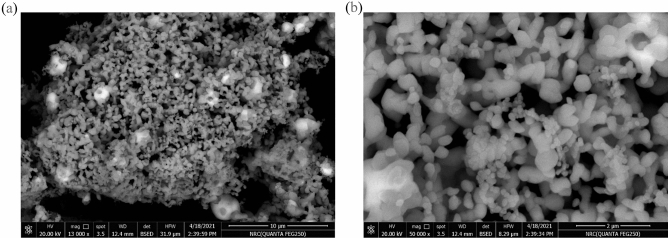
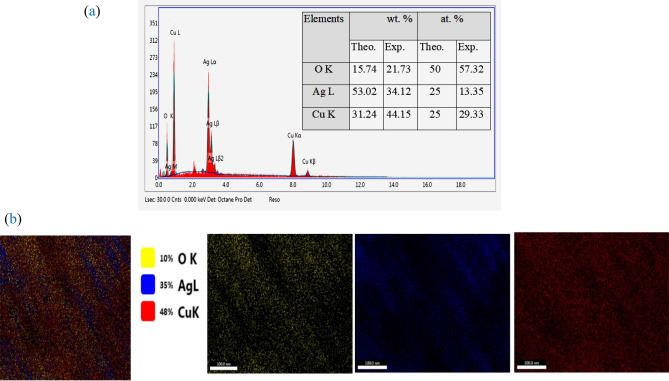
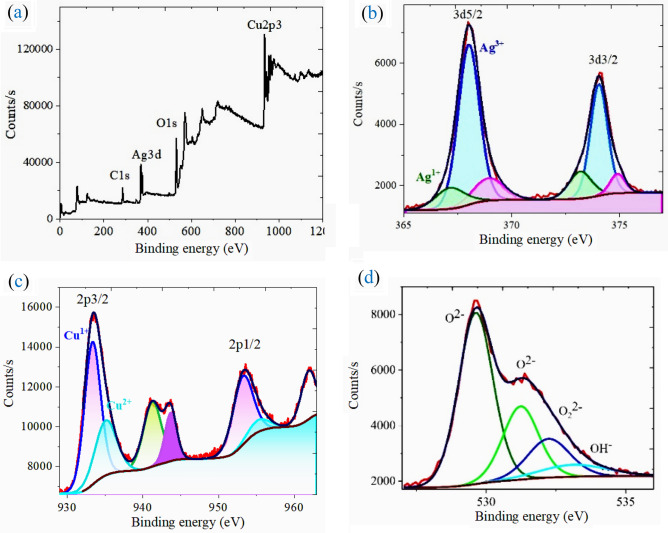
Bi-functional nano-oxides are of growing interest to address environmental issues. In the present study, the structural and magnetic data are presented together with the antimicrobial activities (AMA). For the first time, silver delafossite oxide (AgCuO) is successfully fabricated using a simple, low-cost technique to target antibiotic photodegradation and inactivation of model waterborne pathogens. It is prepared with an equimolar initial Ag:Cu concentration ratio. The structure, morphology, and magnetic properties are studied by different characterization techniques. The size and shape of AgCuO NPs, in addition to their structural polytypes of 2H (hexagonal) or 3R (rhombohedral), are dependent on the preparation conditions. The existence of Cu, Ag, and O in the synthesized delafossite AgCuO NPs with no evidence of any impurity is ratified by the XPS spectrum. AFM measurements are taken to characterize the surface morphologies of AgCuO. The distributed spiks are evaluated by roughness kurtosis (Rku). The roughness kurtosis has a value of 2.65 (< 3), indicating that the prepared sample is classified as bumpy. The prepared sample has 13.0, 10.0, 14.0, and 14.0 mm Inhibition Zone Diameter (IZD) antimicrobial activity against gram-positive Bacillus subtilis (B. subtilis), Bacillus cereus (B. cereus), Enterococcus faecalis (E. faecalis), and Staphylococcus aureus (S. aureus), respectively. The IZD for gram-negative Escherichia coli (E. coli), Neisseria Gonorrhoeae (N. Gonorrhoeae), Pseudomonas aeruginosa (P. aeruginosa), and Salmonella typhimrium (S. typhimrium) were found to be 12.0, 13.0, 14.0, and 13.0 mm, respectively. Therefore, the AgCuO NPs reveal excellent antimicrobial efficiency, and they can be effortlessly separated using a tiny magnet or a simple magnetic separator. The adequate cytotoxicity and magnetic characteristics of the antimicrobial sample suggest a promising future for it in biomedical applications.
双功能纳米氧化物在解决环境问题方面越来越受到关注。在本研究中,同时呈现了结构和磁性数据以及抗菌活性(AMA)。首次使用一种简单、低成本的技术成功制备了银铜酸氧化物(AgCuO),以实现抗生素的光降解和模型水生病原体的灭活。它是用等摩尔初始 Ag:Cu 浓度比制备的。通过不同的表征技术研究了结构、形态和磁性。AgCuO NPs 的尺寸和形状以及它们的结构多型 2H(六方)或 3R(三方)取决于制备条件。XPS 光谱证实了合成的 delafossite AgCuO NPs 中存在 Cu、Ag 和 O,没有任何杂质的证据。原子力显微镜(AFM)测量用于表征 AgCuO 的表面形貌。通过粗糙度峰度(Rku)评估分布的尖峰。粗糙度峰度的值为 2.65(<3),表明制备的样品被归类为凹凸不平。制备的样品对革兰氏阳性枯草芽孢杆菌(B. subtilis)、蜡样芽孢杆菌(B. cereus)、粪肠球菌(E. faecalis)和金黄色葡萄球菌(S. aureus)的抑菌圈直径(IZD)抗菌活性分别为 13.0、10.0、14.0 和 14.0 mm。革兰氏阴性大肠杆菌(E. coli)、淋病奈瑟菌(N. Gonorrhoeae)、铜绿假单胞菌(P. aeruginosa)和鼠伤寒沙门氏菌(S. typhimrium)的 IZD 分别为 12.0、13.0、14.0 和 13.0 mm。因此,AgCuO NPs 表现出优异的抗菌效率,并且可以使用小磁铁或简单的磁分离器轻松分离。抗菌样品具有足够的细胞毒性和磁性特征,这表明它在生物医学应用中有广阔的前景。