Department of Chemistry, College of Science, King Saud University, Riyadh 11451, Saudi Arabia.
Department of Chemistry, Faculty of Science, Alexandria University, Ibrahimia, Alexandria 21321, Egypt.
Int J Nanomedicine. 2020 Apr 3;15:2353-2362. doi: 10.2147/IJN.S244678. eCollection 2020.
Simple methodology for preparation of metal nanoparticles such as AgNPs uses an methanolic aqueous medium at room temperature or a solvent-free procedure under microwave irradiation. The prepared AgNPs showed a significant antimicrobial effect against Gram-positive bacteria, Gram-negative bacteria, and fungi.
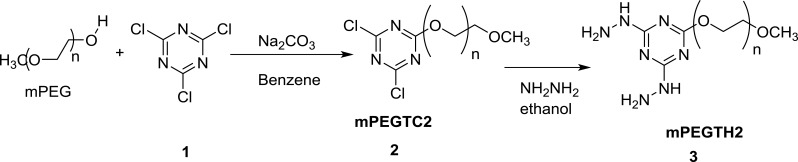
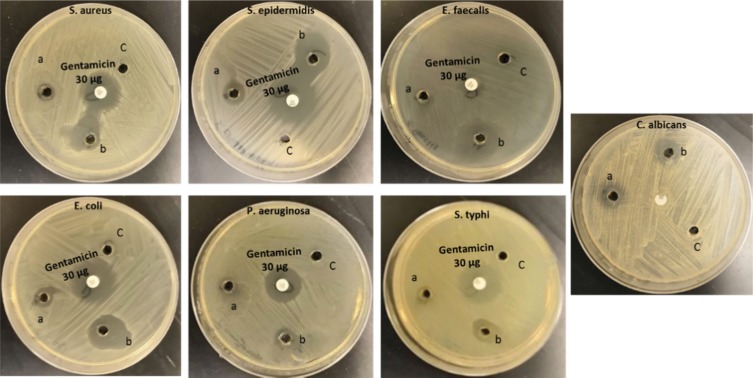
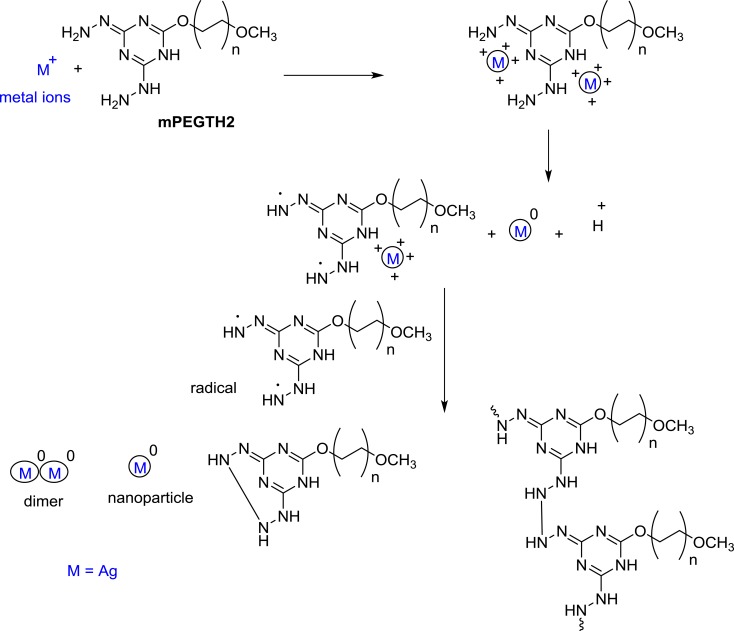
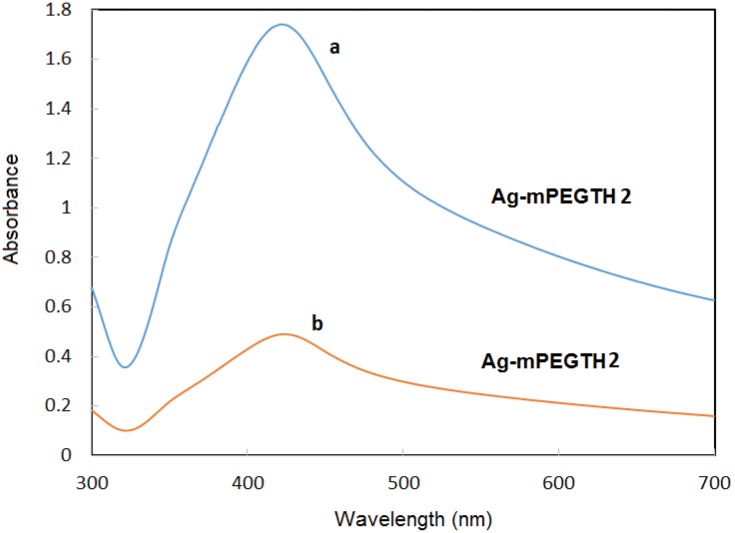
The modified methoxypolyethylene glycol bishydrazino-s-triazine (mPEGTH2) showed remarkable activity for reducing Ag to Ag in an aqueous methanolic solution and using a solvent-free method (solid phase) under microwave irradiation. In the solid phase synthesis, the size and shape of the AgNPs can be controlled by varying the weight ratio of mPEGTH2 to AgNO used. In addition, the antimicrobial activity depends on the ratio of mPEGTH2 to AgNO. The mPEGTH2-AgNPs (2:1) demonstrated higher antimicrobial activity compared to mPEGTH2-AgNPs (1:1) against Gram-positive bacteria, Gram-negative bacteria, and .
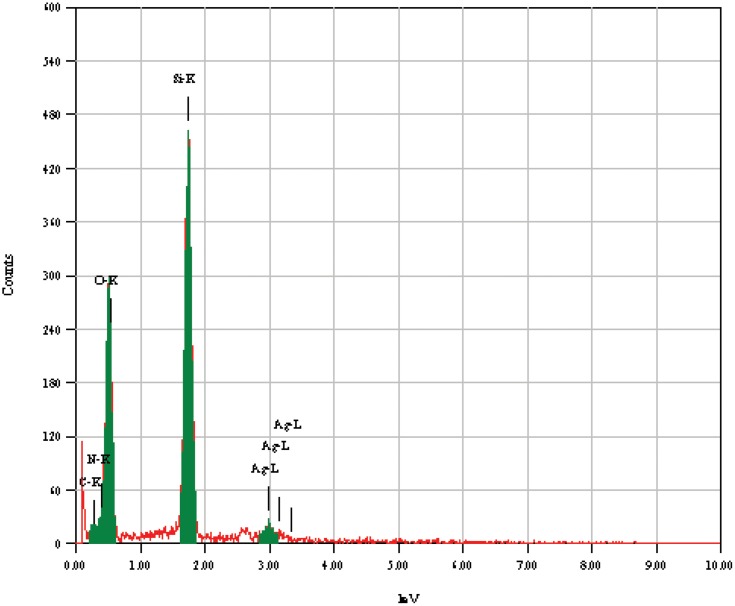
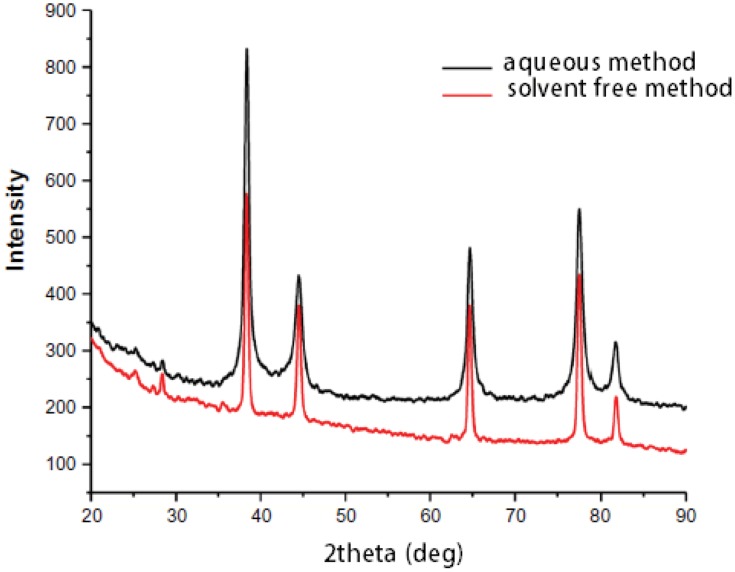
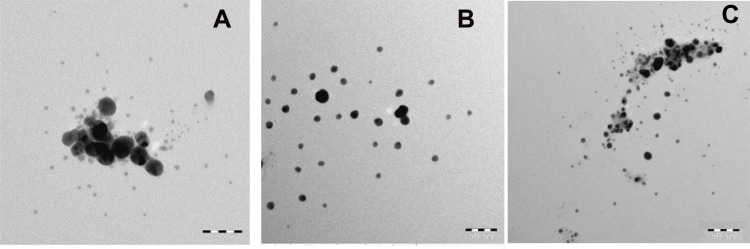
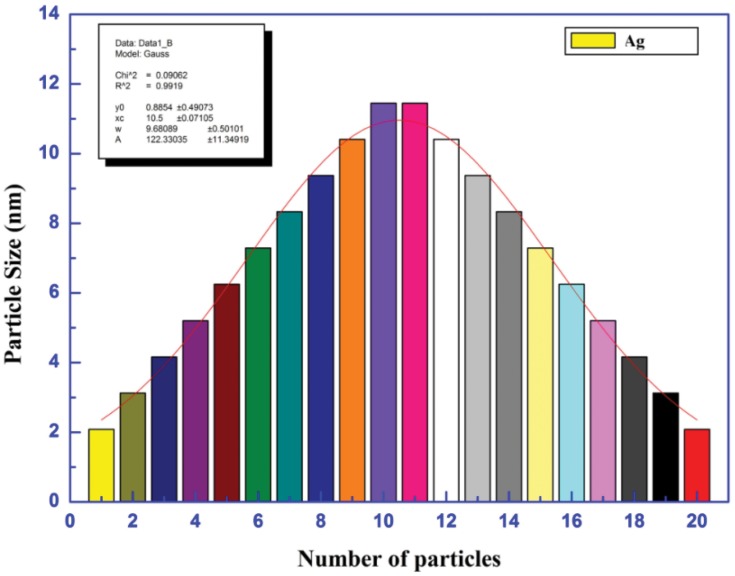
This work presents simple methods for the synthesis of AgNPs using modified methoxypolyethylene glycol with bishydrazino--triazine (mPEGTH2); a solution method, using methanol-water medium at room temperature, and a solvent-free (solid phase) method, employing microwave irradiation or direct heating which could be used for the preparation of AgNPs on large scale. In the solid phase, ratios of mPEGTH2 to AgNO (1:1 or 2:1, respectively) are very important to control the size and shape of AgNPs. While in solution phase is not necessary where the molar ratio used is 10:1. Most of the experimental methods resulted in AgNPs ranging in size from 7 to 10 nm as observed from XRD and TEM characterization. The antimicrobial activity of the AgNPs was also dependent on the weight ratio of mPEGTH2 to AgNO, with a large effect as observed when using the solvent-free method. The mPEGTH2-AgNPs (2:1) demonstrated higher antimicrobial activities compared to mPEGTH2-AgNPs (1:1) against , and . In all cases, the MICs and MBCs of mPEGTH2-AgNPs (1:1) were lower than those of mPEGTH2-AgNPs (2:1).
In summary, mPEGTH2-AgNPs (2:1) is a promising candidate to kill pathogenic microbes. In particular, the method used for the preparation of AgNPs by using polyethylene glycol polymer modified with bishydrazino--triazine has the most potential and would be the most cost-effective method. This method of the synthesis of nanoparticles may be suitable for the preparation of other metal nanoparticles, which would allow for numerous applications in medicinal and industrial.
使用甲醇水性介质在室温下或在微波辐射下无溶剂的方法来制备如 AgNPs 的金属纳米粒子的简单方法。所制备的 AgNPs 对革兰氏阳性菌、革兰氏阴性菌和真菌表现出显著的抗菌作用。
改性的甲氧基聚乙二醇双腙-s-三嗪(mPEGTH2)在甲醇水性溶液中以及在微波辐射下的无溶剂(固相)方法中显示出对 Ag 还原为 Ag 的显著活性。在固相合成中,可以通过改变 mPEGTH2 与 AgNO3 的重量比来控制 AgNPs 的尺寸和形状。此外,抗菌活性取决于 mPEGTH2 与 AgNO3 的比例。与 mPEGTH2-AgNPs(1:1)相比,mPEGTH2-AgNPs(2:1)对革兰氏阳性菌、革兰氏阴性菌和真菌表现出更高的抗菌活性。
本工作提出了使用改性的甲氧基聚乙二醇双腙-s-三嗪(mPEGTH2)合成 AgNPs 的简单方法;一种溶液方法,使用甲醇-水介质在室温下,和一种无溶剂(固相)方法,采用微波辐射或直接加热,可用于大规模制备 AgNPs。在固相中,mPEGTH2 与 AgNO3 的比例(分别为 1:1 或 2:1)对于控制 AgNPs 的尺寸和形状非常重要。而在溶液相中,由于使用的摩尔比为 10:1,因此并不需要。大多数实验方法得到的 AgNPs 尺寸在 7 到 10nm 之间,这可以通过 XRD 和 TEM 表征观察到。AgNPs 的抗菌活性也取决于 mPEGTH2 与 AgNO3 的重量比,当使用无溶剂方法时,观察到很大的影响。与 mPEGTH2-AgNPs(1:1)相比,mPEGTH2-AgNPs(2:1)对革兰氏阳性菌、革兰氏阴性菌和真菌表现出更高的抗菌活性。在所有情况下,mPEGTH2-AgNPs(1:1)的 MIC 和 MBC 均低于 mPEGTH2-AgNPs(2:1)。
总之,mPEGTH2-AgNPs(2:1)是一种有前途的杀死致病微生物的候选物。特别是,使用聚乙二醇聚合物改性的双腙-s-三嗪制备 AgNPs 的方法最有潜力,并且是最具成本效益的方法。这种纳米粒子的合成方法可能适用于其他金属纳米粒子的制备,这将允许在医学和工业领域有许多应用。