Peek Jette J, Max Samuel A, Bakhuis Wouter, Huig Isabelle C, Rosalia Rodney A, Sadeghi Amir H, Mahtab Edris A F
Department of Cardiothoracic Surgery, Erasmus MC, University Medical Center Rotterdam, 3015 GD Rotterdam, The Netherlands.
Medical Sciences Division, University of Oxford, Oxford OX1 2JD, UK.
J Cardiovasc Dev Dis. 2023 Feb 4;10(2):67. doi: 10.3390/jcdd10020067.
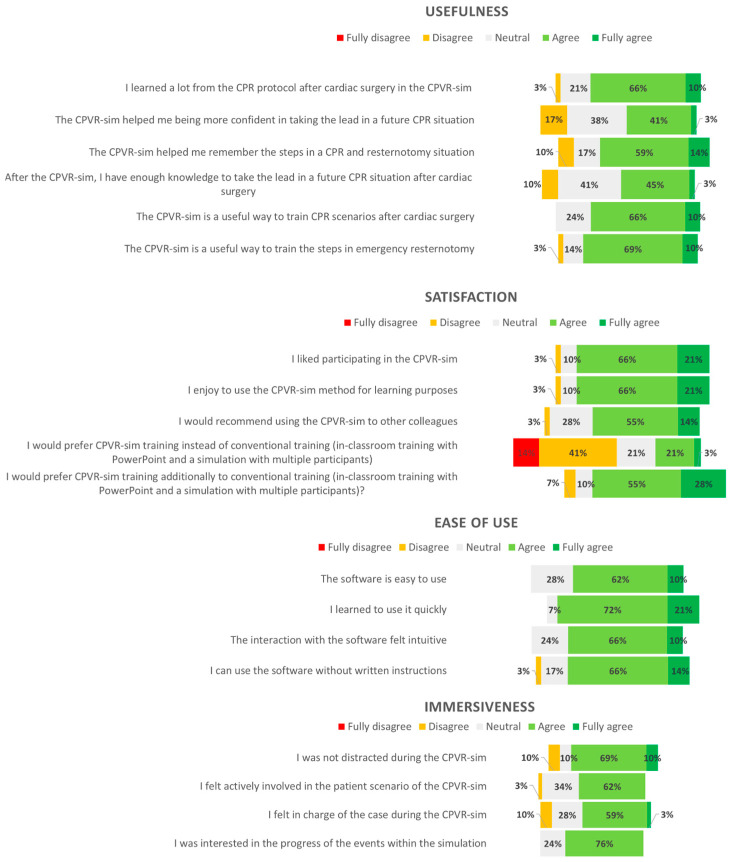
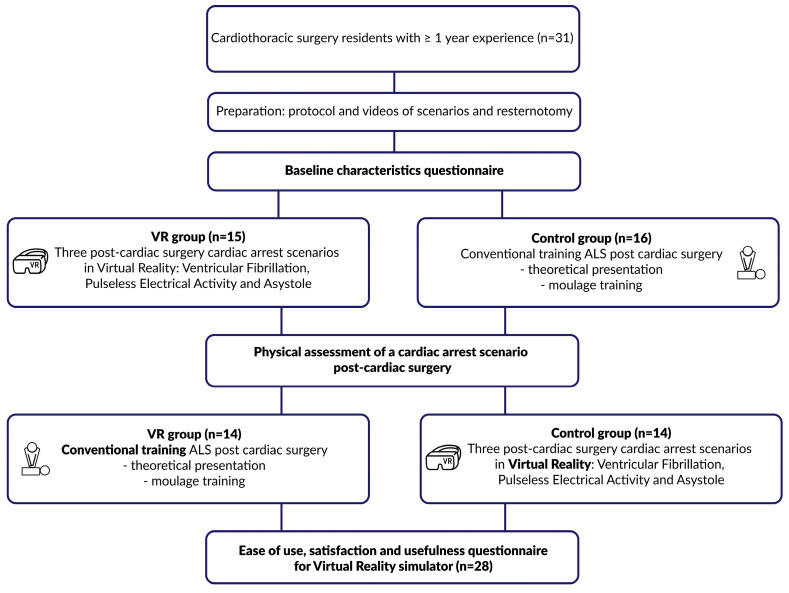
External chest compressions are often ineffective for patients arresting after cardiac surgery, for whom emergency resternotomy may be required. A single-blinded randomized controlled trial (RCT) was performed, with participants being randomized to a virtual reality (VR) Cardiac Surgical Unit Advanced Life Support (CSU-ALS) simulator training arm or a conventional classroom CSU-ALS training arm. Twenty-eight cardiothoracic surgery (CTS) residents were included and subsequently assessed in a moulage scenario in groups of two, either participating as a leader or surgeon. The primary binary outcomes were two time targets: (1) delivering three stacked shocks within 1 min and (2) resternotomy within 5 min. Secondary outcomes were the number of protocol mistakes made and a questionnaire after the VR simulator. The conventional training group administered stacked shocks within 1 min in 43% (n = 6) of cases, and none in the VR group reached this target, missing it by an average of 25 s. The resternotomy time target was reached in 100% of the cases (n = 14) in the conventional training group and in 83% of the cases (n = 10) in the VR group. The VR group made 11 mistakes in total versus 15 for those who underwent conventional training. Participants reported that the VR simulator was useful and easy to use. The results show that the VR simulator can provide adequate CSU-ALS training. Moreover, VR training results in fewer mistakes suggesting that repetitive practice in an immersive environment improves skills.
对于心脏手术后心脏骤停的患者,胸外按压往往无效,这类患者可能需要紧急开胸手术。我们进行了一项单盲随机对照试验(RCT),将参与者随机分为虚拟现实(VR)心脏外科重症监护病房高级生命支持(CSU-ALS)模拟器训练组或传统课堂CSU-ALS训练组。纳入了28名心胸外科(CTS)住院医师,随后两人一组在模拟场景中进行评估,他们分别作为领导者或外科医生参与。主要二元结局是两个时间目标:(1)在1分钟内进行三次叠加电击;(2)在5分钟内进行开胸手术。次要结局是所犯的操作流程错误数量以及VR模拟器训练后的一份问卷。传统训练组在43%(n = 6)的病例中在1分钟内进行了叠加电击,而VR组无人达到这一目标,平均比目标时间晚了25秒。传统训练组100%(n = 14)的病例达到了开胸手术时间目标,VR组为83%(n = 10)。VR组总共犯了11个错误,而接受传统训练的人犯了15个错误。参与者报告称VR模拟器有用且易于使用。结果表明,VR模拟器可以提供充分的CSU-ALS训练。此外,VR训练导致的错误更少,这表明在沉浸式环境中的重复练习可以提高技能。