• 文献检索
  • 文档翻译
  • 深度研究
  • 学术资讯
  • Suppr Zotero 插件Zotero 插件
  • 邀请有礼
  • 套餐&价格
  • 历史记录
应用&插件
Suppr Zotero 插件Zotero 插件浏览器插件Mac 客户端Windows 客户端微信小程序
定价
高级版会员购买积分包购买API积分包
服务
文献检索文档翻译深度研究API 文档MCP 服务
关于我们
关于 Suppr公司介绍联系我们用户协议隐私条款
关注我们

Suppr 超能文献

核心技术专利:CN118964589B侵权必究
粤ICP备2023148730 号-1Suppr @ 2026

文献检索

告别复杂PubMed语法,用中文像聊天一样搜索,搜遍4000万医学文献。AI智能推荐,让科研检索更轻松。

立即免费搜索

文件翻译

保留排版,准确专业,支持PDF/Word/PPT等文件格式,支持 12+语言互译。

免费翻译文档

深度研究

AI帮你快速写综述,25分钟生成高质量综述,智能提取关键信息,辅助科研写作。

立即免费体验

虚拟现实在心肺复苏术医护人员培训中的应用:系统综述。

Virtual Reality for Cardiopulmonary Resuscitation Healthcare Professionals Training: A Systematic Review.

机构信息

Master Degree in Nursing and Midwifery Science, University of Trieste and Udine, Trieste, Italy.

Azienda Sanitaria Universitaria G. Isontina, Trieste, Italy.

出版信息

J Med Syst. 2024 May 15;48(1):50. doi: 10.1007/s10916-024-02063-1.

DOI:10.1007/s10916-024-02063-1
PMID:38748244
原文链接:https://pmc.ncbi.nlm.nih.gov/articles/PMC11096216/
Abstract

INTRODUCTION

Virtual reality (VR) is becoming increasingly popular to train health-care professionals (HCPs) to acquire and/or maintain cardiopulmonary resuscitation (CPR) basic or advanced skills.

AIM

To understand whether VR in CPR training or retraining courses can have benefits for patients (neonatal, pediatric, and adult), HCPs and health-care organizations as compared to traditional CPR training.

METHODS

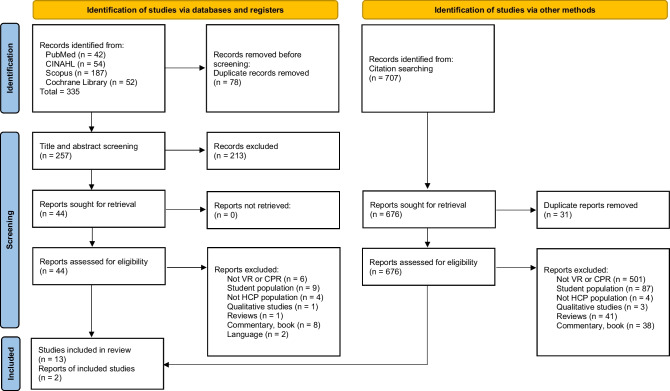
A systematic review (PROSPERO: CRD42023431768) following the Preferred Reporting Items for Systematic reviews and Meta-Analyses (PRISMA) guidelines. In June 2023, the PubMed, Cochrane Library, Scopus and Cumulative Index to Nursing and Allied Health Literature (CINAHL) databases were searched and included studies evaluated in their methodological quality with Joanna Briggs Institute checklists. Data were narratively summarized.

RESULTS

Fifteen studies published between 2013 and 2023 with overall fair quality were included. No studies investigated patients' outcomes. At the HCP level, the virtual learning environment was perceived to be engaging, realistic and facilitated the memorization of the procedures; however, limited decision-making, team building, psychological pressure and frenetic environment were underlined as disadvantages. Moreover, a general improvement in performance was reported in the use of the defibrillator and carrying out the chest compressions. At the organizational level, one study performed a cost/benefit evaluation in favor of VR as compared to traditional CPR training.

CONCLUSIONS

The use of VR for CPR training and retraining is in an early stage of development. Some benefits at the HCP level are promising. However, more research is needed with standardized approaches to ensure a progressive accumulation of the evidence and inform decisions regarding the best training methodology in this field.

摘要

简介

虚拟现实(VR)正越来越多地被用于培训医疗保健专业人员(HCP),以获得和/或维持心肺复苏(CPR)的基本或高级技能。

目的

与传统的 CPR 培训相比,了解 VR 在 CPR 培训或再培训课程中是否对患者(新生儿、儿科和成人)、HCP 和医疗保健组织有好处。

方法

遵循系统评价报告的首选报告项目和荟萃分析(PRISMA)指南进行系统评价(PROSPERO:CRD42023431768)。2023 年 6 月,检索了 PubMed、Cochrane 图书馆、Scopus 和 Cumulative Index to Nursing and Allied Health Literature(CINAHL)数据库,并使用 Joanna Briggs 研究所清单评估了纳入研究的方法学质量。数据以叙述性方式进行总结。

结果

共纳入 15 项 2013 年至 2023 年发表的研究,整体质量为中等。没有研究调查患者的结局。在 HCP 层面,虚拟学习环境被认为具有吸引力、现实性,并有助于记忆程序;然而,也强调了有限的决策制定、团队建设、心理压力和狂热的环境等缺点。此外,报告称在使用除颤器和进行胸外按压方面,性能普遍有所提高。在组织层面,一项研究对 VR 与传统 CPR 培训进行了成本效益评估,结果有利于 VR。

结论

VR 用于 CPR 培训和再培训仍处于早期发展阶段。在 HCP 层面上的一些好处是有希望的。然而,需要更多具有标准化方法的研究,以确保证据的逐步积累,并为该领域的最佳培训方法提供决策依据。
https://cdn.ncbi.nlm.nih.gov/pmc/blobs/748b/11096216/8d1111e02b8a/10916_2024_2063_Fig1_HTML.jpg

相似文献

1
Virtual Reality for Cardiopulmonary Resuscitation Healthcare Professionals Training: A Systematic Review.虚拟现实在心肺复苏术医护人员培训中的应用:系统综述。
J Med Syst. 2024 May 15;48(1):50. doi: 10.1007/s10916-024-02063-1.
2
Health professionals' experience of teamwork education in acute hospital settings: a systematic review of qualitative literature.医疗专业人员在急症医院环境中团队合作教育的经验:对定性文献的系统综述
JBI Database System Rev Implement Rep. 2016 Apr;14(4):96-137. doi: 10.11124/JBISRIR-2016-1843.
3
Efficiency of virtual reality for cardiopulmonary resuscitation training of adult laypersons: A systematic review.虚拟现实在成人非专业人士心肺复苏培训中的效率:系统评价。
Medicine (Baltimore). 2023 Jan 27;102(4):e32736. doi: 10.1097/MD.0000000000032736.
4
Continuous chest compression versus interrupted chest compression for cardiopulmonary resuscitation of non-asphyxial out-of-hospital cardiac arrest.持续胸外按压与间断胸外按压用于非窒息性院外心脏骤停心肺复苏的比较
Cochrane Database Syst Rev. 2017 Mar 27;3(3):CD010134. doi: 10.1002/14651858.CD010134.pub2.
5
Communication skills training for healthcare professionals working with people who have cancer.为与癌症患者打交道的医护人员提供沟通技巧培训。
Cochrane Database Syst Rev. 2013 Mar 28;2013(3):CD003751. doi: 10.1002/14651858.CD003751.pub3.
6
Communication skills training for healthcare professionals working with people who have cancer.针对与癌症患者打交道的医疗保健专业人员的沟通技能培训。
Cochrane Database Syst Rev. 2018 Jul 24;7(7):CD003751. doi: 10.1002/14651858.CD003751.pub4.
7
The effectiveness of using non-traditional teaching methods to prepare student health care professionals for the delivery of mental state examination: a systematic review.使用非传统教学方法培养学生医护专业人员进行精神状态检查的有效性:一项系统综述。
JBI Database System Rev Implement Rep. 2015 Aug 14;13(7):177-212. doi: 10.11124/jbisrir-2015-2263.
8
Sexual Harassment and Prevention Training性骚扰与预防培训
9
Virtual reality simulation training for health professions trainees in gastrointestinal endoscopy.面向胃肠内镜检查领域卫生专业学员的虚拟现实模拟训练
Cochrane Database Syst Rev. 2012 Jun 13(6):CD008237. doi: 10.1002/14651858.CD008237.pub2.
10
The effect of waterbirth on neonatal mortality and morbidity: a systematic review and meta-analysis.水中分娩对新生儿死亡率和发病率的影响:一项系统评价与荟萃分析。
JBI Database System Rev Implement Rep. 2015 Oct;13(10):180-231. doi: 10.11124/jbisrir-2015-2105.

引用本文的文献

1
Experiences, challenges, and best practices of dispatcher-assisted cardiopulmonary resuscitation: a scoping review.调度员辅助心肺复苏的经验、挑战及最佳实践:一项范围综述
Intern Emerg Med. 2025 Aug 11. doi: 10.1007/s11739-025-03991-7.
2
Deconstructing resuscitation training for healthcare providers: a protocol for a component network meta-analysis.解构医疗服务提供者的复苏培训:一项成分网络荟萃分析方案
BMJ Open. 2025 Jul 25;15(7):e094869. doi: 10.1136/bmjopen-2024-094869.
3
The combined impact of AI and VR on interdisciplinary learning and patient safety in healthcare education: a narrative review.

本文引用的文献

1
Virtual Reality, Augmented Reality, Augmented Virtuality, or Mixed Reality in cardiopulmonary resuscitation: Which Extended Reality am I using for teaching adult basic life support?虚拟现实、增强现实、增强虚拟或混合现实在心肺复苏中的应用:我正在使用哪种扩展现实技术来教授成人基础生命支持?
Resuscitation. 2023 Nov;192:109973. doi: 10.1016/j.resuscitation.2023.109973. Epub 2023 Sep 18.
2
Virtual and augmented reality in intensive care medicine: a systematic review.重症监护医学中的虚拟现实和增强现实:一项系统综述。
Ann Intensive Care. 2023 Sep 11;13(1):81. doi: 10.1186/s13613-023-01176-z.
3
Using 360-degree immersive videos to assess multiple transdiagnostic symptoms: A study focusing on fear of negative evaluation, paranoid thoughts, negative automatic thoughts, and craving.
人工智能与虚拟现实对医疗教育中跨学科学习和患者安全的综合影响:一项叙述性综述。
BMC Med Educ. 2025 Jul 11;25(1):1039. doi: 10.1186/s12909-025-07589-7.
4
Transforming Healthcare: A Comprehensive Review of Augmented and Virtual Reality Interventions.变革医疗保健:增强现实和虚拟现实干预的全面综述
Sensors (Basel). 2025 Jun 15;25(12):3748. doi: 10.3390/s25123748.
5
Extended reality technologies in adult basic life support education: A scoping review.成人基础生命支持教育中的扩展现实技术:一项范围综述。
Resusc Plus. 2025 Mar 14;23:100927. doi: 10.1016/j.resplu.2025.100927. eCollection 2025 May.
6
Elucidating cognitive processes in cardiac arrest team leaders: a virtual reality-based cued-recall study of experts and novices.阐明心脏骤停团队领导者的认知过程:一项基于虚拟现实的专家和新手线索回忆研究。
Ann Med. 2025 Dec;57(1):2470976. doi: 10.1080/07853890.2025.2470976. Epub 2025 Mar 3.
7
Shaping tomorrow: how the STEP training course pioneered noninvasive brain stimulation training for psychiatry in France.塑造未来:STEP培训课程如何在法国开创了精神科无创脑刺激培训的先河。
Front Psychiatry. 2024 Nov 25;15:1450351. doi: 10.3389/fpsyt.2024.1450351. eCollection 2024.
8
Metaverse-based simulation: a scoping review of charting medical education over the last two decades in the lens of the 'marvelous medical education machine'.基于元宇宙的模拟:二十年来医学教育的范围综述,从“奇妙的医学教育机器”的角度来看。
Ann Med. 2024 Dec;56(1):2424450. doi: 10.1080/07853890.2024.2424450. Epub 2024 Nov 13.
使用360度沉浸式视频评估多种跨诊断症状:一项聚焦于对负面评价的恐惧、偏执想法、消极自动思维和渴望的研究。
Virtual Real. 2023 Mar 9:1-16. doi: 10.1007/s10055-023-00779-y.
4
Virtual Reality Simulator versus Conventional Advanced Life Support Training for Cardiopulmonary Resuscitation Post-Cardiac Surgery: A Randomized Controlled Trial.虚拟现实模拟器与传统高级生命支持培训用于心脏手术后心肺复苏的比较:一项随机对照试验
J Cardiovasc Dev Dis. 2023 Feb 4;10(2):67. doi: 10.3390/jcdd10020067.
5
The revised JBI critical appraisal tool for the assessment of risk of bias for randomized controlled trials.JBI 偏倚风险评估工具修订版用于评估随机对照试验的偏倚风险。
JBI Evid Synth. 2023 Mar 1;21(3):494-506. doi: 10.11124/JBIES-22-00430.
6
Efficiency of virtual reality for cardiopulmonary resuscitation training of adult laypersons: A systematic review.虚拟现实在成人非专业人士心肺复苏培训中的效率:系统评价。
Medicine (Baltimore). 2023 Jan 27;102(4):e32736. doi: 10.1097/MD.0000000000032736.
7
Implementation of Virtual Reality in Health Professions Education: Scoping Review.虚拟现实在卫生专业教育中的应用:范围综述
JMIR Med Educ. 2023 Jan 24;9:e41589. doi: 10.2196/41589.
8
Using Mobile Virtual Reality Simulation to Prepare for In-Person Helping Babies Breathe Training: Secondary Analysis of a Randomized Controlled Trial (the eHBB/mHBS Trial).使用移动虚拟现实模拟为面对面的帮助婴儿呼吸培训做准备:一项随机对照试验(eHBB/mHBS试验)的二次分析。
JMIR Med Educ. 2022 Sep 12;8(3):e37297. doi: 10.2196/37297.
9
Development of an Extended Reality Simulator for Basic Life Support Training.开发用于基本生命支持培训的扩展现实模拟器。
IEEE J Transl Eng Health Med. 2022 Feb 16;10:4900507. doi: 10.1109/JTEHM.2022.3152365. eCollection 2022.
10
A New Immersive Virtual Reality Station for Cardiopulmonary Resuscitation Objective Structured Clinical Exam Evaluation.用于心肺复苏客观结构化临床考试评估的新型沉浸式虚拟现实站。
Sensors (Basel). 2022 Jun 29;22(13):4913. doi: 10.3390/s22134913.