Efremenko Elena, Stepanov Nikolay, Aslanli Aysel, Lyagin Ilya, Senko Olga, Maslova Olga
Faculty of Chemistry, Lomonosov Moscow State University, Lenin Hills 1/3, 119991 Moscow, Russia.
N.M. Emanuel Institute of Biochemical Physics RAS, Kosygin str. 4, 119334 Moscow, Russia.
J Funct Biomater. 2023 Jan 25;14(2):64. doi: 10.3390/jfb14020064.
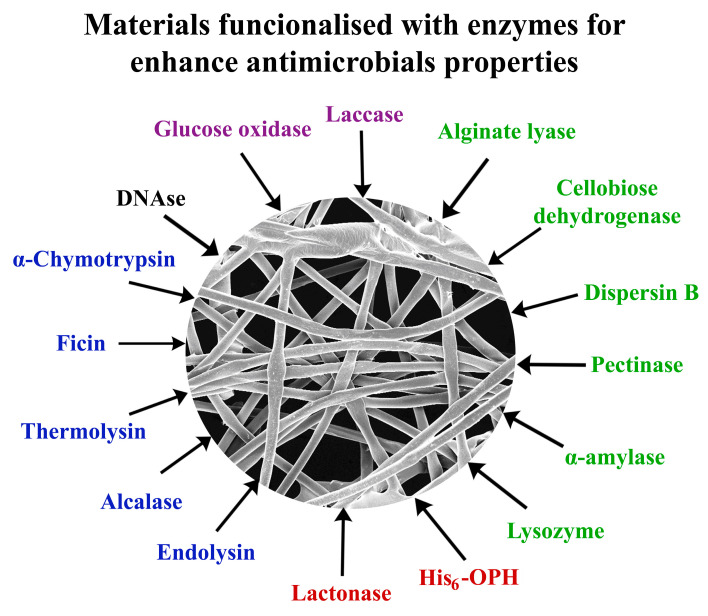
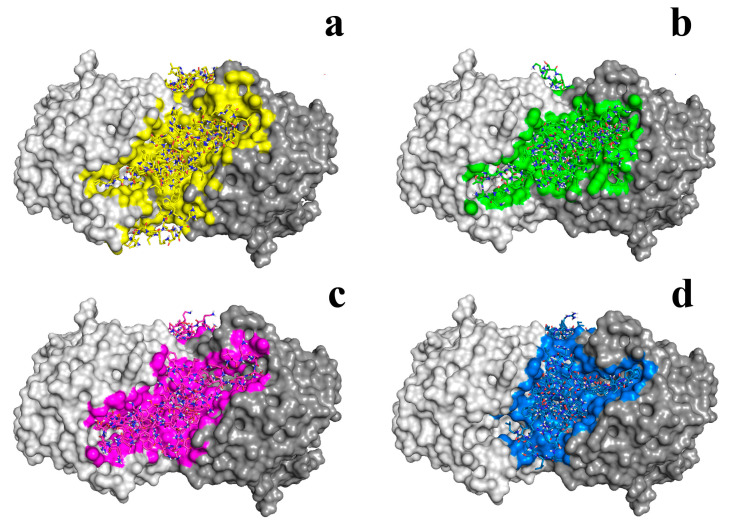
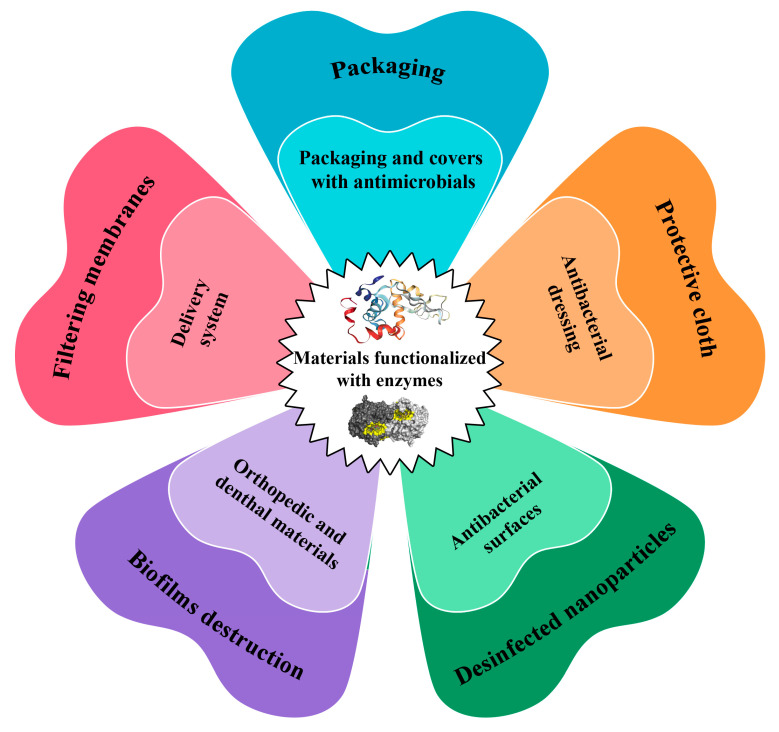
Multidrug-resistant bacteria form serious problems in many areas, including medicine and the food industry. At the same time, great interest is shown in the transfer or enhancement of antimicrobial properties to various materials by modifying them with enzymes. The use of enzymes in biomaterials with antimicrobial properties is important because enzymes can be used as the main active components providing antimicrobial properties of functionalized composite biomaterials, or can serve as enhancers of the antimicrobial action of certain substances (antibiotics, antimicrobial peptides, metal nanoparticles, etc.) against cells of various microorganisms. Enzymes can simultaneously widen the spectrum of antimicrobial activity of biomaterials. This review presents the most promising enzymes recently used for the production of antibacterial materials, namely hydrolases and oxidoreductases. Computer modeling plays an important role in finding the most effective combinations between enzymes and antimicrobial compounds, revealing their possible interactions. The range of materials that can be functionalized using enzymes looks diverse. The physicochemical characteristics and functionalization methods of the materials have a significant impact on the activity of enzymes. In this context, fibrous materials are of particular interest. The purpose of this review is to analyze the current state of the art in this area.
多重耐药菌在包括医学和食品工业在内的许多领域都构成了严重问题。与此同时,人们对通过用酶对各种材料进行改性来赋予其抗菌性能的转移或增强表现出了浓厚兴趣。在具有抗菌性能的生物材料中使用酶很重要,因为酶既可以用作提供功能化复合生物材料抗菌性能的主要活性成分,也可以作为某些物质(抗生素、抗菌肽、金属纳米颗粒等)对各种微生物细胞抗菌作用的增强剂。酶可以同时拓宽生物材料的抗菌活性谱。本综述介绍了最近用于生产抗菌材料的最有前景的酶,即水解酶和氧化还原酶。计算机建模在寻找酶与抗菌化合物之间最有效的组合、揭示它们可能的相互作用方面发挥着重要作用。可以使用酶进行功能化的材料范围看起来多种多样。材料的物理化学特性和功能化方法对酶的活性有重大影响。在这种情况下,纤维材料特别受关注。本综述的目的是分析该领域的当前技术水平。