Barry Timothy, Farina Juan Maria, Chao Chieh-Ju, Ayoub Chadi, Jeong Jiwoong, Patel Bhavik N, Banerjee Imon, Arsanjani Reza
Department of Cardiovascular Diseases, Mayo Clinic Arizona, Scottsdale, AZ 85054, USA.
Department of Cardiovascular Diseases, Mayo Clinic Rochester, Rochester, MN 55902, USA.
J Imaging. 2023 Feb 20;9(2):50. doi: 10.3390/jimaging9020050.
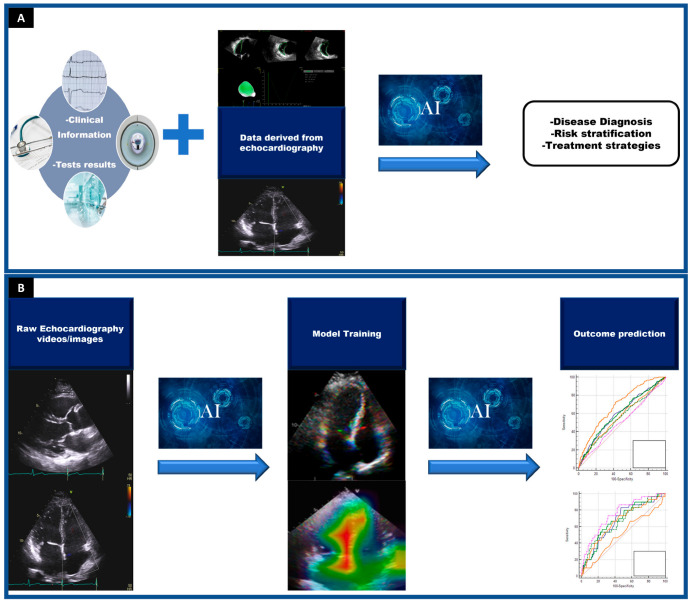
Echocardiography is an integral part of the diagnosis and management of cardiovascular disease. The use and application of artificial intelligence (AI) is a rapidly expanding field in medicine to improve consistency and reduce interobserver variability. AI can be successfully applied to echocardiography in addressing variance during image acquisition and interpretation. Furthermore, AI and machine learning can aid in the diagnosis and management of cardiovascular disease. In the realm of echocardiography, accurate interpretation is largely dependent on the subjective knowledge of the operator. Echocardiography is burdened by the high dependence on the level of experience of the operator, to a greater extent than other imaging modalities like computed tomography, nuclear imaging, and magnetic resonance imaging. AI technologies offer new opportunities for echocardiography to produce accurate, automated, and more consistent interpretations. This review discusses machine learning as a subfield within AI in relation to image interpretation and how machine learning can improve the diagnostic performance of echocardiography. This review also explores the published literature outlining the value of AI and its potential to improve patient care.
超声心动图是心血管疾病诊断和管理不可或缺的一部分。人工智能(AI)的应用是医学领域中一个迅速发展的领域,旨在提高一致性并减少观察者间的变异性。AI可以成功应用于超声心动图,以解决图像采集和解读过程中的差异。此外,AI和机器学习有助于心血管疾病的诊断和管理。在超声心动图领域,准确的解读很大程度上依赖于操作者的主观知识。与计算机断层扫描、核成像和磁共振成像等其他成像方式相比,超声心动图在更大程度上受到对操作者经验水平高度依赖的困扰。AI技术为超声心动图提供了新的机会,以产生准确、自动化且更一致的解读。本综述讨论了机器学习作为AI中的一个子领域与图像解读的关系,以及机器学习如何提高超声心动图的诊断性能。本综述还探讨了已发表的文献,概述了AI的价值及其改善患者护理的潜力。