Department of Cardiovascular Medicine, Tokushima University Hospital, 2-50-1 Kuramoto, Tokushima, Japan.
J Echocardiogr. 2021 Mar;19(1):21-27. doi: 10.1007/s12574-020-00496-4. Epub 2020 Oct 12.
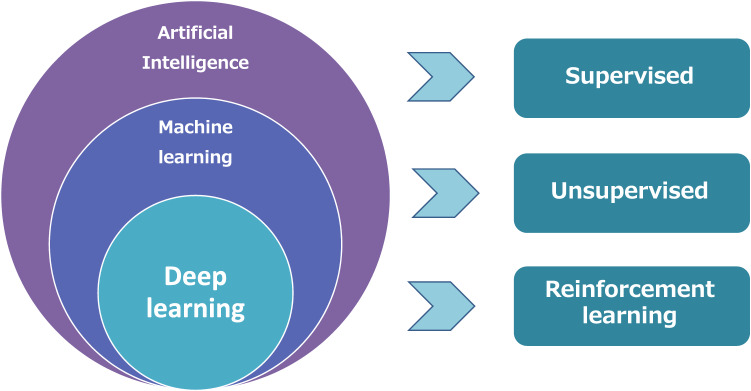
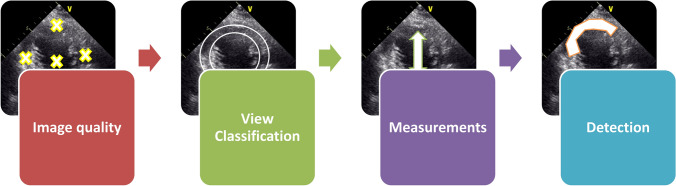
Artificial intelligence (AI) has influenced every field of cardiovascular imaging in all phases from acquisition to reporting. Compared with computed tomography and magnetic resonance imaging, there is an issue of high observer variation in the interpretation of echocardiograms. Therefore, AI can help minimize the observer variation and provide accurate diagnosis in the field of echocardiography. In this review, we summarize the necessity for automated diagnosis in the echocardiographic field, and discuss the results of AI application to echocardiography and future perspectives. Currently, there are two roles for AI in cardiovascular imaging. One is the automation of tasks performed by humans, such as image segmentation, measurement of cardiac structural and functional parameters. The other is the discovery of clinically important insights. Most reported applications were focused on the automation of tasks. Moreover, algorithms that can obtain cardiac measurements are also being reported. In the next stage, AI can be expected to expand and enrich existing knowledge. With the continual evolution of technology, cardiologists should become well versed in this new knowledge of AI and be able to harness it as a tool. AI can be incorporated into everyday clinical practice and become a valuable aid for many healthcare professionals dealing with cardiovascular diseases.
人工智能(AI)已经影响到心血管成像的各个领域,从采集到报告的各个阶段。与计算机断层扫描和磁共振成像相比,超声心动图的解释存在观察者变异较大的问题。因此,人工智能可以帮助最大限度地减少观察者的变异,并在超声心动图领域提供准确的诊断。在这篇综述中,我们总结了在超声心动图领域实现自动化诊断的必要性,并讨论了 AI 在超声心动图中的应用结果和未来展望。目前,人工智能在心血管成像中有两个作用。一个是自动化人类执行的任务,例如图像分割、心脏结构和功能参数的测量。另一个是发现具有临床重要意义的见解。大多数报道的应用都集中在任务的自动化上。此外,还报告了可以获取心脏测量值的算法。在下一阶段,人工智能可以扩展和丰富现有的知识。随着技术的不断发展,心脏病专家应该精通这一新的人工智能知识,并能够将其作为一种工具加以利用。人工智能可以融入日常临床实践,成为许多处理心血管疾病的医疗保健专业人员的宝贵辅助工具。