
新型百里香酚@天然沸石/低密度聚乙烯活性包装薄膜的研制与评价:在猪里脊肉保鲜中的应用
Development and Evaluation of a Novel-Thymol@Natural-Zeolite/Low-Density-Polyethylene Active Packaging Film: Applications for Pork Fillets Preservation.
作者信息
Salmas Constantinos E, Giannakas Aris E, Karabagias Vassilios K, Moschovas Dimitrios, Karabagias Ioannis K, Gioti Christina, Georgopoulos Stavros, Leontiou Areti, Kehayias George, Avgeropoulos Apostolos, Proestos Charalampos
机构信息
Department of Material Science and Engineering, University of Ioannina, 45110 Ioannina, Greece.
Department of Food Science and Technology, University of Patras, 30100 Agrinio, Greece.
出版信息
Antioxidants (Basel). 2023 Feb 19;12(2):523. doi: 10.3390/antiox12020523.
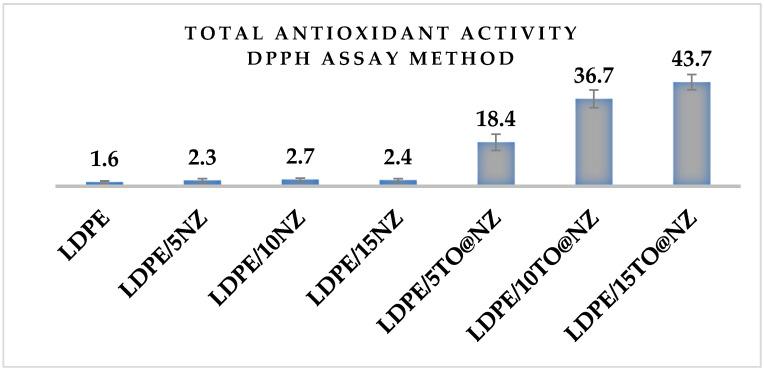
Sustainability, the circular economy, and the "greenhouse" effect have led the food packaging industry to use naturally available bio-compounds. The integration of such compounds in packaging films increases food safety and extends food shelf-life. The development of an active/antioxidant packaging film based on the widely commercially used low-density polyethylene, natural zeolite, and Thymol, a natural extract from thyme oil, is presented in this work. The obtained active films were characterized using X-Ray Diffraction, Fourier-Transform Infrared Spectroscopy, Scanning Electron Microscopy, and Differential Scanning Calorimetry techniques. The tensile strength, water-oxygen barrier properties, and total antioxidant activity were measured. Low-density polyethylene incorporated with Thymol@Natural Zeolite at a proportion of 15 wt% was the most promising material and was used as film to wrap-up pork fillets. The thiobarbituric acid (TBA) method and heme iron measurements indicated a delayed lipids oxidation using this film. A linear correlation between the TBA method and heme iron values seems to be established, which could result in a fast method to determine the degree of lipid oxidation in pork fillets. Finally, a two-stage diffusion process during Thymol release was observed, and the values of the diffusion coefficient was 2.09 × 10 and 1.21 × 10 cm/s for each stage. The applied pseudo-second sorption model provided a rate constant k = 0.01647 (s). These results indicate the strong potential of such films to be used as food packaging materials free of E-number preservatives.
可持续性、循环经济和“温室”效应促使食品包装行业使用天然可得的生物化合物。将此类化合物整合到包装薄膜中可提高食品安全并延长食品保质期。本文介绍了一种基于广泛商业使用的低密度聚乙烯、天然沸石和百里香油天然提取物百里香酚开发的活性/抗氧化包装薄膜。使用X射线衍射、傅里叶变换红外光谱、扫描电子显微镜和差示扫描量热法技术对所得活性薄膜进行了表征。测量了拉伸强度、水氧阻隔性能和总抗氧化活性。以15 wt%的比例掺入百里香酚@天然沸石的低密度聚乙烯是最有前景的材料,并用作包裹猪里脊肉的薄膜。硫代巴比妥酸(TBA)法和血红素铁测量表明使用该薄膜可延缓脂质氧化。TBA法和血红素铁值之间似乎建立了线性相关性,这可能会产生一种快速测定猪里脊肉脂质氧化程度的方法。最后,观察到百里香酚释放过程中的两阶段扩散过程,每个阶段的扩散系数值分别为2.09×10和1.21×10 cm/s。应用的伪二级吸附模型提供了速率常数k = 0.01647(s)。这些结果表明此类薄膜作为不含E编码防腐剂的食品包装材料具有巨大潜力。



 Zotero 插件