Listyarini Kasita, Sumantri Cece, Rahayu Sri, Islam Md Aminul, Akter Syeda Hasina, Uddin Muhammad Jasim, Gunawan Asep
Graduate School of Animal Production and Technology, Faculty of Animal Science, IPB University, Bogor 16680, Indonesia.
Department of Animal Production and Technology, Faculty of Animal Science, IPB University, Bogor 16680, Indonesia.
Animals (Basel). 2023 Feb 15;13(4):674. doi: 10.3390/ani13040674.
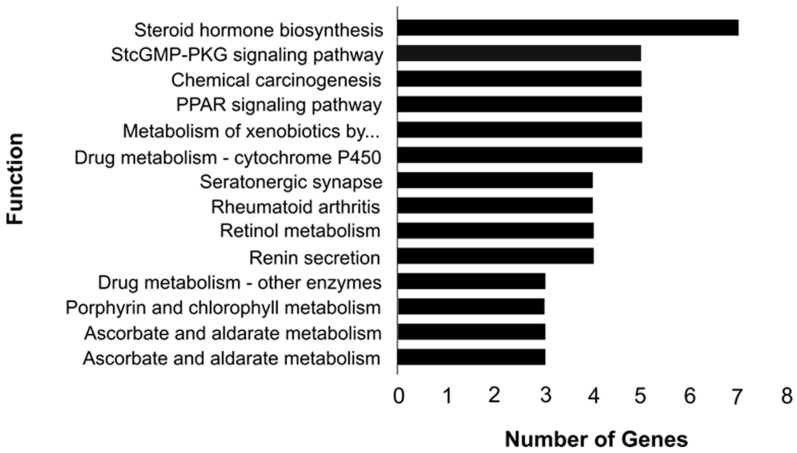
Tenderness is a key meat quality trait that determines the public acceptance of lamb consumption, so genetic improvement toward lamb with higher tenderness is pivotal for a sustainable sheep industry. However, unravelling the genomics controlling the tenderness is the first step. Therefore, this study aimed to identify the transcriptome signatures and polymorphisms related to divergent lamb tenderness using RNA deep sequencing. Since the molecules and enzymes that control muscle growth and tenderness are metabolized and synthesized in the liver, hepatic tissues of ten sheep with divergent phenotypes: five high- and five low-lamb tenderness samples were applied for deep sequencing. Sequence analysis identified the number of reads ranged from 21.37 to 25.37 million bases with a mean value of 22.90 million bases. In total, 328 genes are detected as differentially expressed (DEGs) including 110 and 218 genes that were up- and down-regulated, respectively. Pathway analysis showed steroid hormone biosynthesis as the dominant pathway behind the lamb tenderness. Gene expression analysis identified the top high (such as , , , , and ) and low (such as , , , , and ) expressed candidate genes. Polymorphism and association analysis revealed that mutation in , , and genes could be potential candidate markers for tenderness in sheep. The genes and pathways identified in this study cause variation in tenderness, thus could be potential genetic markers to improve meat quality in sheep. However, further validation is needed to confirm the effect of these markers in different sheep populations so that these could be used in a selection program for lamb with high tenderness.
嫩度是决定羊肉消费公众接受度的关键肉质性状,因此,培育嫩度更高的羔羊对于绵羊产业的可持续发展至关重要。然而,解析控制嫩度的基因组学是第一步。因此,本研究旨在通过RNA深度测序鉴定与羔羊嫩度差异相关的转录组特征和多态性。由于控制肌肉生长和嫩度的分子和酶在肝脏中代谢和合成,因此选取了10只具有不同表型的绵羊的肝脏组织进行深度测序,其中包括5个高嫩度和5个低嫩度的羔羊样本。序列分析确定读取的碱基数在2137万至2537万之间,平均值为2290万碱基。总共检测到328个差异表达基因(DEGs),其中分别有110个和218个基因上调和下调。通路分析表明类固醇激素生物合成是羔羊嫩度背后的主要通路。基因表达分析确定了高表达(如 、 、 、 、 和 )和低表达(如 、 、 、 、 和 )的候选基因。多态性和关联分析表明, 、 和 基因中的突变可能是绵羊嫩度的潜在候选标记。本研究中鉴定的基因和通路导致嫩度差异,因此可能是改善绵羊肉质的潜在遗传标记。然而,需要进一步验证以确认这些标记在不同绵羊群体中的作用,以便将其用于高嫩度羔羊的选择计划。