Imran Mohd, Alshammari Mohammed Kanan, Arora Mandeep Kumar, Dubey Amit Kumar, Das Sabya Sachi, Kamal Mehnaz, Alqahtani Abdulaziz Saad Abdulrahman, Sahloly Mohammed Ahmed Yahya, Alshammari Ahmed Hammad, Alhomam Hessah Mohammed, Mahzari Aeshah Mousa, Rabaan Ali A, Dzinamarira Tafadzwa
Department of Pharmaceutical Chemistry, Faculty of Pharmacy, Northern Border University, Rafha 91911, Saudi Arabia.
Department of Clinical Pharmacy, King Fahad Medical City, Riyadh 12211, Saudi Arabia.
Biomedicines. 2023 Jan 19;11(2):278. doi: 10.3390/biomedicines11020278.
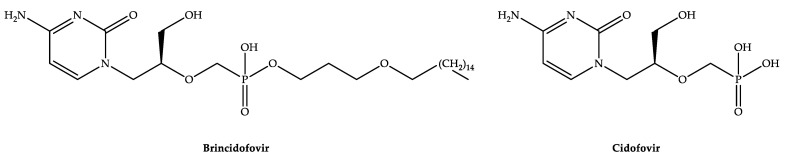
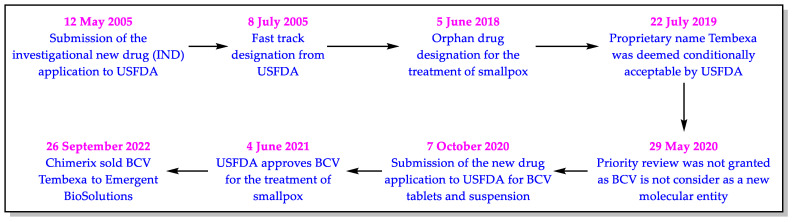
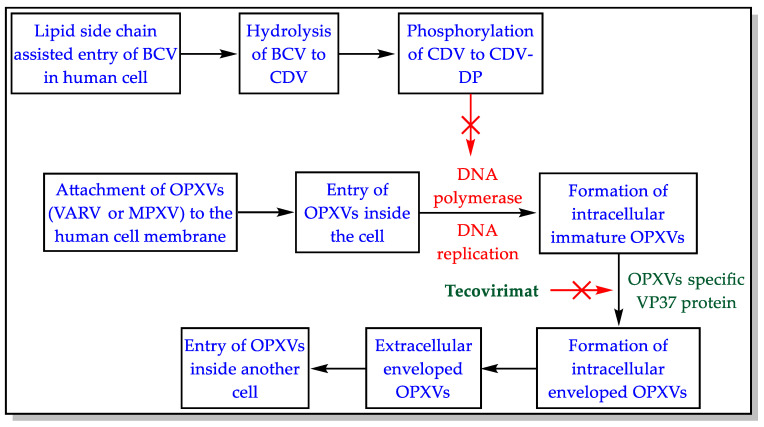
The monkeypox disease (MPX) outbreak of 2022 has been reported in more than one hundred countries and is becoming a global concern. Unfortunately, only a few treatments, such as tecovirimat (TCV), are available against MPX. Brincidofovir (BCV) is a United States Food and Drug Administration (USFDA)-approved antiviral against smallpox. This article reviews the potential of BCV for treating MPX and other Orthopoxvirus (OPXVs) diseases. The literature for this review was collected from PubMed, authentic websites (USFDA, Chimerix), and freely available patent databases (USPTO, Espacenet, and Patentscope). BCV (a lipophilic derivative of cidofovir) has been discovered and developed by Chimerix Incorporation, USA. Besides smallpox, BCV has also been tested clinically for various viral infections (adenovirus, cytomegalovirus, ebola virus, herpes simplex virus, and double-stranded DNA virus). Many health agencies and reports have recommended using BCV for MPX. However, no health agency has yet approved BCV for MPX. Accordingly, the off-label use of BCV is anticipated for MPX and various viral diseases. The patent literature revealed some important antiviral compositions of BCV. The authors believe there is a huge opportunity to create novel, inventive, and patentable BCV-based antiviral therapies (new combinations with existing antivirals) for OPXVs illnesses (MPX, smallpox, cowpox, camelpox, and vaccinia). It is also advised to conduct drug interaction (food, drug, and disease interaction) and drug resistance investigations on BCV while developing its combinations with other medications. The BCV-based drug repurposing options are also open for further exploration. BCV offers a promising opportunity for biosecurity against OPXV-based bioterrorism attacks and to control the MPX outbreak of 2022.
2022年猴痘病(MPX)疫情已在一百多个国家报告,正成为全球关注的问题。不幸的是,针对MPX的治疗方法很少,例如tecovirimat(TCV)。布林西多福韦(BCV)是一种经美国食品药品监督管理局(USFDA)批准用于治疗天花的抗病毒药物。本文综述了BCV治疗MPX和其他正痘病毒(OPXVs)疾病的潜力。本综述的文献来自PubMed、权威网站(USFDA、Chimerix)和免费的专利数据库(美国专利商标局、欧洲专利局专利数据库和世界知识产权组织专利数据库)。BCV(西多福韦的亲脂性衍生物)由美国Chimerix公司发现和开发。除天花外,BCV还针对多种病毒感染(腺病毒、巨细胞病毒、埃博拉病毒、单纯疱疹病毒和双链DNA病毒)进行了临床试验。许多卫生机构和报告建议使用BCV治疗MPX。然而,尚无卫生机构批准将BCV用于MPX。因此,预计BCV将用于MPX和各种病毒性疾病的超说明书用药。专利文献揭示了BCV的一些重要抗病毒组合物。作者认为,有巨大机会开发基于BCV的新型、有创造性且可获得专利的抗病毒疗法(与现有抗病毒药物的新组合)用于治疗OPXVs疾病(MPX、天花、牛痘、骆驼痘和痘苗)。还建议在开发BCV与其他药物的组合时,对其进行药物相互作用(食物、药物和疾病相互作用)和耐药性研究。基于BCV的药物重新利用选项也有待进一步探索。BCV为防范基于OPXV的生物恐怖主义袭击和控制2022年MPX疫情提供了一个有前景的机会。