Tate Tomohiro, Matsumoto Saki, Nemoto Kensaku, Leisegang Matthias, Nagayama Satoshi, Obama Kazutaka, Nakamura Yusuke, Kiyotani Kazuma
Immunopharmacogenomics Group, Cancer Precision Medicine Center, Japanese Foundation for Cancer Research, Tokyo 135-8550, Japan.
Department of Surgery, Graduate School of Medicine, Kyoto University, Kyoto 606-8507, Japan.
Cancers (Basel). 2023 Feb 6;15(4):1031. doi: 10.3390/cancers15041031.
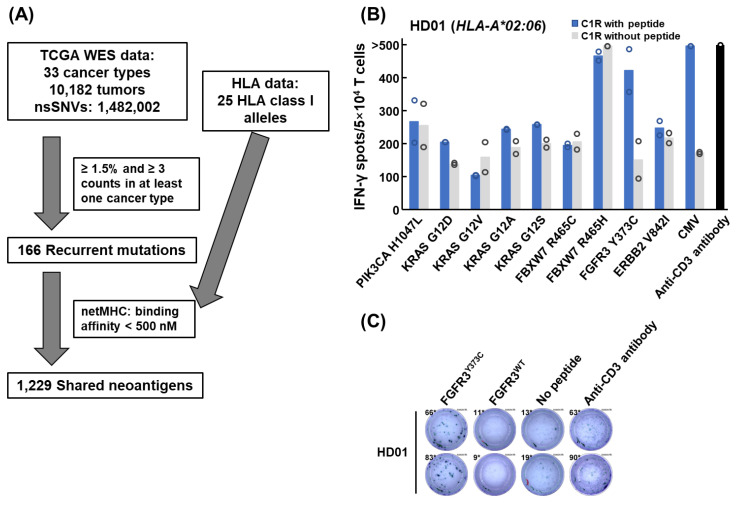
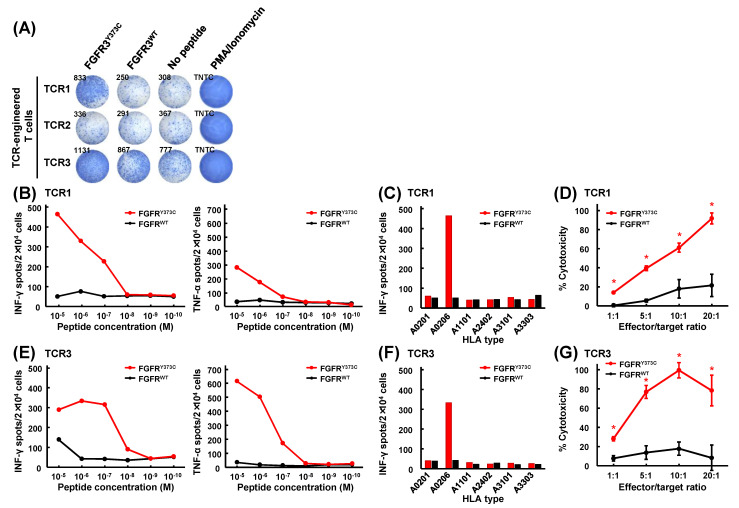
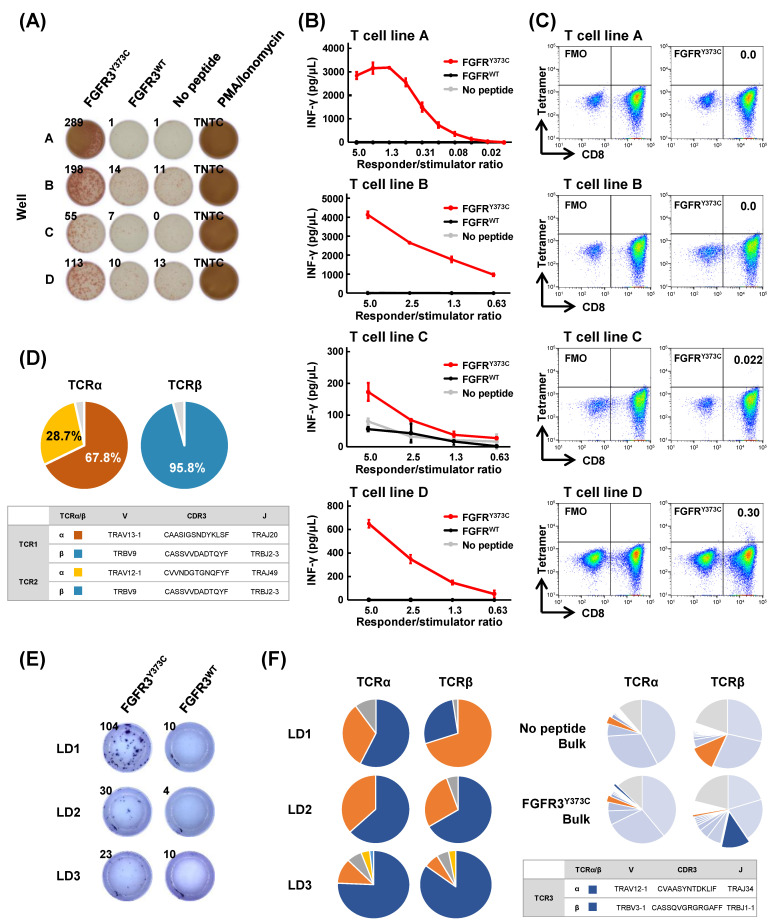
Immunotherapies, including immune checkpoint blockades, play a critically important role in cancer treatments. For immunotherapies, neoantigens, which are generated by somatic mutations in cancer cells, are thought to be good targets due to their tumor specificity. Because neoantigens are unique in individual cancers, it is challenging to develop personalized immunotherapy targeting neoantigens. In this study, we screened "shared neoantigens", which are specific types of neoantigens derived from mutations observed commonly in a subset of cancer patients. Using exome sequencing data in the Cancer Genome Atlas (TCGA), we predicted shared neoantigen peptides and performed in vitro screening of shared neoantigen-reactive CD8 T cells using peripheral blood from healthy donors. We examined the functional activity of neoantigen-specific T cell receptors (TCRs) by generating TCR-engineered T cells. Among the predicted shared neoantigens from TCGA data, we found that the mutated FGFR3 peptide induced antigen-specific CD8 T cells from the donor with via an ELISPOT assay. Subsequently, we obtained FGFR3-specific CD8 T cell clones and identified two different sets of TCRs specifically reactive to FGFR3. We found that the TCR-engineered T cells expressing FGFR3-specific TCRs recognized the mutated FGFR3 peptide but not the corresponding wild-type peptide. These two FGFR3-specific TCR-engineered T cells showed cytotoxic activity against mutated FGFR3-loaded cells. These results imply the possibility of strategies of immunotherapies targeting shared neoantigens, including cancer vaccines and TCR-engineered T cell therapies.
免疫疗法,包括免疫检查点阻断疗法,在癌症治疗中发挥着至关重要的作用。对于免疫疗法而言,由癌细胞体细胞突变产生的新抗原,因其肿瘤特异性,被认为是良好的靶点。由于新抗原在个体癌症中具有独特性,开发针对新抗原的个性化免疫疗法具有挑战性。在本研究中,我们筛选了“共享新抗原”,这是一类特定的新抗原,源自部分癌症患者中常见的突变。利用癌症基因组图谱(TCGA)中的外显子组测序数据,我们预测了共享新抗原肽,并使用健康供体的外周血对共享新抗原反应性CD8 T细胞进行了体外筛选。我们通过生成TCR工程化T细胞来检测新抗原特异性T细胞受体(TCR)的功能活性。在从TCGA数据预测的共享新抗原中,我们发现通过ELISPOT分析,突变的FGFR3肽可诱导供体产生抗原特异性CD8 T细胞。随后,我们获得了FGFR3特异性CD8 T细胞克隆,并鉴定出两组对FGFR3具有特异性反应的不同TCR。我们发现,表达FGFR3特异性TCR的TCR工程化T细胞识别突变的FGFR3肽,但不识别相应的野生型肽。这两种FGFR3特异性TCR工程化T细胞对负载突变FGFR3的细胞显示出细胞毒性活性。这些结果暗示了针对共享新抗原的免疫治疗策略的可能性,包括癌症疫苗和TCR工程化T细胞疗法。