Singh Sabita, Dutta Joytri, Ray Archita, Karmakar Atmaja, Mabalirajan Ulaganathan
Molecular Pathobiology of Respiratory Diseases, Cell Biology and Physiology Division, Council of Scientific and Industrial Research (CSIR)-Indian Institute of Chemical Biology (IICB), Kolkata 700091, West Bengal, India.
Academy of Scientific and Innovative Research (AcSIR), Sector-19, Kamla Nehru Nagar, Ghaziabad 201002, Uttar Pradesh, India.
Diagnostics (Basel). 2023 Feb 20;13(4):808. doi: 10.3390/diagnostics13040808.
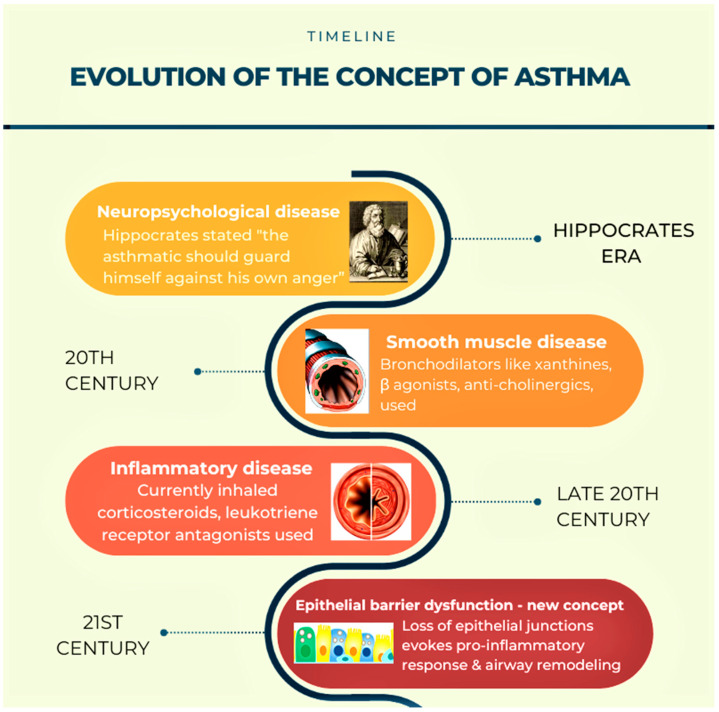
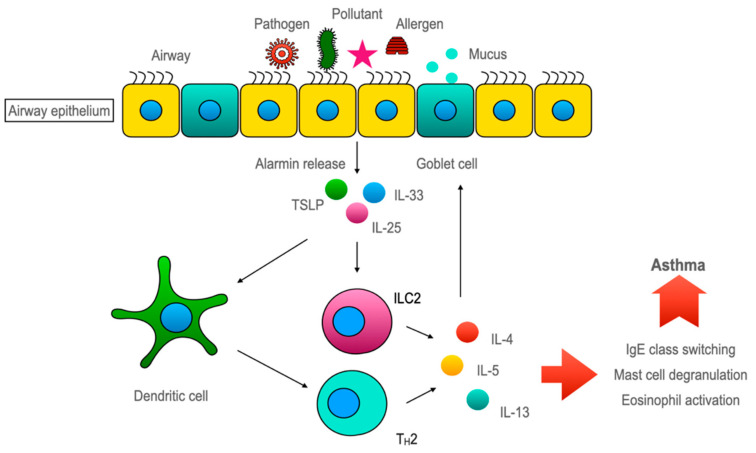
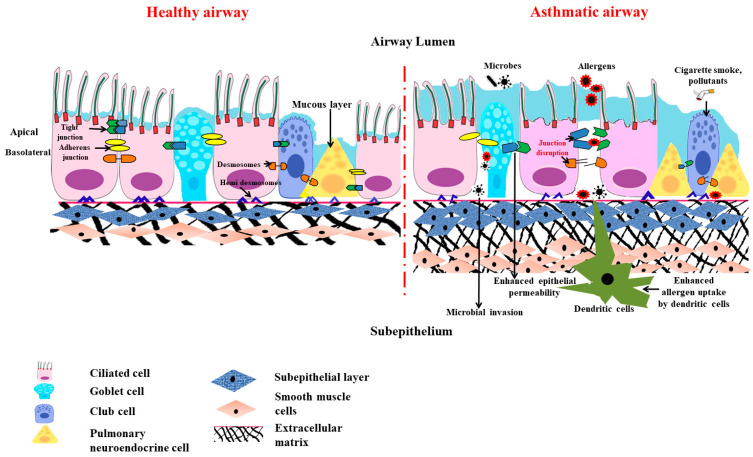
The features of allergic asthma are believed to be mediated mostly through the Th2 immune response. In this Th2-dominant concept, the airway epithelium is presented as the helpless victim of Th2 cytokines. However, this Th2-dominant concept is inadequate to fill some of the vital knowledge gaps in asthma pathogenesis, like the poor correlation between airway inflammation and airway remodeling and severe asthma endotypes, including Th2-low asthma, therapy resistance, etc. Since the discovery of type 2 innate lymphoid cells in 2010, asthma researchers started believing in that the airway epithelium played a crucial role, as alarmins, which are the inducers of ILC2, are almost exclusively secreted by the airway epithelium. This underscores the eminence of airway epithelium in asthma pathogenesis. However, the airway epithelium has a bipartite functionality in sustaining healthy lung homeostasis and asthmatic lungs. On the one hand, the airway epithelium maintains lung homeostasis against environmental irritants/pollutants with the aid of its various armamentaria, including its chemosensory apparatus and detoxification system. Alternatively, it induces an ILC2-mediated type 2 immune response through alarmins to amplify the inflammatory response. However, the available evidence indicates that restoring epithelial health may attenuate asthmatic features. Thus, we conjecture that an epithelium-driven concept in asthma pathogenesis could fill most of the gaps in current asthma knowledge, and the incorporation of epithelial-protective agents to enhance the robustness of the epithelial barrier and the combative capacity of the airway epithelium against exogenous irritants/allergens may mitigate asthma incidence and severity, resulting in better asthma control.
过敏性哮喘的特征被认为主要是通过Th2免疫反应介导的。在这个以Th2为主导的概念中,气道上皮被视为Th2细胞因子的无助受害者。然而,这个以Th2为主导的概念不足以填补哮喘发病机制中一些至关重要的知识空白,比如气道炎症与气道重塑以及严重哮喘亚型(包括低Th2哮喘、治疗抵抗等)之间的相关性较差。自2010年发现2型固有淋巴细胞以来,哮喘研究人员开始相信气道上皮发挥了关键作用,因为作为ILC2诱导剂的警报素几乎完全由气道上皮分泌。这突出了气道上皮在哮喘发病机制中的重要性。然而,气道上皮在维持健康的肺内环境稳定和哮喘肺方面具有双重功能。一方面,气道上皮借助其各种装备,包括其化学感应装置和解毒系统,来维持肺内环境稳定以抵御环境刺激物/污染物。另一方面,它通过警报素诱导ILC2介导的2型免疫反应来放大炎症反应。然而,现有证据表明恢复上皮健康可能会减轻哮喘特征。因此,我们推测哮喘发病机制中的上皮驱动概念可以填补当前哮喘知识中的大部分空白,并且加入上皮保护剂以增强上皮屏障的稳健性以及气道上皮对外源刺激物/过敏原的抵抗能力可能会降低哮喘的发病率和严重程度,从而更好地控制哮喘。