Department of Community Health, Faculty of Medicine and Health Sciences, Universiti Putra Malaysia (UPM), Serdang 43400, Selangor, Malaysia.
Institute for Health Systems Research, National Institutes of Health, Ministry of Health Malaysia, Blok B2, Kompleks NIH, No. 1, Jalan Setia Murni U13/52, Seksyen U13 Setia Alam, Shah Alam 40170, Selangor, Malaysia.
Int J Environ Res Public Health. 2023 Feb 10;20(4):3147. doi: 10.3390/ijerph20043147.
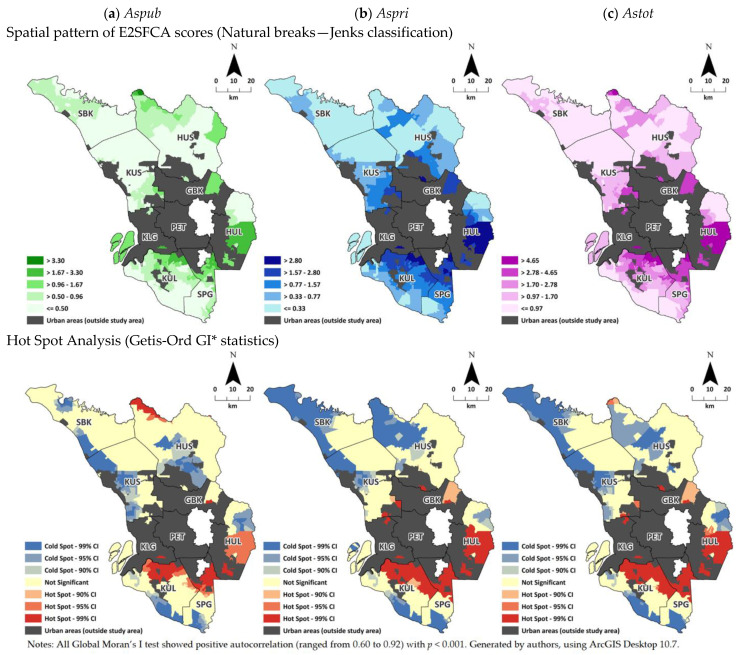
Disparities in access to health services in rural areas represent a global health issue. Various external factors contribute to these disparities and each root requires specific remedial action to alleviate the issue. This study elucidates an approach to assessing the spatial accessibility of primary care, considering Malaysia's dual public-private system specifically in rural areas, and identifies its associated ecological factors. Spatial accessibility was calculated using the Enhance 2-Step Floating Catchment Area (E2SFCA) method, modified as per local context. Data were secondary sourced from Population and Housing Census data and administrative datasets pertaining to health facilities and road network. The spatial pattern of the E2SFCA scores were depicted using Hot spot Analysis. Hierarchical multiple linear regression and geographical weight regression were performed to identify factors that affect E2SFCA scores. Hot spot areas revolved near the urban agglomeration, largely contributed by the private sector. Distance to urban areas, road density, population density dependency ratios and ethnic composition were among the associated factors. Accurate conceptualization and comprehensive assessment of accessibility are crucial for evidence-based decision making by the policymakers and health authorities in identifying areas that need attention for a more specific and localized planning and development.
农村地区卫生服务获取方面的差异是一个全球性的卫生问题。各种外部因素导致了这些差异,每个根源都需要具体的补救措施来缓解这个问题。本研究阐明了一种评估初级保健空间可达性的方法,特别考虑了马来西亚农村地区的公私双重体系,并确定了其相关的生态因素。空间可达性使用增强型两步浮动集水区(E2SFCA)方法进行计算,并根据当地情况进行了修改。数据来源于人口和住房普查数据以及与卫生设施和道路网络相关的行政数据集。使用热点分析描述了 E2SFCA 得分的空间格局。采用层次多元线性回归和地理权重回归来确定影响 E2SFCA 得分的因素。热点区域集中在城市群附近,主要由私营部门贡献。与 E2SFCA 得分相关的因素包括到城市地区的距离、道路密度、人口密度抚养比和族裔构成。准确的概念化和全面的可达性评估对于决策者和卫生当局来说至关重要,有助于基于证据做出决策,确定需要关注的地区,以便进行更具体和本地化的规划和发展。