Kröncke Nina, Neumeister Monique, Benning Rainer
Institute of Food Technology and Bioprocess Engineering, University of Applied Sciences Bremerhaven, 27568 Bremerhaven, Germany.
Insects. 2023 Jan 23;14(2):114. doi: 10.3390/insects14020114.
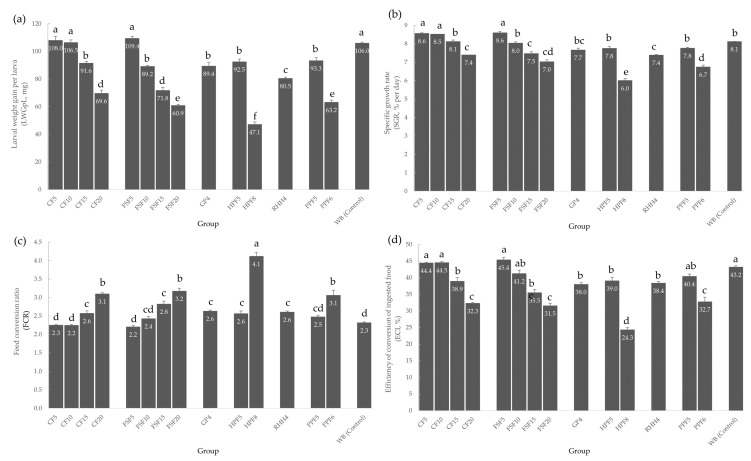
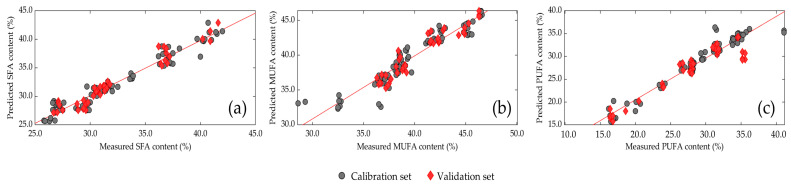
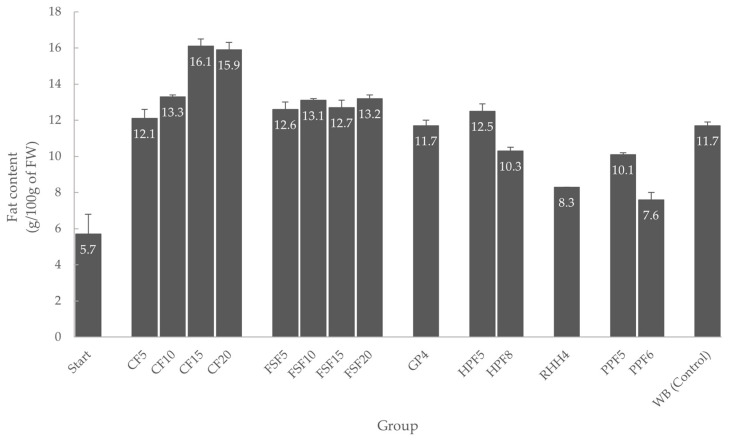
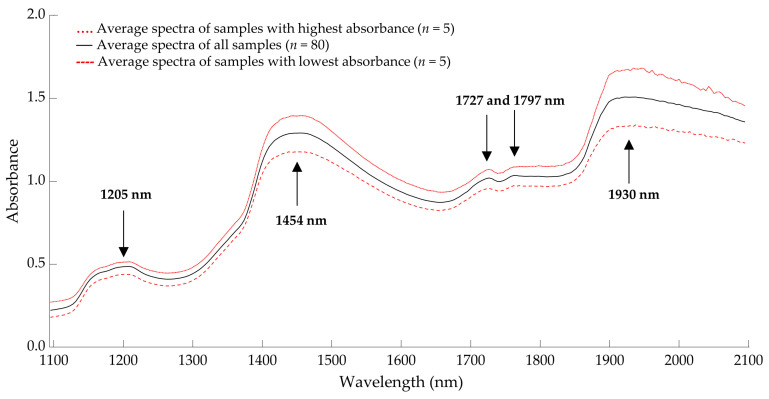
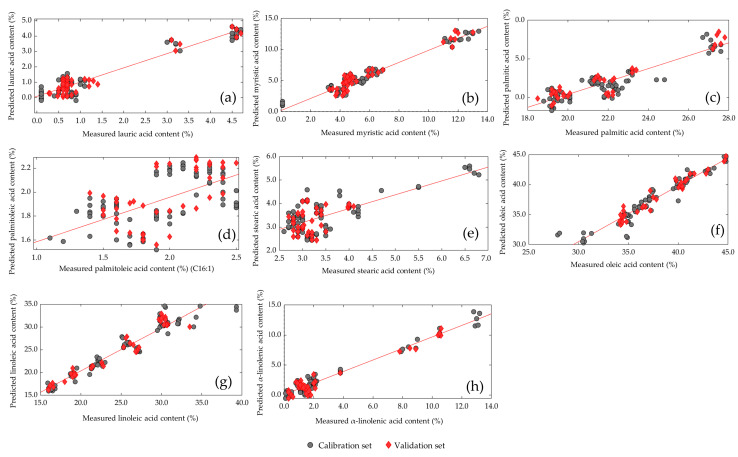
Several studies have shown that mealworms ( L.) could provide animals and humans with valuable nutrients. larvae were studied to determine whether their rearing diets affected their fat and fatty acid content and to ascertain if it is possible to detect the changes in the larval fat composition using near-infrared reflectance spectroscopy (NIRS). For this reason, a standard control diet (100% wheat bran) and an experimental diet, consisting of wheat bran and the supplementation of a different substrate (coconut flour, flaxseed flour, pea protein flour, rose hip hulls, grape pomace, or hemp protein flour) were used. The results showed lesser weight gain and slower growth rates for larvae raised on diets with a high fat content. A total of eight fatty acids were identified and quantified, where palmitic, oleic, and linoleic acids were the most prevalent and showed a correlation between larval content and their content in the rearing diets. There was a high content of lauric acid (3.2-4.6%), myristic acid (11.4-12.9%), and α-linolenic acid 8.4-13.0%) in mealworm larvae as a result of the high dietary content of these fatty acids. NIR spectra were also influenced by the fat and fatty acid composition, as larval absorbance values differed greatly. The coefficient of the determination of prediction (R) was over 0.97, with an RPD value of 8.3 for the fat content, which indicates the high predictive accuracy of the NIR model. Furthermore, it was possible to develop calibration models with great predictive efficiency (R = 0.81-0.95, RPD = 2.6-5.6) for all fatty acids, except palmitoleic and stearic acids which had a low predictive power (R < 0.5, RPD < 2.0). The detection of fat and fatty acids using NIRS can help insect producers to quickly and easily analyze the nutritional composition of mealworm larvae during the rearing process.
多项研究表明,黄粉虫(L.)可为动物和人类提供有价值的营养物质。对黄粉虫幼虫进行了研究,以确定其饲养日粮是否会影响其脂肪和脂肪酸含量,并确定是否有可能使用近红外反射光谱法(NIRS)检测幼虫脂肪组成的变化。因此,使用了一种标准对照日粮(100%麦麸)和一种实验日粮,该实验日粮由麦麸和添加不同底物(椰子粉、亚麻籽粉、豌豆蛋白粉、玫瑰果壳、葡萄皮渣或大麻蛋白粉)组成。结果表明,在高脂肪日粮中饲养的幼虫体重增加较少且生长速度较慢。共鉴定并定量了8种脂肪酸,其中棕榈酸、油酸和亚油酸最为普遍,且幼虫含量与其饲养日粮中的含量之间存在相关性。由于这些脂肪酸在日粮中的含量较高,黄粉虫幼虫中月桂酸(3.2 - 4.6%)、肉豆蔻酸(11.4 - 12.9%)和α-亚麻酸(8.4 - 13.0%)的含量也很高。近红外光谱也受脂肪和脂肪酸组成的影响,因为幼虫的吸光度值差异很大。预测决定系数(R)超过0.97,脂肪含量的RPD值为8.3,这表明近红外模型具有较高的预测准确性。此外,除了棕榈油酸和硬脂酸预测能力较低(R < 0.5,RPD < 2.0)外,对于所有脂肪酸都可以开发出预测效率很高的校准模型(R = 0.81 - 0.95,RPD = 2.6 - 5.6)。使用近红外光谱法检测脂肪和脂肪酸可以帮助昆虫生产者在饲养过程中快速、轻松地分析黄粉虫幼虫的营养成分。