D'Amore Teresa, Miedico Oto, Pompa Ciro, Preite Chiara, Iammarino Marco, Nardelli Valeria
Department of Chemistry, Istituto Zooprofilattico Sperimentale della Puglia e della Basilicata, Via Manfredonia 20, 71121 Foggia, Italy.
Life (Basel). 2023 Feb 12;13(2):511. doi: 10.3390/life13020511.
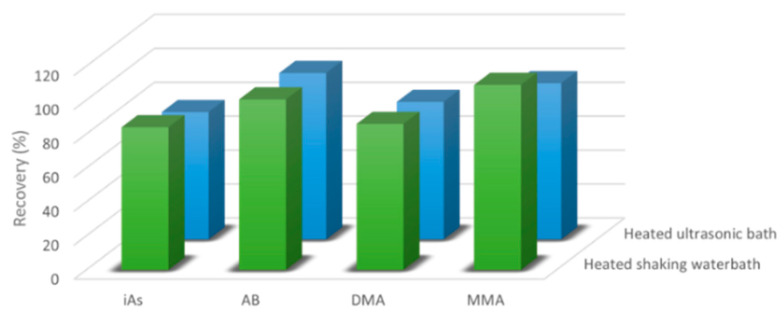
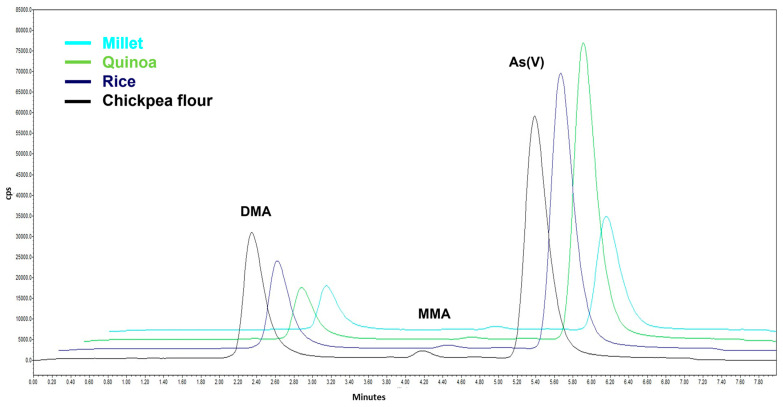
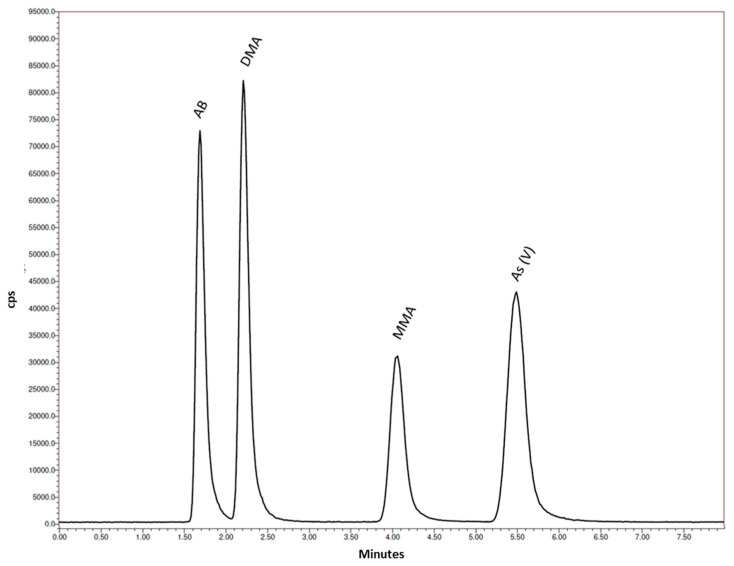
Arsenic is a well-known carcinogenic, mutagenic and toxic element and occurs in the environment both as inorganic arsenic (iAs) and organoarsenical compounds (oAsCs). Since the toxicity of arsenic compounds depends on their chemical form, the identification and determination of arsenic species are essential. Recently, the European Food Safety Authority, following the European Commission request, published a report on chronic dietary exposure to iAs and recommended the development and validation of analytical methods with adequate sensitivity and refined extraction procedures for this determination. Moreover, the authority called upon new arsenic speciation data for complex food matrices such as seaweeds, grains and grain-based products. Looking at this context, an optimized, sensitive and fast analytical method using high performance liquid chromatography followed by inductively coupled plasma-mass spectrometry (HPLC/ICP-MS) was developed for the determination of iAs (sum of arsenite-As and arsenate-As) and the most relevant oAsCs, arsenobetaine, dimethylarsinic acid and monomethylarsonic acid. The method was validated with satisfactory results in terms of linearity, sensitivity, selectivity, precision, recovery, uncertainty, ruggedness and matrix effect, and then successfully applied for the analysis of several matrices, i.e., processed and unprocessed cereal and cereal products, fruits, vegetables, legumes, seaweeds, nuts and seeds. The results obtained indicate that not only seaweed and rice matrices but also many cereals, legumes and plant-based foods for infants and young children contain significant concentrations of iAs and oAsCs. These findings contribute to the data collection necessary to assess the role of these matrices in the total arsenic exposure and if specific maximum limits have to be established.
砷是一种众所周知的致癌、致突变和有毒元素,在环境中以无机砷(iAs)和有机砷化合物(oAsCs)的形式存在。由于砷化合物的毒性取决于其化学形态,因此砷形态的鉴定和测定至关重要。最近,欧洲食品安全局应欧盟委员会的要求,发布了一份关于长期膳食中无机砷暴露的报告,并建议开发和验证具有足够灵敏度的分析方法以及用于此测定的精细提取程序。此外,该机构呼吁获取关于复杂食品基质(如海藻、谷物和谷物制品)的新的砷形态数据。在此背景下,开发了一种优化、灵敏且快速的分析方法,即采用高效液相色谱-电感耦合等离子体质谱联用(HPLC/ICP-MS)来测定无机砷(亚砷酸盐-砷和砷酸盐-砷的总和)以及最相关的有机砷化合物,如砷甜菜碱、二甲基砷酸和一甲基砷酸。该方法在线性、灵敏度、选择性、精密度、回收率、不确定度、耐用性和基质效应方面均得到了令人满意的验证结果,随后成功应用于多种基质的分析,即加工和未加工的谷物及谷物制品、水果、蔬菜、豆类、海藻、坚果和种子。所得结果表明,不仅海藻和大米基质,而且许多谷物、豆类以及婴幼儿的植物性食品中都含有大量的无机砷和有机砷化合物。这些发现有助于收集必要的数据,以评估这些基质在总砷暴露中的作用以及是否需要制定特定的最大限量。