Department of Oncology, Faculty of Medicine, Victor Babeş University of Medicine and Pharmacy Timisoara, Eftimie Murgu Square 2, 300041 Timisoara, Romania.
Departments of Radiology, Victor Babeş University of Medicine and Pharmacy Timisoara, 300041 Timisoara, Romania.
Medicina (Kaunas). 2023 Feb 2;59(2):289. doi: 10.3390/medicina59020289.
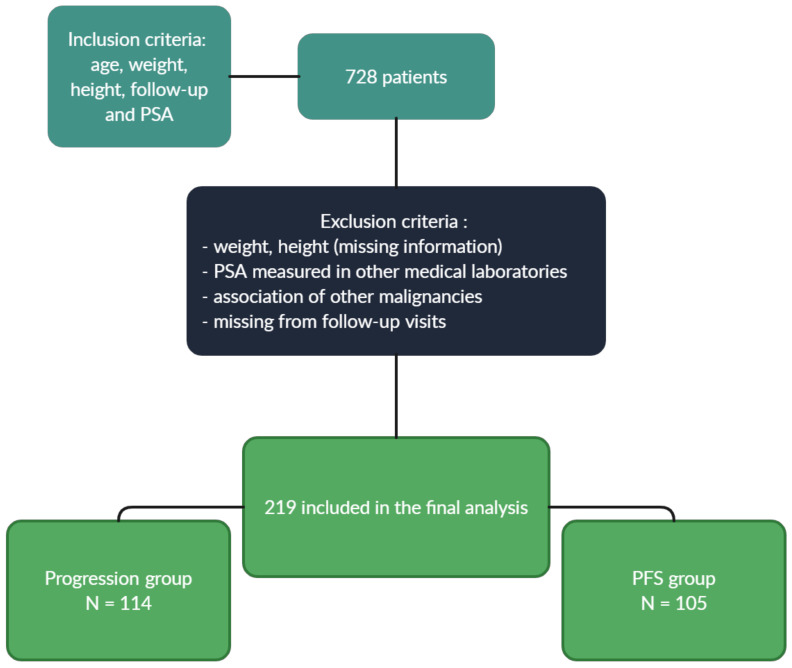
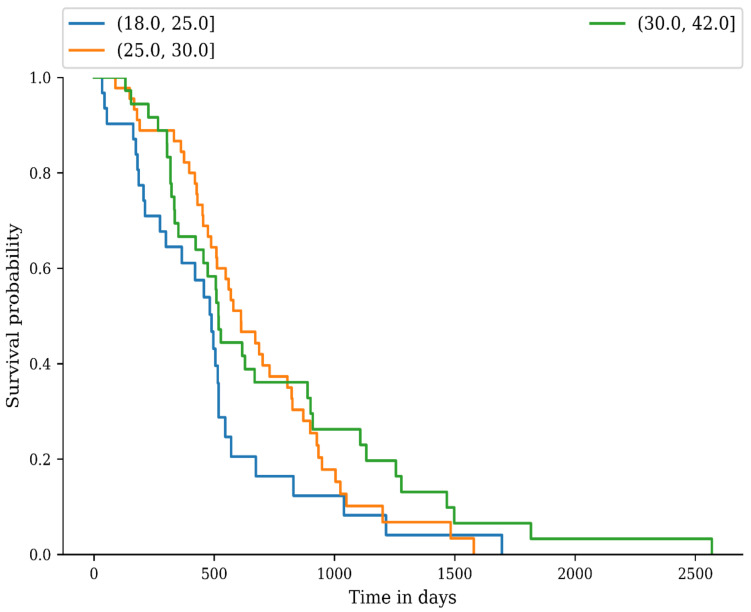
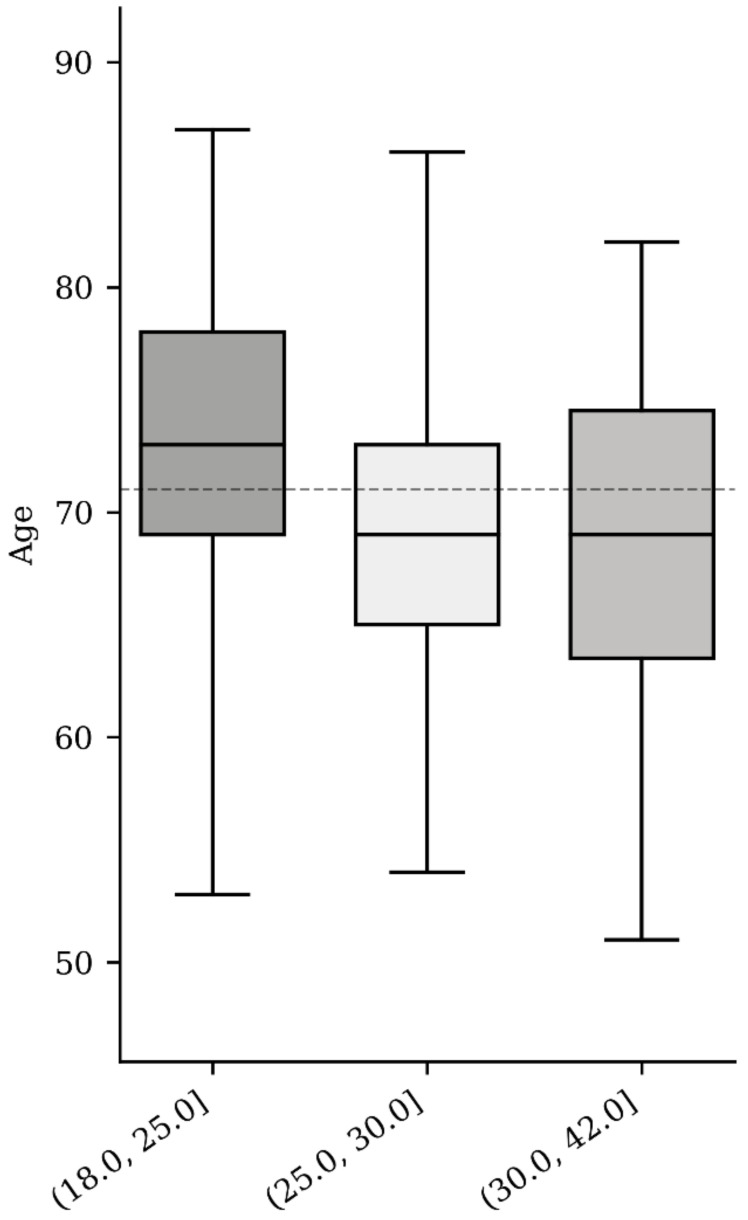
This study aimed to evaluate the impact of body mass index on PCa outcomes in our institution and also to find if there are statistically significant differences between the variables. A retrospective chart review was performed to extract information about all male patients with prostate cancer between 1 February 2015, and 25 October 2022, and with information about age, weight, height, follow-up, and PSA. We identified a group of 728 patients, of which a total of 219 patients resulted after the inclusion and exclusion criteria were applied. The primary endpoint was progression-free survival, which was defined as the length of time that the patient lives with the disease, but no relapses occur, and this group included 105 patients. In this case, 114 patients had a biological, local or metastatic relapse and were included in the progression group. Our study suggests that prostate cancer incidence rises with age (72 ± 7.81 years) in men with a normal BMI, but the diagnostic age tends to drop in those with higher BMIs, i.e., overweight, and obese in the age range of 69.47 ± 6.31 years, respectively, 69.1 ± 7.51 years. A statistically significant difference was observed in the progression group of de novo metastases versus the absent metastases group at diagnostic ( = 0.04). The progression group with metastases present (n = 70) at diagnostic had a shorter time to progression, compared to the absent metastases group (n = 44), 18.04 ± 11.37 months, respectively, 23.95 ± 16.39 months. Also, PSA levels tend to diminish with increasing BMI classification, but no statistically significant difference was observed. The median diagnostic age decreases with increasing BMI category. Overweight and obese patients are more likely to have an advanced or metastatic prostate cancer at diagnosis. The progression group with metastatic disease at diagnostic had a shorter time to progression, compared to the absent metastases group. Regarding prostate serum antigen, the levels tend to become lower in the higher BMI groups, possibly leading to a late diagnosis.
本研究旨在评估我们机构中体重指数对前列腺癌结果的影响,并确定这些变量之间是否存在统计学上的显著差异。我们进行了回顾性图表审查,以提取 2015 年 2 月 1 日至 2022 年 10 月 25 日期间所有患有前列腺癌的男性患者的信息,包括年龄、体重、身高、随访和 PSA。我们确定了一组 728 名患者,其中应用纳入和排除标准后,共有 219 名患者符合条件。主要终点是无进展生存期,即患者患有疾病但未复发的时间长度,该组包括 105 名患者。在这种情况下,114 名患者出现了生物学、局部或转移性复发,被归入进展组。我们的研究表明,在 BMI 正常的男性中,前列腺癌的发病率随着年龄的增长而上升(72±7.81 岁),但在 BMI 较高的超重和肥胖男性中,诊断年龄趋于下降,分别为 69.47±6.31 岁和 69.1±7.51 岁。在诊断时,新发转移组与无转移组之间的进展组存在统计学显著差异(=0.04)。与无转移组(n=44)相比,诊断时存在转移的进展组(n=70)的进展时间更短,分别为 18.04±11.37 个月和 23.95±16.39 个月。此外,随着 BMI 分类的增加,PSA 水平趋于下降,但没有观察到统计学显著差异。诊断年龄的中位数随着 BMI 分类的增加而降低。超重和肥胖患者在诊断时更有可能患有晚期或转移性前列腺癌。与无转移组相比,诊断时存在转移的进展组的进展时间更短。关于前列腺血清抗原,在 BMI 较高的组中,水平可能会降低,从而导致诊断延迟。