Pavlidou Eleni, Papadopoulou Sousana K, Seroglou Kyriakos, Giaginis Constantinos
Department of Food Science and Nutrition, School of Environment, University of the Aegean, 81400 Myrina, Lemnos, Greece.
Department of Nutritional Sciences and Dietetics, International Hellenic University, 57400 Thessaloniki, Greece.
Metabolites. 2023 Jan 28;13(2):189. doi: 10.3390/metabo13020189.
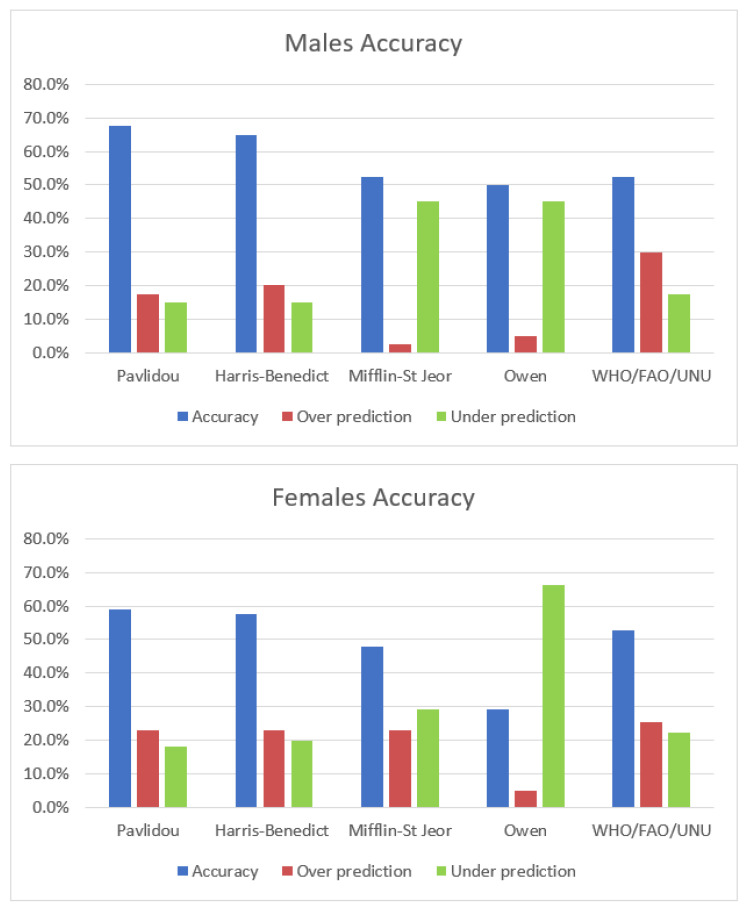
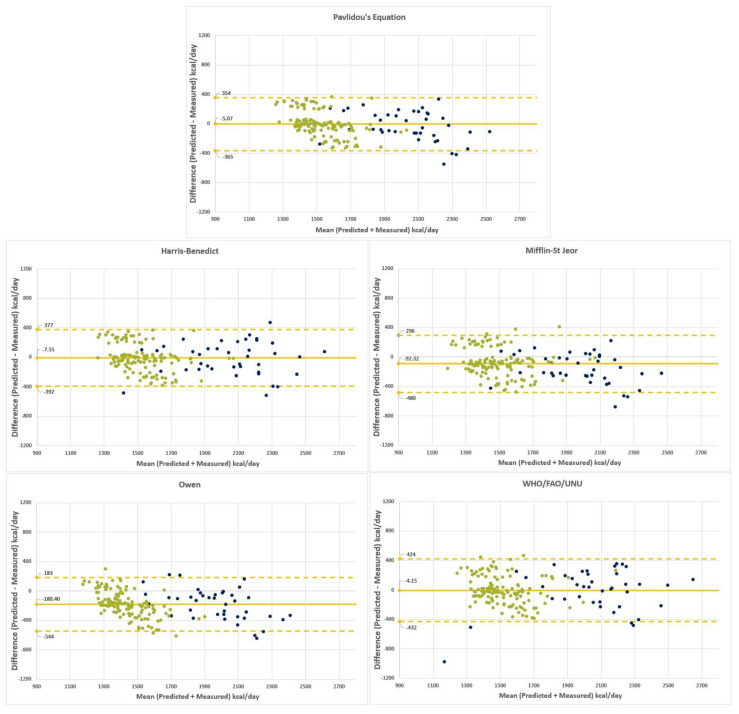
This paper contains a revision of the Harris-Benedict equations through the development and validation of new equations for the estimation of resting metabolic rate (RMR) in normal, overweight, and obese adult subjects, taking into account the same anthropometric parameters. A total of 722 adult Caucasian subjects were enrolled in this analysis. After taking a detailed medical history, the study enrolled non-hospitalized subjects with medically and nutritionally controlled diseases such as diabetes mellitus, cardiovascular disease, and thyroid disease, excluding subjects with active infections and pregnant or lactating women. Measurement of somatometric characteristics and indirect calorimetry were performed. The values obtained from RMR measurement were compared with the values of the new equations and the Harris-Benedict, Mifflin-St Jeor, FAO/WHO/UNU, and Owen equations. New predictive RMR equations were developed using age, body weight, height, and sex parameters. RMR males: (9.65 × weight in kg) + (573 × height in m) - (5.08 × age in years) + 260; RMR females: (7.38 × weight in kg) + (607 × height in m) - (2.31 × age in years) + 43; RMR males: (4.38 × weight in pounds) + (14.55 × height in inches) - (5.08 × age in years) + 260; RMR females: (3.35 × weight in pounds) + (15.42 × height in inches) - (2.31 × age in years) + 43. The accuracy of the new equations was tested in the test group in both groups, in accordance with the resting metabolic rate measurements. The new equations showed more accurate results than the other equations, with the equation for men (R-squared: 0.95) showing better prediction than the equation for women (R-squared: 0.86). The new equations showed good accuracy at both group and individual levels, and better reliability compared to other equations using the same anthropometric variables as predictors of RMR. The new equations were created under modern obesogenic conditions, and do not exclude individuals with regulated (dietary or pharmacological) Westernized diseases (e.g., cardiovascular disease, diabetes, and thyroid disease).
本文通过开发和验证新的方程,对哈里斯-本尼迪克特方程进行了修订,这些新方程用于估计正常、超重和肥胖成年受试者的静息代谢率(RMR),同时考虑相同的人体测量参数。本分析共纳入722名成年白种人受试者。在详细询问病史后,该研究纳入了患有糖尿病、心血管疾病和甲状腺疾病等医学和营养状况得到控制的非住院受试者,排除了有活动性感染的受试者以及孕妇或哺乳期妇女。进行了身体测量特征和间接测热法的测量。将静息代谢率测量获得的值与新方程以及哈里斯-本尼迪克特、米夫林-圣杰尔、粮农组织/世界卫生组织/联合国大学和欧文方程的值进行比较。利用年龄、体重、身高和性别参数开发了新的预测静息代谢率方程。男性静息代谢率:(9.65×体重(千克))+(573×身高(米))-(5.08×年龄(岁))+260;女性静息代谢率:(7.38×体重(千克))+(607×身高(米))-(2.31×年龄(岁))+43;男性静息代谢率:(4.38×体重(磅))+(14.55×身高(英寸))-(5.08×年龄(岁))+260;女性静息代谢率:(3.35×体重(磅))+(15.42×身高(英寸))-(2.31×年龄(岁))+43。根据静息代谢率测量结果,在两个组的测试组中对新方程的准确性进行了测试。新方程显示出比其他方程更准确的结果,男性方程(决定系数:0.95)的预测效果优于女性方程(决定系数:0.86)。新方程在组和个体水平上均显示出良好的准确性,并且与使用相同人体测量变量作为静息代谢率预测指标的其他方程相比,具有更好的可靠性。新方程是在现代致肥胖条件下创建的,不排除患有经调节(饮食或药物)的西方化疾病(如心血管疾病、糖尿病和甲状腺疾病)的个体。