Hermans Syrie M, Lear Gavin, Case Bradley S, Buckley Hannah L
School of Science, Auckland University of Technology, 34 St Paul Street, Auckland 1010, New Zealand.
School of Biological Sciences, University of Auckland, 3A Symonds Street, Auckland 1010, New Zealand.
iScience. 2023 Feb 1;26(2):106028. doi: 10.1016/j.isci.2023.106028. eCollection 2023 Feb 17.
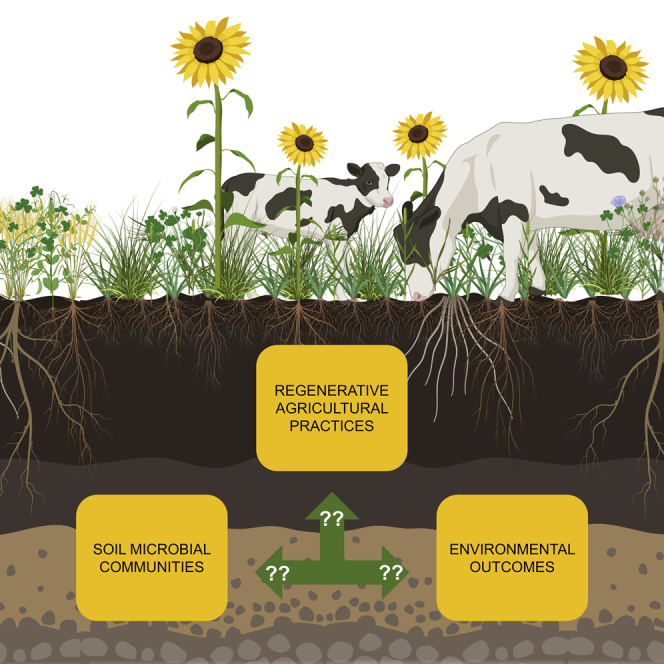
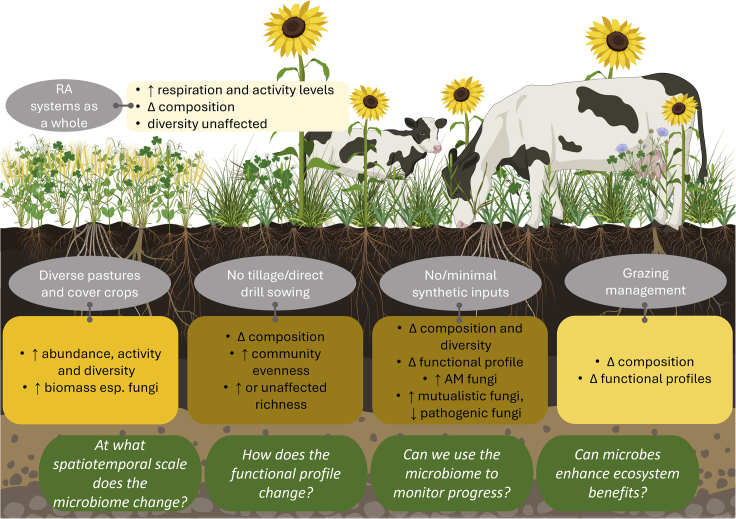
Regenerative agriculture (RA) is gaining traction globally as an approach for meeting growing food demands while avoiding, or even remediating, the detrimental environmental consequences associated with conventional farming. Momentum is building for science to provide evidence for, or against, the putative ecosystem benefits of RA practices relative to conventional farming. In this perspective article, we advance the argument that consideration of the soil microbiome in RA research is crucial for disentangling the varied and complex relationships RA practices have with the biotic and abiotic environment, outline the expected changes in soil microbiomes under RA, and make recommendations for designing research that will answer the outstanding questions on the soil microbiome under RA. Ultimately, deeper insights into the role of microbial communities in RA soils will allow the development of biologically relevant monitoring tools which will support land managers in addressing the key environmental issues associated with agriculture.
再生农业(RA)作为一种既能满足不断增长的粮食需求,又能避免甚至修复与传统农业相关的有害环境后果的方法,正在全球范围内获得关注。科学界正在加大力度,以提供证据支持或反对RA实践相对于传统农业所假定的生态系统益处。在这篇观点文章中,我们提出这样的观点:在RA研究中考虑土壤微生物组对于理清RA实践与生物和非生物环境之间多样而复杂的关系至关重要,概述了RA条件下土壤微生物组的预期变化,并就设计研究以回答有关RA条件下土壤微生物组的未决问题提出建议。最终,对微生物群落在RA土壤中的作用有更深入的了解,将有助于开发具有生物学相关性的监测工具,这将支持土地管理者解决与农业相关的关键环境问题。