Department of Oncology, The First Affiliated Hospital of Zhengzhou University, Zhengzhou, China.
Front Immunol. 2023 Feb 10;14:1133308. doi: 10.3389/fimmu.2023.1133308. eCollection 2023.
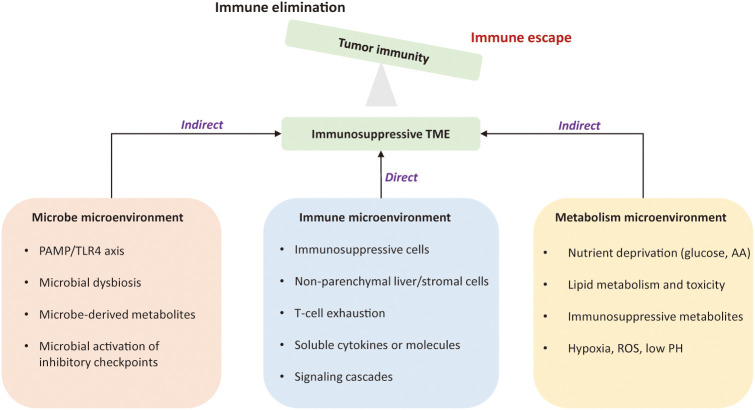
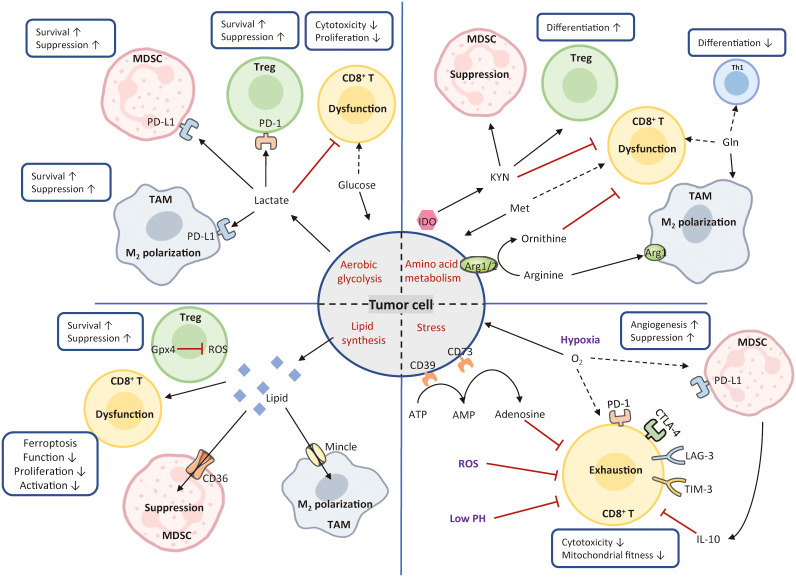
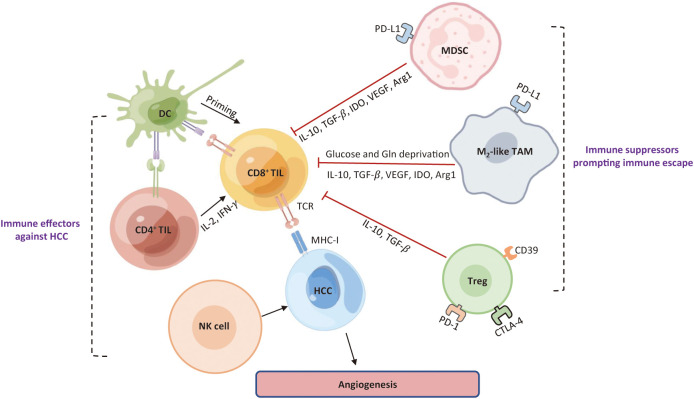
Hepatocellular carcinoma (HCC) is the most common primary liver malignancy and is the third leading cause of tumor-related mortality worldwide. In recent years, the emergency of immune checkpoint inhibitor (ICI) has revolutionized the management of HCC. Especially, the combination of atezolizumab (anti-PD1) and bevacizumab (anti-VEGF) has been approved by the FDA as the first-line treatment for advanced HCC. Despite great breakthrough in systemic therapy, HCC continues to portend a poor prognosis owing to drug resistance and frequent recurrence. The tumor microenvironment (TME) of HCC is a complex and structured mixture characterized by abnormal angiogenesis, chronic inflammation, and dysregulated extracellular matrix (ECM) remodeling, collectively contributing to the immunosuppressive milieu that in turn prompts HCC proliferation, invasion, and metastasis. The tumor microenvironment coexists and interacts with various immune cells to maintain the development of HCC. It is widely accepted that a dysfunctional tumor-immune ecosystem can lead to the failure of immune surveillance. The immunosuppressive TME is an external cause for immune evasion in HCC consisting of 1) immunosuppressive cells; 2) co-inhibitory signals; 3) soluble cytokines and signaling cascades; 4) metabolically hostile tumor microenvironment; 5) the gut microbiota that affects the immune microenvironment. Importantly, the effectiveness of immunotherapy largely depends on the tumor immune microenvironment (TIME). Also, the gut microbiota and metabolism profoundly affect the immune microenvironment. Understanding how TME affects HCC development and progression will contribute to better preventing HCC-specific immune evasion and overcoming resistance to already developed therapies. In this review, we mainly introduce immune evasion of HCC underlying the role of immune microenvironment, describe the dynamic interaction of immune microenvironment with dysfunctional metabolism and the gut microbiome, and propose therapeutic strategies to manipulate the TME in favor of more effective immunotherapy.
肝细胞癌(HCC)是最常见的原发性肝脏恶性肿瘤,也是全球肿瘤相关死亡的第三大主要原因。近年来,免疫检查点抑制剂(ICI)的出现彻底改变了 HCC 的治疗管理模式。特别是,阿替利珠单抗(抗 PD-1)联合贝伐珠单抗(抗 VEGF)已被 FDA 批准作为晚期 HCC 的一线治疗药物。尽管在系统治疗方面取得了重大突破,但由于耐药性和频繁复发,HCC 的预后仍然较差。HCC 的肿瘤微环境(TME)是一种复杂而有结构的混合物,其特征为异常血管生成、慢性炎症和细胞外基质(ECM)失调重塑,共同导致免疫抑制微环境,进而促使 HCC 增殖、侵袭和转移。肿瘤微环境与各种免疫细胞共存并相互作用,以维持 HCC 的发展。人们普遍认为,功能失调的肿瘤免疫生态系统会导致免疫监视失败。免疫抑制性 TME 是 HCC 免疫逃逸的外在原因,包括 1)免疫抑制细胞;2)共抑制信号;3)可溶性细胞因子和信号级联;4)代谢性恶劣的肿瘤微环境;5)影响免疫微环境的肠道微生物群。重要的是,免疫疗法的有效性在很大程度上取决于肿瘤免疫微环境(TIME)。此外,肠道微生物群和代谢对免疫微环境有深远影响。了解 TME 如何影响 HCC 的发展和进展将有助于更好地预防 HCC 特异性免疫逃逸,并克服已开发疗法的耐药性。在这篇综述中,我们主要介绍了 HCC 免疫逃逸的潜在机制,即免疫微环境的作用,描述了免疫微环境与功能失调的代谢和肠道微生物群的动态相互作用,并提出了操纵 TME 以有利于更有效的免疫治疗的治疗策略。