Department of Chemical Engineering and Analytical Chemistry, University of Barcelona, Barcelona, Spain.
Department of Marine Biology and Oceanography, Institute of Marine Sciences (ICM-CSIC), Barcelona, Spain.
Anal Methods. 2023 Mar 9;15(10):1355-1364. doi: 10.1039/d2ay02019j.
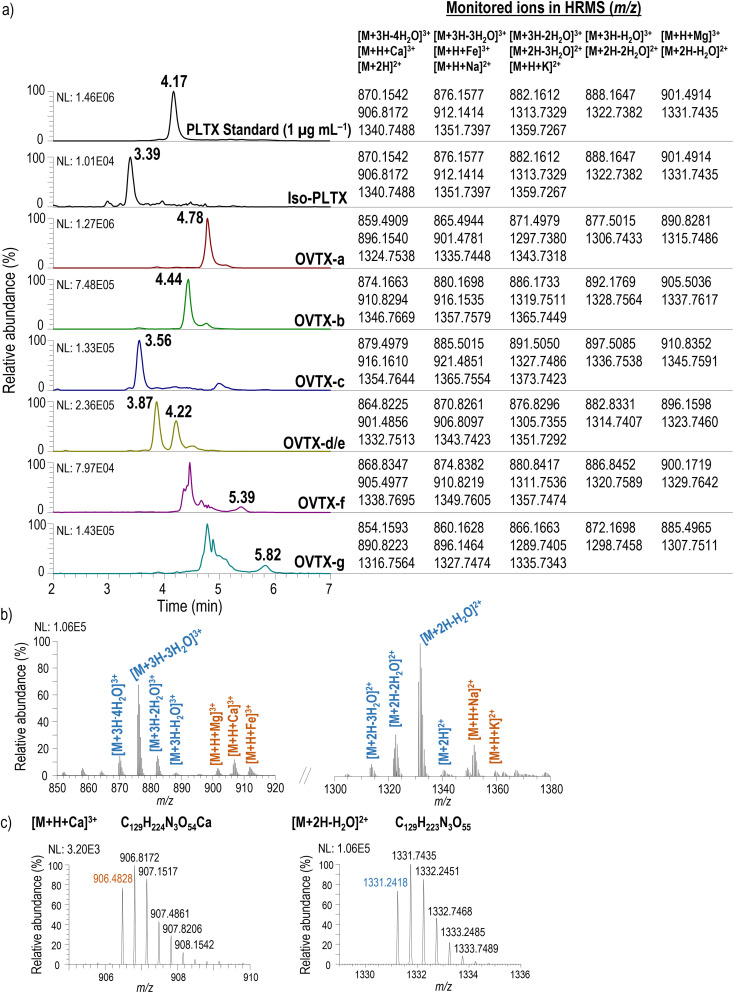
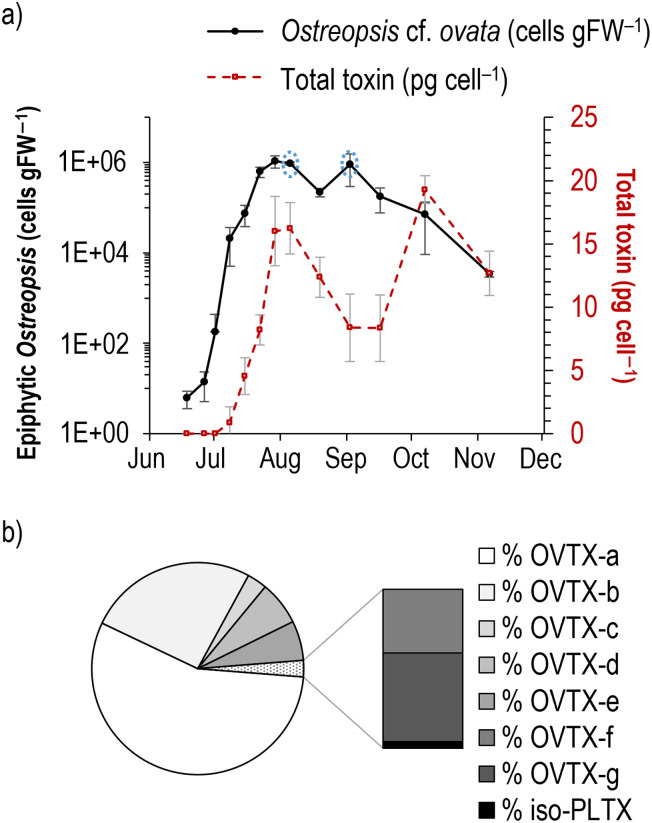
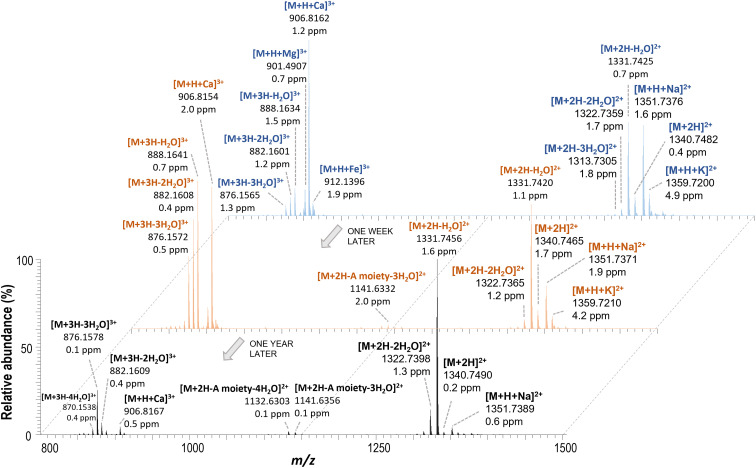
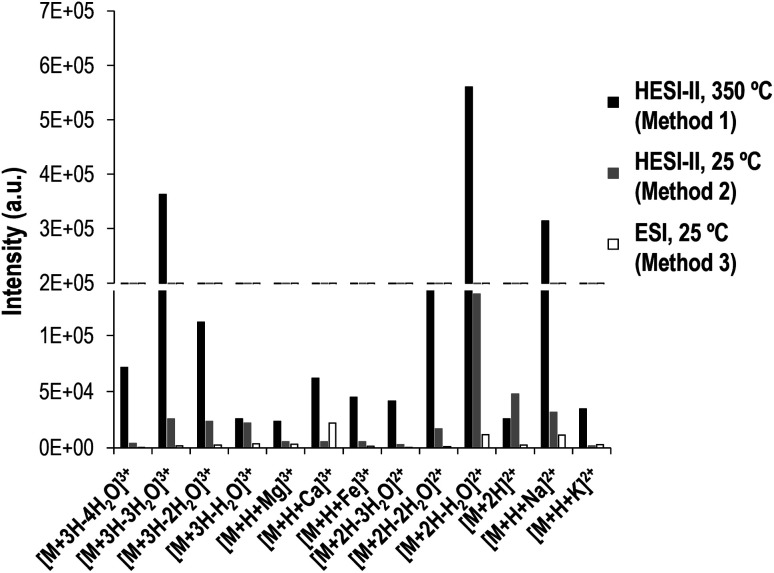
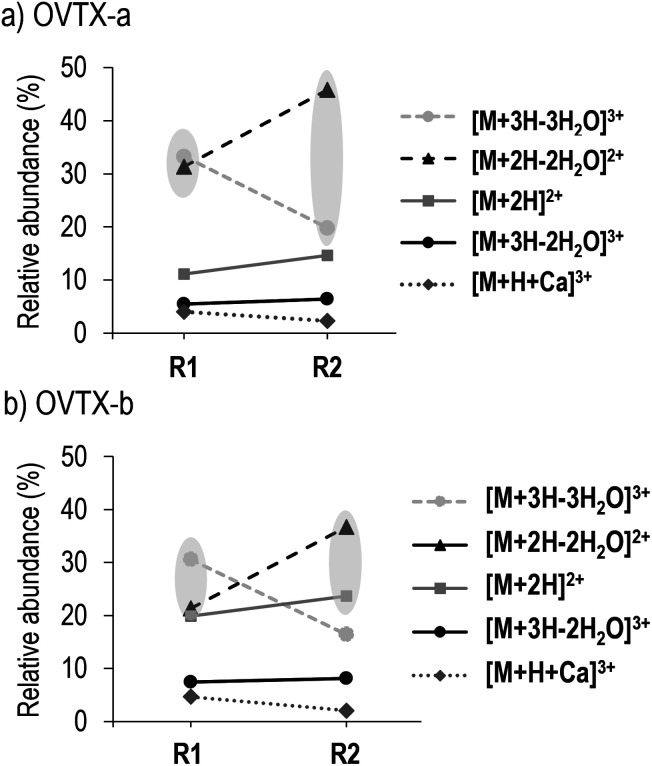
Analogues of palytoxin (PLTX), one of the most potent marine biotoxins, are produced by some species of the marine dinoflagellates of the genus . The proliferation of these species in different coastal zones represents a potential threat of seafood poisoning in humans because the produced toxins can be transferred through marine food webs. Thus, the determination of the concentration of PLTX analogues (ovatoxins-OVTXs, ostreocins-OSTs and isobaric PLTX) in different matrices (seawater, marine fauna, ) is necessary to protect human health. This study is addressed to overcome some of the challenges that the chemical complexity of these molecules poses to their quantification by ultra-high-performance liquid chromatography high-resolution mass spectrometry-based techniques (UHPLC-HRMS). In particular, the mass spectra of the palytoxin analogues show the presence of a large number of ions (including mono- and multiply charged ions) whose nature, relative abundances and behavior can lead to quantitation errors if the correct ions are not selected. In this work, the variability of the PLTX and OVTX profiles under different instrument conditions, including the use of diverse electrospray generation sources and different quantitation methods, is studied. Moreover, the extraction protocol in seawater containing sp. cells is also evaluated. The use of a heated electrospray operating at 350 °C and a quantitative method including ions from different multiply charged species provides a more robust and reliable method for overcoming the problems due to the variability in the toxin's mass spectrum profile. A single MeOH : HO (80 : 20, v/v) extraction is proposed as the best and reliable procedure. The overall method proposed was applied to quantify OVTXs (-a to -g) and iso-PLTX along the 2019 cf. bloom. The cells contained a total toxin concentration of up to 20.39 pg per cell.
芋螺毒素 (PLTX) 的类似物是海洋生物毒素中最有效的毒素之一,由某些属的海洋甲藻产生。这些物种在不同沿海地区的增殖对人类海鲜中毒构成了潜在威胁,因为产生的毒素可以通过海洋食物网转移。因此,有必要在不同基质(海水、海洋动物群、)中测定 PLTX 类似物(卵形毒素-OVTXs、牡蛎毒素-OSTs 和等压 PLTX)的浓度,以保护人类健康。本研究旨在克服这些分子的化学复杂性对其通过基于超高效液相色谱高分辨率质谱技术 (UHPLC-HRMS) 的定量方法提出的一些挑战。特别是,芋螺毒素类似物的质谱显示存在大量离子(包括单电荷和多电荷离子),如果未选择正确的离子,其性质、相对丰度和行为可能导致定量错误。在这项工作中,研究了不同仪器条件下 PLTX 和 OVTX 谱图的可变性,包括使用不同的电喷雾生成源和不同的定量方法。此外,还评估了含有 细胞的海水中的提取方案。使用在 350°C 下操作的加热电喷雾和包括来自不同多电荷物种的离子的定量方法提供了一种更稳健和可靠的方法,可以克服由于毒素质谱图轮廓的可变性而导致的问题。建议使用单一的 MeOH:HO(80:20,v/v)提取作为最佳和可靠的程序。所提出的综合方法用于定量 2019 年 cf. 藻华期间的 OVTXs (-a 至 -g) 和 iso-PLTX。细胞中总毒素浓度高达每个细胞 20.39pg。