School of Physiology, Pharmacology and Neuroscience, Faculty of Biomedical Sciences, University of Bristol, Bristol BS8 1TD, UK.
Department of Life Sciences, University of Bath, Bath BA2 7AY, UK.
Dis Model Mech. 2023 Feb 1;16(2). doi: 10.1242/dmm.049874. Epub 2023 Feb 27.
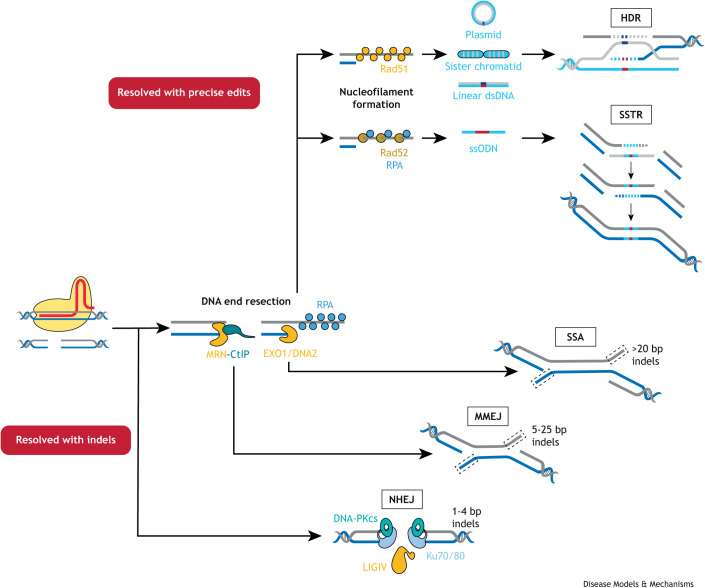
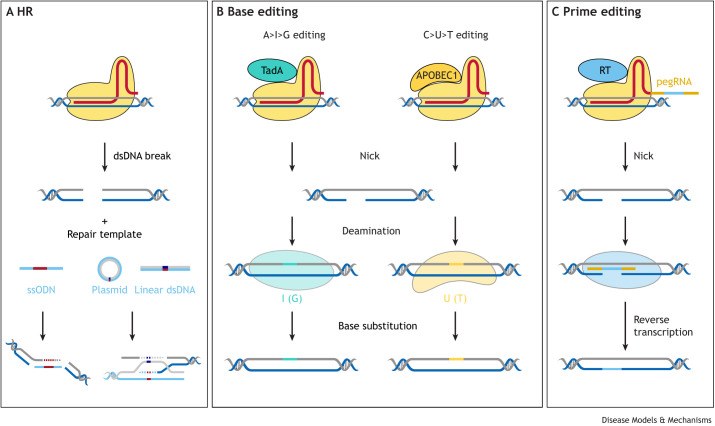
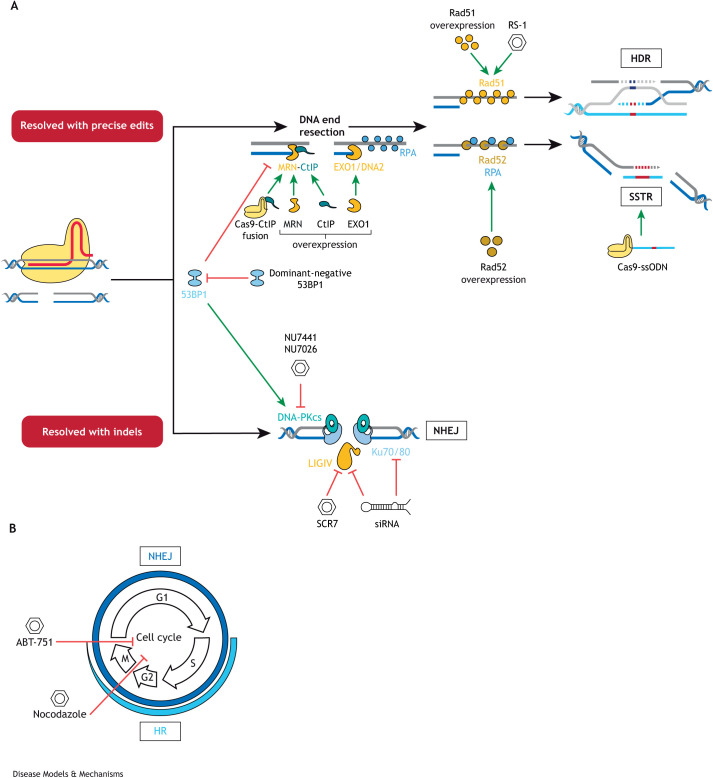
Over the past decade, CRISPR/Cas-based gene editing has become a powerful tool for generating mutations in a variety of model organisms, from Escherichia coli to zebrafish, rodents and large mammals. CRISPR/Cas-based gene editing effectively generates insertions or deletions (indels), which allow for rapid gene disruption. However, a large proportion of human genetic diseases are caused by single-base-pair substitutions, which result in more subtle alterations to protein function, and which require more complex and precise editing to recreate in model systems. Precise genome editing (PGE) methods, however, typically have efficiencies of less than a tenth of those that generate less-specific indels, and so there has been a great deal of effort to improve PGE efficiency. Such optimisations include optimal guide RNA and mutation-bearing donor DNA template design, modulation of DNA repair pathways that underpin how edits result from Cas-induced cuts, and the development of Cas9 fusion proteins that introduce edits via alternative mechanisms. In this Review, we provide an overview of the recent progress in optimising PGE methods and their potential for generating models of human genetic disease.
在过去的十年中,基于 CRISPR/Cas 的基因编辑已成为在各种模式生物(从大肠杆菌到斑马鱼、啮齿动物和大型哺乳动物)中产生突变的强大工具。基于 CRISPR/Cas 的基因编辑有效地产生插入或缺失(indels),从而可以快速基因敲除。然而,很大一部分人类遗传疾病是由单碱基对替换引起的,这会导致蛋白质功能发生更细微的改变,并且需要更复杂和精确的编辑才能在模型系统中重现。然而,精确的基因组编辑(PGE)方法的效率通常不到产生非特异性 indels 的十分之一,因此人们付出了巨大的努力来提高 PGE 的效率。这些优化包括最佳指导 RNA 和携带突变的供体 DNA 模板设计、调节构成 Cas 诱导切割导致编辑的 DNA 修复途径,以及开发通过替代机制引入编辑的 Cas9 融合蛋白。在这篇综述中,我们概述了优化 PGE 方法的最新进展及其在产生人类遗传疾病模型方面的潜力。