Department of Health Care Management, Berlin Centre of Health Economics Research (BerlinHECOR), Technische Universität Berlin, Berlin, Germany.
PLoS One. 2023 Feb 27;18(2):e0280441. doi: 10.1371/journal.pone.0280441. eCollection 2023.
Dental diseases are a major problem worldwide. Costs are a burden on healthcare systems and patients. Missed treatments can have health and financial consequences. Compared to other health services, dental treatments are only covered in parts by statutory health insurance (SHI). Using the example of dental crowns for a cost-intensive treatment, our study aims to investigate whether (1) certain treatment attributes determine patients' treatment choice, and (2) out-of-pocket payments represent a barrier to access dental care.
We conducted a discrete-choice-experiment by mailing questionnaires to 10,752 people in Germany. In presented scenarios the participants could choose between treatment options (A, B, or none) composed of treatment attribute levels (e.g., color of teeth) for posterior (PT) and anterior teeth (AT). Considering interaction effects, we used a D-efficient fractional factorial design. Choice analysis was performed using different models. Furthermore, we analyzed willingness-to-pay (WTP), preference of choosing no and SHI standard care treatment, and influence of socioeconomic characteristics on individual WTP.
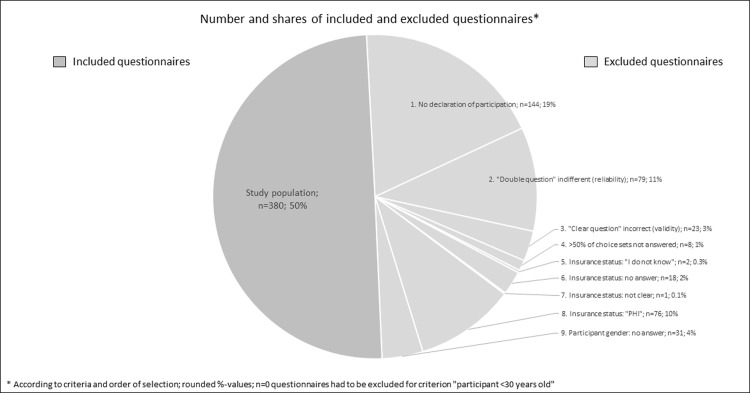
Out of n = 762 returned questionnaires (response rate of r = 7.1), n = 380 were included in the analysis. Most of the participants are in age group "50 to 59 years" (n = 103, 27.1%) and female (n = 249, 65.5%). The participants' benefit allocations varied across treatment attributes. Aesthetics and durability of dental crowns play most important roles in decision-making. WTP regarding natural color teeth is higher than standard SHI out-of-pocket payment. Estimations for AT dominate. For both tooth areas, "no treatment" was a frequent choice (PT: 25.7%, AT: 37.2%). Especially for AT, treatment beyond SHI standard care was often chosen (49.8%, PT: 31.3%). Age, gender, and incentive measures (bonus booklet) influenced WTP per participant.
This study provides important insights into patient preferences for dental crown treatment in Germany. For our participants, aesthetic for AT and PT as well as out-of-pocket payments for PT play an important role in decision-making. Overall, they are willing to pay more than the current out-of-pockt payments for what they consider to be better crown treatments. Findings may be valuable for policy makers in developing measures that better match patient preferences.
口腔疾病是全球范围内的一个主要问题。成本是医疗保健系统和患者的负担。错过治疗可能会对健康和经济产生影响。与其他卫生服务相比,牙科治疗仅由法定健康保险(SHI)部分覆盖。以成本密集型治疗的牙冠为例,我们的研究旨在调查以下两个问题:(1)某些治疗属性是否决定了患者的治疗选择;(2)自付费用是否是获得牙科护理的障碍。
我们通过向德国的 10752 人邮寄问卷进行了离散选择实验。在呈现的方案中,参与者可以选择由后牙(PT)和前牙(AT)的治疗属性水平(例如牙齿颜色)组成的治疗选项(A、B 或无)。考虑到交互效应,我们使用了高效的分数阶因子设计。使用不同的模型进行选择分析。此外,我们分析了支付意愿(WTP)、选择不治疗和 SHI 标准护理治疗的偏好,以及社会经济特征对个体 WTP 的影响。
在 n = 762 份退回的问卷中(响应率 r = 7.1%),n = 380 份被纳入分析。大多数参与者处于“50 至 59 岁”年龄组(n = 103,27.1%),女性(n = 249,65.5%)。参与者的利益分配因治疗属性而异。牙冠的美观和耐用性在决策中起着最重要的作用。对天然色牙齿的 WTP 高于 SHI 自付费用标准。AT 的估计值占主导地位。对于两个牙齿区域,“不治疗”都是常见的选择(PT:25.7%,AT:37.2%)。特别是对于 AT,经常选择超出 SHI 标准护理的治疗方法(PT:49.8%,AT:31.3%)。年龄、性别和激励措施(奖金册)影响每位参与者的 WTP。
本研究提供了有关德国患者对牙冠治疗偏好的重要见解。对于我们的参与者,前牙和后牙的美观以及后牙的自付费用在决策中起着重要作用。总的来说,他们愿意支付更多的费用,以获得他们认为更好的牙冠治疗。研究结果对于政策制定者制定更好地匹配患者偏好的措施可能具有重要价值。