Department of Economics, University of Calgary, Calgary, AB, Canada.
Program on Regulation, Therapeutics, and Law, Division of Pharmacoepidemiology and Pharmacoeconomics, Department of Medicine, Brigham and Women's Hospital and Harvard Medical School, Boston, MA, USA.
J Antibiot (Tokyo). 2023 May;76(5):270-278. doi: 10.1038/s41429-023-00601-6. Epub 2023 Feb 28.
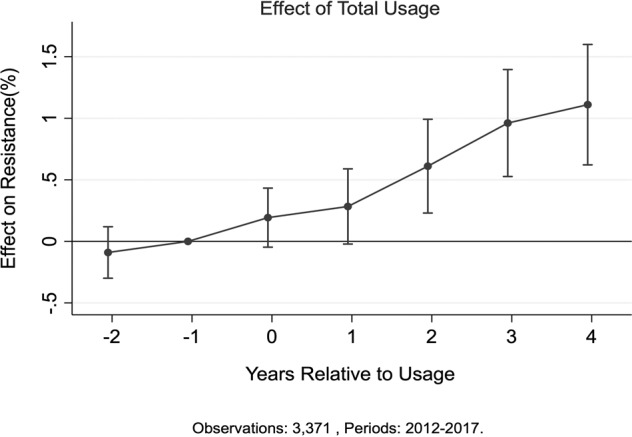
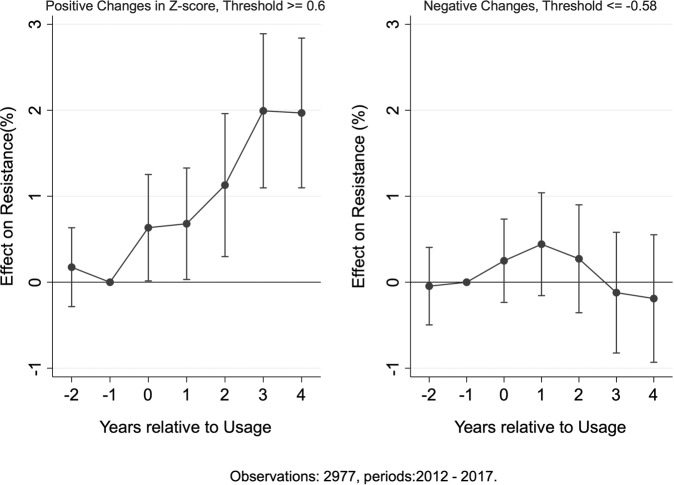
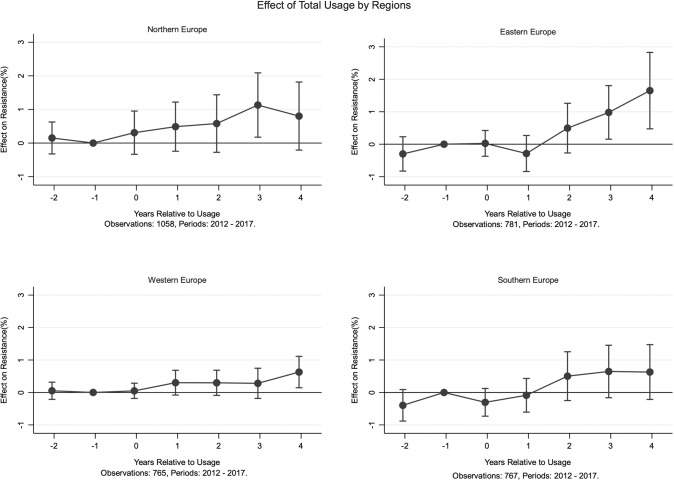
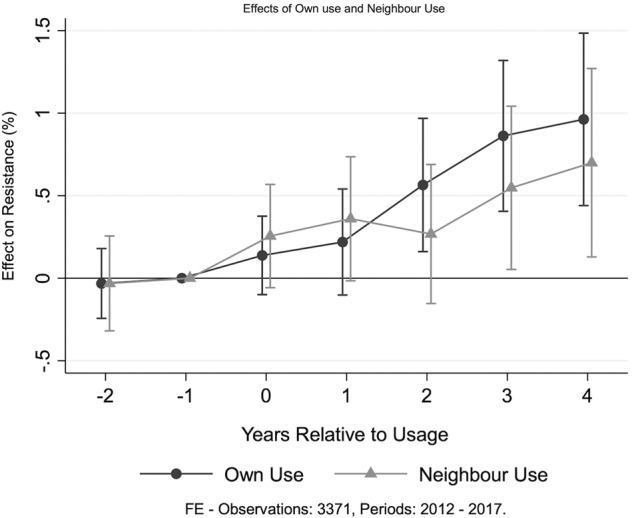
The use of antibiotics promotes the emergence of resistant bacteria in the patient and the environment. The extent of this well-documented biological relationship is, however, not well characterized at an ecological level. To make good policy around antibiotic use, it is important to understand the empirical connection between usage and resistance. We provide a consistent approach to estimate this relationship using national-level surveillance data. This paper estimates the effect of antibiotic usage on antibiotic resistance using an 11-year panel of data on both usage and resistance for 26 antibiotic-bacteria combinations in 26 European countries. Using distributed-lag models and event-study specifications, we provide estimates of the rate at which increases in antibiotic usage at the national level affect antibiotic resistance nationally and internationally. We also calculate the persistence of resistance and analyze how resistance behaves asymmetrically with respect to increases and decreases in usage. Our analysis finds the prevalence of resistant bacteria increases immediately after usage and continues to increase for at least 4 years after usage. We show that a decrease in usage has little identifiable impact on resistance over the same period. Usage in neighboring countries increases resistance in a country, independent of usage in that country. Trends in usage-related resistance vary across European regions and across bacterial classifications.
抗生素的使用会促进患者和环境中耐药菌的出现。然而,在生态层面上,这种有充分文献记录的生物学关系的程度还没有得到很好的描述。为了制定合理的抗生素使用政策,了解使用与耐药性之间的经验关系非常重要。我们提供了一种一致的方法,使用国家级监测数据来估计这种关系。本文使用 26 个欧洲国家 11 年的抗生素使用和耐药性面板数据,对 26 种抗生素-细菌组合的数据进行了分析,估计了抗生素使用对抗生素耐药性的影响。我们使用分布式滞后模型和事件研究规范,提供了国家层面抗生素使用增加对国家和国际层面抗生素耐药性的影响的估计。我们还计算了耐药性的持久性,并分析了耐药性在使用量增加和减少时的不对称行为。我们的分析发现,耐药细菌的流行在使用后立即增加,并在使用后至少 4 年内持续增加。我们表明,在同一时期,使用量的减少对耐药性几乎没有明显的影响。邻国的使用量增加会增加一个国家的耐药性,而与该国的使用量无关。与使用相关的耐药性趋势在欧洲各地区和细菌分类之间存在差异。