Yücel Shiv G, Pereira Rafael H M, Peixoto Pedro S, Camargo Chico Q
School of Geography and the Environment, University of Oxford, Oxford, UK.
Institute for Applied Economic Research (IPEA), Brasília, Brazil.
Appl Netw Sci. 2023;8(1):16. doi: 10.1007/s41109-023-00540-z. Epub 2023 Feb 24.
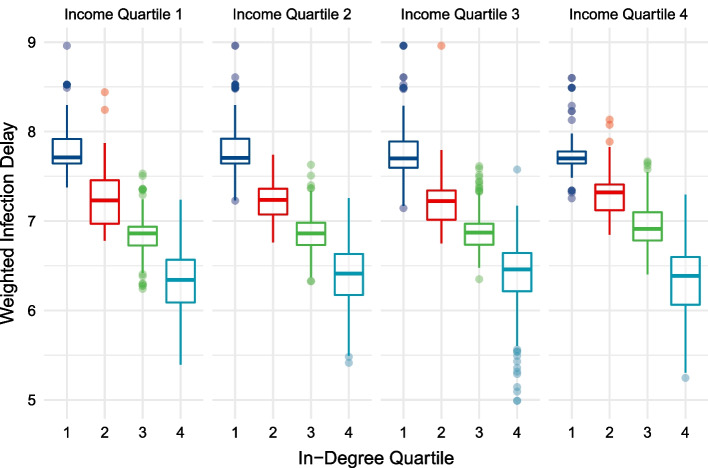
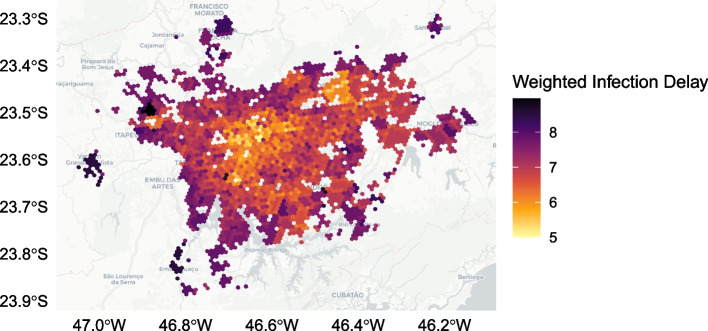
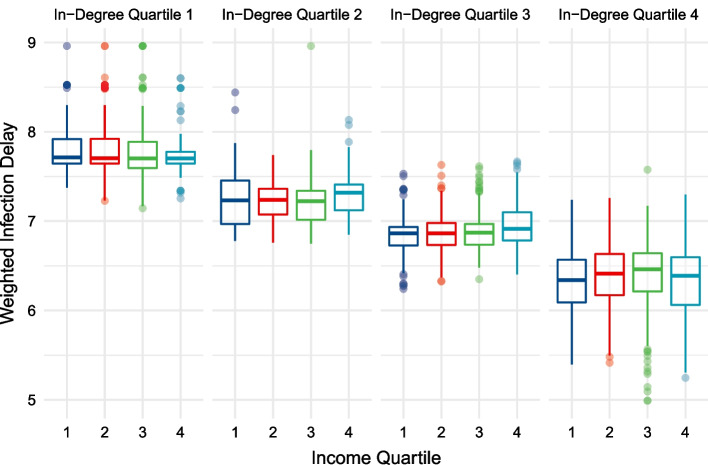
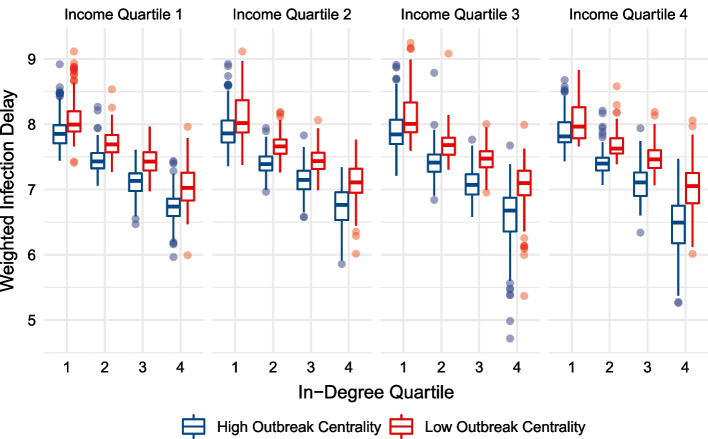
The COVID-19 pandemic has shed light on how the spread of infectious diseases worldwide are importantly shaped by both human mobility networks and socio-economic factors. However, few studies look at how both socio-economic conditions and the complex network properties of human mobility patterns interact, and how they influence outbreaks together. We introduce a novel methodology, called the Infection Delay Model, to calculate how the arrival time of an infection varies geographically, considering both effective distance-based metrics and differences in regions' capacity to isolate-a feature associated with socio-economic inequalities. To illustrate an application of the Infection Delay Model, this paper integrates household travel survey data with cell phone mobility data from the São Paulo metropolitan region to assess the effectiveness of lockdowns to slow the spread of COVID-19. Rather than operating under the assumption that the next pandemic will begin in the same region as the last, the model estimates infection delays under every possible outbreak scenario, allowing for generalizable insights into the effectiveness of interventions to delay a region's first case. The model sheds light on how the effectiveness of lockdowns to slow the spread of disease is influenced by the interaction of mobility networks and socio-economic levels. We find that a negative relationship emerges between network centrality and the infection delay after a lockdown, irrespective of income. Furthermore, for regions across all income and centrality levels, outbreaks starting in less central locations were more effectively slowed by a lockdown. Using the Infection Delay Model, this paper identifies and quantifies a new dimension of disease risk faced by those most central in a mobility network.
新冠疫情揭示了全球传染病传播如何受到人员流动网络和社会经济因素的重要影响。然而,很少有研究关注社会经济状况与人员流动模式的复杂网络特性如何相互作用,以及它们如何共同影响疫情爆发。我们引入了一种名为感染延迟模型的新方法,以计算感染到达时间在地理上的变化情况,同时考虑基于有效距离的指标以及各地区隔离能力的差异——这一特征与社会经济不平等相关。为了说明感染延迟模型的应用,本文将家庭出行调查数据与圣保罗大都市区的手机移动数据相结合,以评估封锁措施减缓新冠疫情传播的有效性。该模型并非假设下一次疫情将在上次疫情爆发的同一地区开始,而是估计每种可能的疫情爆发情况下的感染延迟,从而对延迟一个地区首例病例的干预措施的有效性得出可推广的见解。该模型揭示了封锁措施减缓疾病传播的有效性如何受到流动网络和社会经济水平相互作用的影响。我们发现,封锁后,网络中心性与感染延迟之间出现了负相关关系,与收入无关。此外,对于所有收入和中心性水平的地区,从中心性较低的地点开始的疫情爆发在封锁措施下得到了更有效的减缓。通过使用感染延迟模型,本文识别并量化了流动网络中处于最中心位置的人群所面临的疾病风险的一个新维度。