Neurology, Charité-Universitätsmedizin Berlin, Berlin, Germany
Neurology, Charité-Universitätsmedizin Berlin, Berlin, Germany.
Stroke Vasc Neurol. 2023 Oct;8(5):379-386. doi: 10.1136/svn-2022-001784. Epub 2023 Mar 1.
Retinal pathologies are an independent risk factor for ischaemic stroke, but research on the predictive value of retinal abnormalities for recurrent vascular events in patients with prior stroke is inconclusive. We investigated the association of retinal pathologies with subsequent vascular events.
In a substudy of the Intensified secondary prevention intending a reduction of recurrent events in TIA and minor stroke patients (INSPiRE-TMS) trial, we enrolled patients with recent transient ischaemic attack (TIA) or minor stroke with at least one modifiable risk factor. Primary outcome was the composite of subsequent vascular events. Retinal photographs were taken at baseline and categorised into three different fundus groups by a telemedically linked ophthalmologist.
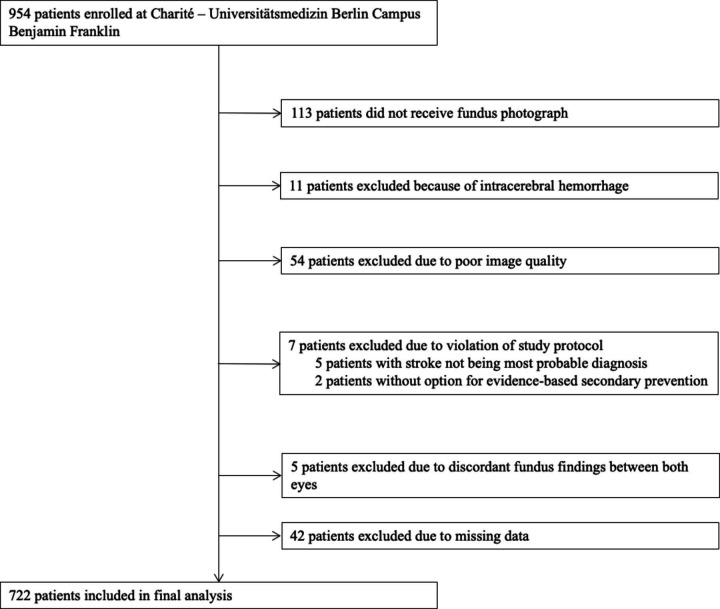
722 patients participated in the current study and 109 major vascular events occurred. After multivariable adjustments, we did not find a significant association between fundus categories and risk for subsequent vascular events (HRs for moderate vascular retinopathy and vascular retinopathy with vessel rarefaction in comparison to no vascular retinopathy 1.03 (95% CI 0.64 to 1.67), p=0.905 and 1.17 (95% CI 0.62 to 2.20), p=0.626). In a selective post hoc analysis in patients with diabetes mellitus and hypertension, patients with vascular retinopathy with vessel rarefaction had a higher risk for recurrent stroke (HR 24.14 (95% CI 2.74 to 212.50), p=0.004).
Retinal changes did not predict major subsequent vascular events in patients with recent TIA or minor stroke. Further studies are needed to examine the utility of fundus photography in assessing the risk of stroke recurrence in patients with diabetes mellitus and hypertension.
视网膜病变是缺血性卒中的独立危险因素,但既往卒中患者视网膜异常对复发性血管事件的预测价值的研究结果尚不一致。我们旨在研究视网膜病变与随后血管事件的相关性。
在强化二级预防以降低短暂性脑缺血发作(TIA)和小卒中患者复发事件的研究(INSPiRE-TMS)试验的子研究中,我们招募了近期发生 TIA 或小卒中且至少存在一个可改变的危险因素的患者。主要结局是随后血管事件的复合结局。在基线时拍摄视网膜照片,并由远程连接的眼科医生将其分为三种不同的眼底组。
722 例患者参与了本研究,发生了 109 例主要血管事件。经多变量调整后,我们未发现眼底类别与随后血管事件风险之间存在显著相关性(中度血管性视网膜病变和伴有血管稀疏的血管性视网膜病变与无血管性视网膜病变相比,风险比分别为 1.03(95%可信区间 0.64 至 1.67),p=0.905 和 1.17(95%可信区间 0.62 至 2.20),p=0.626)。在糖尿病和高血压患者的选择性事后分析中,伴有血管稀疏的血管性视网膜病变患者复发性卒中的风险更高(风险比 24.14(95%可信区间 2.74 至 212.50),p=0.004)。
在近期发生 TIA 或小卒中的患者中,视网膜变化不能预测主要的后续血管事件。需要进一步研究来检查眼底摄影在评估糖尿病和高血压患者卒中复发风险中的作用。