Wang Dandan, Wang Lina, Wang Jinjin, Du Yang, Wang Kaiyue, Wang Meizi, Yang Liu, Zhao Xingquan
Department of Neurology, Beijing Tiantan Hospital, Capital Medical University, Beijing, China.
Department of Ophthalmology, Beijing Tiantan Hospital, Capital Medical University, Beijing, China.
Front Neurosci. 2024 Feb 26;18:1288380. doi: 10.3389/fnins.2024.1288380. eCollection 2024.
Cerebral small vessel disease (CSVD) attaches people's attention in recent years. In this study, we aim to explore retinal structure and vessel density changes in CSVD patients.
We collected information on retinal metrics assessed by optical coherence tomography (OCT) and OCT angiography and CSVD characters. Logistic and liner regression was used to analyze the relationship between retinal metrics and CSVD.
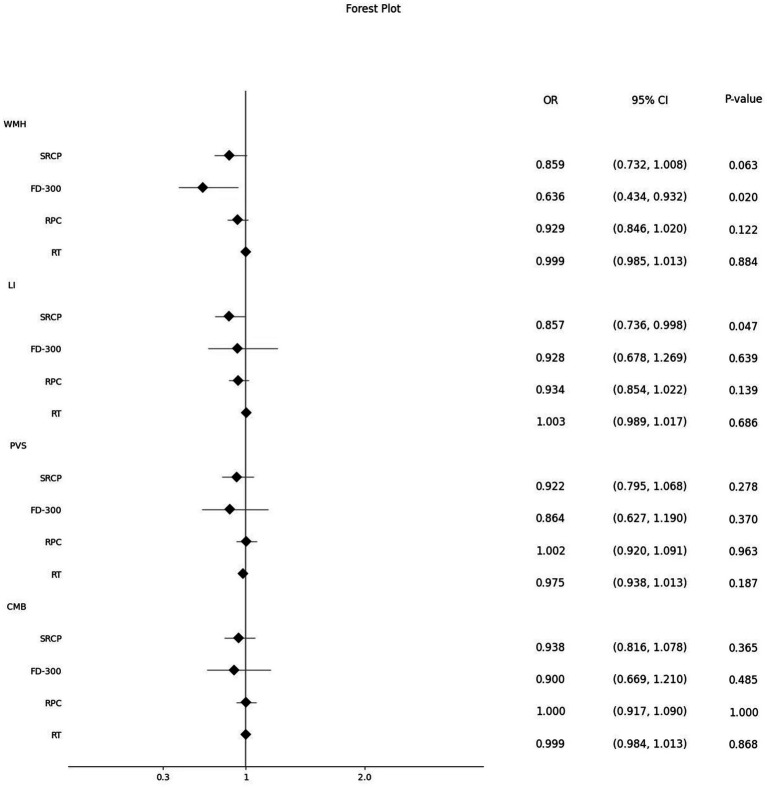
Vessel density of superficial retinal capillary plexus (SRCP), foveal density- 300 length (FD-300), radial peripapillary capillary (RPC) and thickness of retina were significantly lower in CSVD patients, the difference only existed in the thickness of retina after adjusted relevant risk factors (OR (95% CI): 0.954 (0.912, 0.997), = 0.037). SRCP vessel density showed a significant downward trend with the increase of CSVD scores (β: -0.087, 95%CI: -0.166, -0.008, = 0.031). SRCP and FD-300 were significantly lower in patients with lacunar infarctions and white matter hypertensions separately [OR (95% CI): 0.857 (0.736, 0.998), = 0.047 and OR (95% CI): 0.636 (0.434, 0.932), = 0.020, separately].
SRCP, FD-300 and thickness of retina were associated with the occurrence and severity of total CSVD scores and its different radiological manifestations. Exploring CSVD by observing alterations in retinal metrics has become an optional research direction in future.
近年来,脑小血管病(CSVD)备受关注。在本研究中,我们旨在探讨CSVD患者的视网膜结构和血管密度变化。
我们收集了通过光学相干断层扫描(OCT)和OCT血管造影评估的视网膜指标信息以及CSVD特征。采用逻辑回归和线性回归分析视网膜指标与CSVD之间的关系。
CSVD患者的浅表视网膜毛细血管丛(SRCP)血管密度、黄斑中心凹密度-300长度(FD-300)、视乳头周围放射状毛细血管(RPC)和视网膜厚度显著降低,在调整相关危险因素后,仅视网膜厚度存在差异(OR(95%CI):0.954(0.912,0.997),P = 0.037)。SRCP血管密度随CSVD评分增加呈显著下降趋势(β:-0.087,95%CI:-0.166,-0.008,P = 0.031)。腔隙性脑梗死和白质高血压患者的SRCP和FD-300分别显著降低[OR(95%CI):0.857(0.736,0.998),P = 0.047和OR(95%CI):0.636(0.434,0.932),P = 0.020]。
SRCP、FD-300和视网膜厚度与总CSVD评分及其不同影像学表现的发生和严重程度相关。通过观察视网膜指标的变化来探索CSVD已成为未来一个可选的研究方向。