Department of Neurology, University of California San Francisco, San Francisco, CA, USA.
Department of Pediatrics, University of California San Francisco, San Francisco, CA, USA.
Pediatr Res. 2023 Sep;94(3):1018-1025. doi: 10.1038/s41390-023-02510-8. Epub 2023 Mar 1.
In newborns with hypoxic-ischemic encephalopathy (HIE), the correlation between neonatal neuroimaging and the degree of neurodevelopmental impairment (NDI) is unclear.
Infants with HIE enrolled in a randomized controlled trial underwent neonatal MRI/MR spectroscopy (MRS) using a harmonized protocol at 4-6 days of age. The severity of brain injury was measured with a validated scoring system. Using proportional odds regression, we calculated adjusted odds ratios (aOR) for the associations between MRI/MRS measures of injury and primary ordinal outcome (i.e., normal, mild NDI, moderate NDI, severe NDI, or death) at age 2 years.
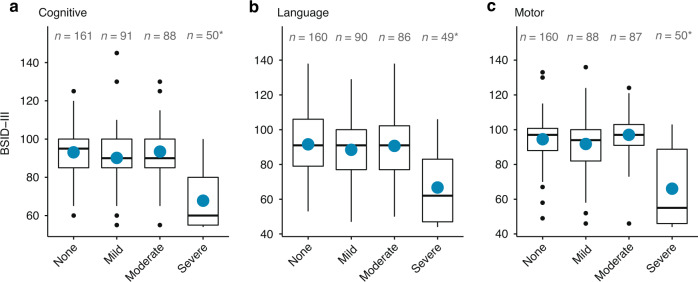
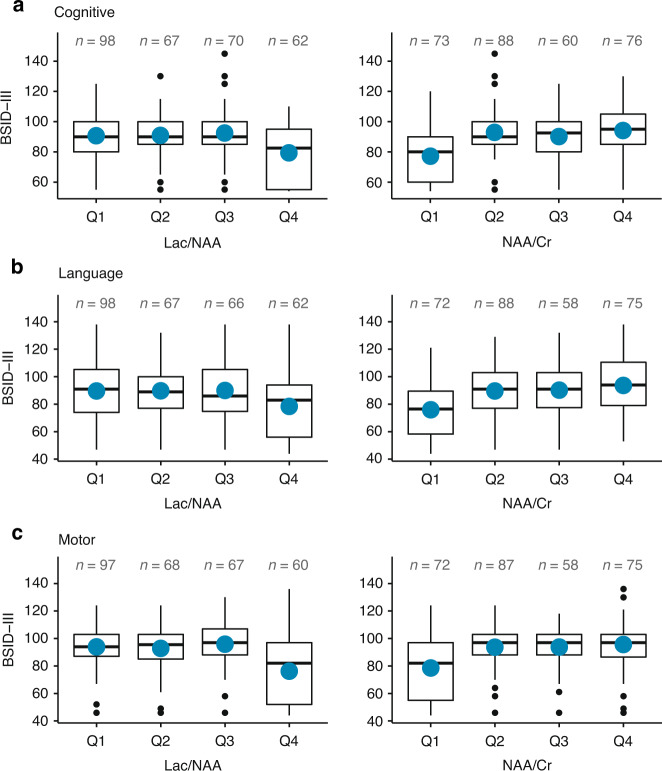
Of 451 infants with MRI/MRS at a median age of 5 days (IQR 4.5-5.8), outcomes were normal (51%); mild (12%), moderate (14%), severe NDI (13%); or death (9%). MRI injury score (aOR 1.06, 95% CI 1.05, 1.07), severe brain injury (aOR 39.6, 95% CI 16.4, 95.6), and MRS lactate/n-acetylaspartate (NAA) ratio (aOR 1.6, 95% CI 1.4,1.8) were associated with worse primary outcomes. Infants with mild/moderate MRI brain injury had similar BSID-III cognitive, language, and motor scores as infants with no injury.
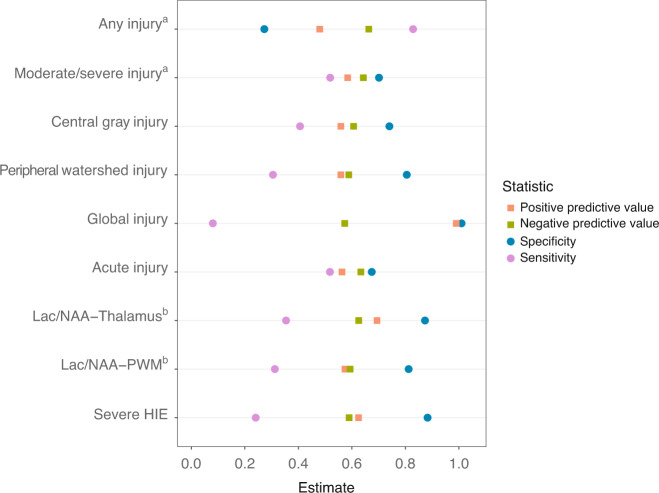
In the absence of severe injury, brain MRI/MRS does not accurately discriminate the degree of NDI. Given diagnostic uncertainty, families need to be counseled regarding a range of possible neurodevelopmental outcomes.
Half of all infants with hypoxic-ischemic encephalopathy (HIE) enrolled in a large clinical trial either died or had neurodevelopmental impairment at age 2 years despite receiving therapeutic hypothermia. Severe brain injury and a global pattern of brain injury on MRI were both strongly associated with death or neurodevelopmental impairment. Infants with mild or moderate brain injury had similar mean BSID-III cognitive, language, and motor scores as infants with no brain injury on MRI. Given the prognostic uncertainty of brain MRI among infants with less severe degrees of brain injury, families should be counseled regarding a range of possible neurodevelopmental outcomes.
在患有缺氧缺血性脑病(HIE)的新生儿中,新生儿神经影像学与神经发育损伤程度(NDI)之间的相关性尚不清楚。
纳入一项随机对照试验中的 HIE 患儿,在出生后 4-6 天内采用标准化方案进行新生儿 MRI/MR 光谱(MRS)检查。使用验证后的评分系统评估脑损伤严重程度。采用比例优势比(OR)回归计算 MRI/MRS 损伤指标与主要有序结局(即正常、轻度 NDI、中度 NDI、重度 NDI 或死亡)在 2 岁时的相关性。
在 451 例中位年龄为 5 天(IQR 4.5-5.8)的患儿中,结局为正常(51%);轻度(12%)、中度(14%)、重度 NDI(13%)或死亡(9%)。MRI 损伤评分(OR 1.06,95%CI 1.05,1.07)、严重脑损伤(OR 39.6,95%CI 16.4,95.6)和 MRS 乳酸/n-乙酰天冬氨酸(NAA)比值(OR 1.6,95%CI 1.4,1.8)与较差的主要结局相关。MRI 脑损伤程度为轻度/中度的患儿的贝利婴幼儿发展量表第三版(BSID-III)认知、语言和运动评分与无脑损伤的患儿相似。
在没有严重损伤的情况下,脑 MRI/MRS 不能准确区分 NDI 的程度。鉴于诊断存在不确定性,需要向患儿家属告知可能出现的一系列神经发育结局。
尽管接受了治疗性低温治疗,但在一项大型临床试验中,所有 HIE 患儿中有一半在 2 岁时死亡或存在神经发育损伤。严重脑损伤和 MRI 上的全脑损伤模式均与死亡或神经发育损伤密切相关。MRI 检查未见脑损伤的患儿的 BSID-III 认知、语言和运动评分的平均水平与 MRI 检查未见脑损伤的患儿相似。鉴于轻度至中度脑损伤患儿的脑 MRI 存在预后不确定性,应向患儿家属告知可能出现的一系列神经发育结局。