Division of Forensic Medicine and Toxicology, Department of Pathology, Faculty of Health Sciences, University of Cape Town, Cape Town, South Africa.
Int J Legal Med. 2023 Jul;137(4):1193-1202. doi: 10.1007/s00414-023-02968-5. Epub 2023 Mar 2.
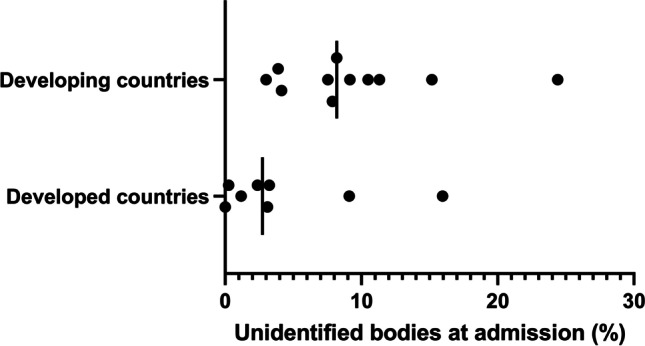
While human identification is a crucial aspect of medico-legal investigations, many individuals remain unidentified each year across the world. The burden of unidentified bodies is often referred to when motivating for improved methods of identification, and anatomical teaching, yet the actual burden is somewhat unclear. A systematic literature review was undertaken to identify articles that empirically investigate the number of unidentified bodies experienced. Despite the large number of articles returned, an alarmingly low number (24 articles) provided specific and empirical details on the number of unidentified bodies, demographics and trends thereof. It is possible that this lack of data is due to the variable definition of 'unidentified' bodies and the use of alternative terminology such as 'homelessness' or 'unclaimed' bodies. Nevertheless, the 24 articles provided data for 15 forensic facilities across ten countries of both developed and developing statuses. On average, developing countries experienced more than double (9.56%) the number of unidentified bodies when compared to developed nations (4.40%). While facilities were mandated under different legislations and infrastructures available varied greatly, the most common issue faced is the lack of standardised procedures for forensic human identification. Further to this, the need for investigative databases was highlighted. Through addressing the standardisation of identification procedures and terminology, alongside the appropriate utilisation of existing infrastructure and database creation, the number of unidentified bodies could be significantly reduced globally.
虽然人类识别是法医学调查的一个关键方面,但每年在全球仍有许多人未被识别。在推动改进识别方法和解剖教学时,经常提到未被识别的尸体的负担,但实际负担有些不清楚。进行了系统的文献回顾,以确定实证研究未被识别的尸体数量的文章。尽管返回的文章数量很多,但令人震惊的是,只有很少的文章(24 篇)提供了关于未被识别的尸体数量、人口统计学特征和趋势的具体和实证细节。这种缺乏数据的情况可能是由于“未被识别”的尸体的定义变量以及使用替代性术语,如“无家可归”或“无人认领”的尸体。然而,这 24 篇文章提供了来自十个国家的 15 个法医机构的数据,这些国家既有发达国家也有发展中国家。平均而言,与发达国家(4.40%)相比,发展中国家经历的未被识别的尸体数量多了一倍以上(9.56%)。尽管这些机构受到不同法规的约束,可用的基础设施也大不相同,但最常见的问题是缺乏标准化的法医人类识别程序。此外,还强调了建立调查数据库的必要性。通过解决识别程序和术语的标准化问题,以及适当利用现有基础设施和创建数据库,可以大大减少全球范围内未被识别的尸体数量。